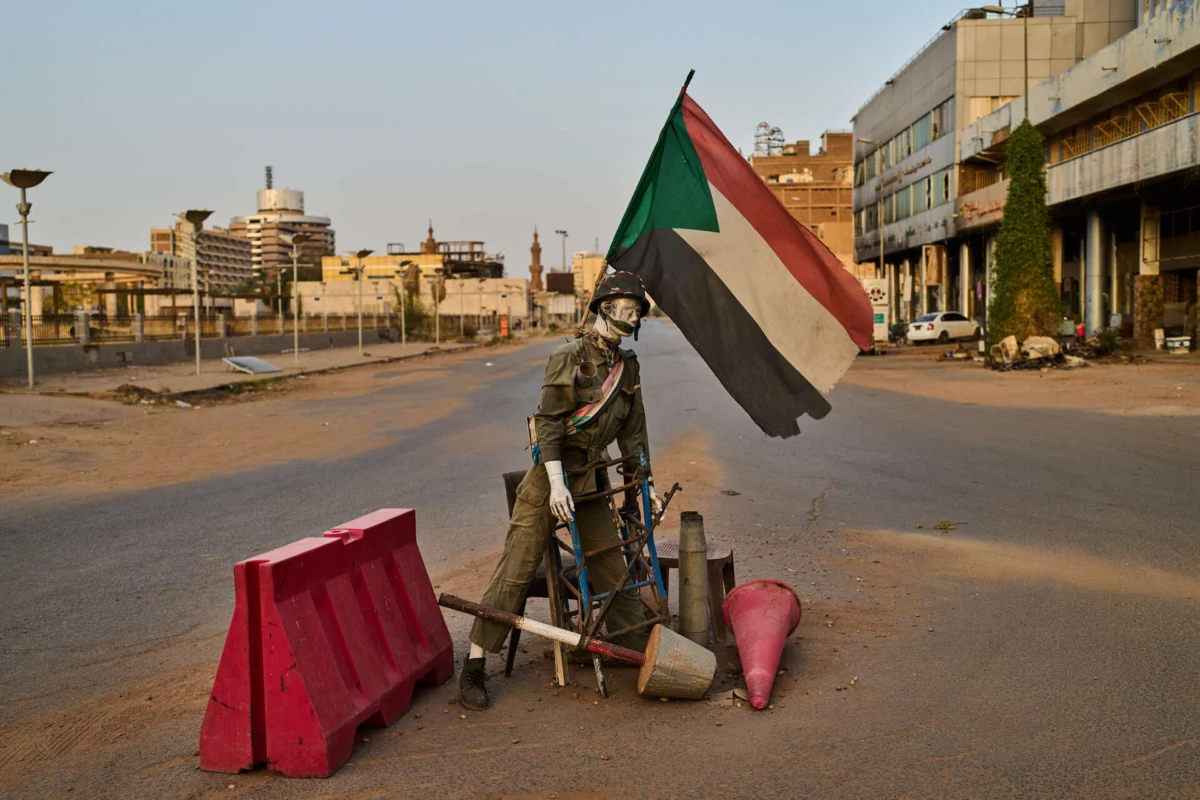
The skies over West Kordofan, once a symbol of commerce and community, turned into a theater of carnage this past Sunday evening. A devastating drone strike targeted a bustling market area, claiming the lives of at least 80 civilians in what stands as one of the most lethal single incidents since the eruption of Sudan’s brutal civil war in April 2023. As the smoke clears, the tragedy serves as a harrowing indictment of the international community’s inability to stem the tide of sophisticated weaponry flowing into the hands of warring factions.
The Anatomy of the Attack: A Market Turned Battlefield
The strike occurred in a region under the firm administrative and military control of the paramilitary Rapid Support Forces (RSF). Witnesses describe a scene of sudden, indiscriminate violence as aerial munitions impacted a densely populated marketplace—the lifeblood of the local economy. The timing, during the early evening hours, ensured maximum casualty counts, as families were gathered for commerce and communal activities.
The RSF was swift to issue a formal condemnation, pointing the finger directly at the Sudanese Armed Forces (SAF). While the military establishment has yet to issue a definitive denial, the strike underscores a terrifying shift in the war’s operational doctrine. No longer confined to traditional artillery or infantry skirmishes, the conflict has entered a "drone age," where unmanned aerial vehicles (UAVs) provide a lethal, low-cost, and high-precision method for belligerents to strike deep into rival-controlled territory.
A Chronology of Escalation: From Political Crisis to Total War
To understand the tragedy in West Kordofan, one must view it through the lens of a conflict that has spiraled far beyond its initial political origins.
- April 2023: The fragile transition toward democratic governance collapses. Tensions between General Abdel Fattah al-Burhan’s SAF and General Mohamed Hamdan "Hemedti" Dagalo’s RSF boil over into open warfare in Khartoum.
- Mid-2023: The conflict metastasizes from the capital into the western regions of Darfur and Kordofan. Ethnic undertones and historical grievances are weaponized, drawing in local militias.
- Early 2024: The introduction of commercial-grade and military-spec drones shifts the tactical landscape. Both sides begin to utilize UAVs for reconnaissance and increasingly for offensive strikes.
- October 2026: The UN Security Council struggles to find consensus on arms control, even as the death toll in civilian sectors hits record highs. The West Kordofan strike follows weeks of intensified aerial bombardment across the country.
The UN Impasse: A Failure of Global Governance
The diplomatic fallout from the West Kordofan massacre has been immediate, yet largely performative. The United Nations Security Council remains deadlocked, trapped in a cycle of procedural delays and geopolitical posturing.
Earlier this month, the Council succeeded in passing a short-term extension of the existing arms embargo on the Darfur region—a measure that expires in December. However, a robust U.S.-led proposal to expand this embargo nationwide, which would have specifically targeted the proliferation of drones and their dual-use components, was blocked.
The failure to achieve a nationwide embargo is emblematic of a fractured international consensus. Critics argue that by limiting the scope of sanctions to Darfur, the Security Council is effectively granting the warring parties a "license to kill" in other strategic zones like West Kordofan. The lack of a cohesive policy has emboldened both the SAF and the RSF to continue procuring advanced military hardware through porous borders and opaque supply chains.
Supporting Data: The Proliferation of Aerial Lethality
The lethality of this conflict is not merely a product of intent but of technological capability. Intelligence reports suggest that both sides have utilized third-party facilitators to circumvent existing, albeit weak, international restrictions.
- Market Vulnerability: Data from regional human rights monitors indicates that markets, hospitals, and displacement camps have become "preferred" targets, not due to military necessity, but as a strategy of terror designed to hollow out the population and assert territorial dominance.
- The Drone Gap: While traditional arms embargoes focus on heavy artillery and aircraft, drones represent a new paradigm. These devices are often small, easy to transport, and can be purchased on the global market as "dual-use" technology, making them difficult to track via traditional customs enforcement.
- Casualty Trends: Since the introduction of sustained drone warfare, civilian casualty rates in conflict-adjacent areas have increased by an estimated 40 percent compared to the first year of the war.
Perspectives on Enforcement: A "Lackluster" Reality
In her recent column for World Politics Review, geopolitical analyst Lesly Anne Warner cut through the diplomatic jargon to address the root of the problem: the enforcement gap. Warner argues that the obsession with passing new resolutions—which the Security Council has struggled to do—often distracts from the glaring reality that the existing framework is fundamentally broken.
"The discourse on Sudan is plagued by the illusion that a piece of paper in New York will stop a drone in Kordofan," Warner notes. "The problem is not the absence of legal frameworks, but the lackluster enforcement of the existing ones. We see a systematic failure to monitor supply chains, track illicit financial flows, and hold regional actors accountable for facilitating the movement of military equipment."
The argument for better enforcement centers on:
- Enhanced Satellite Monitoring: Using real-time surveillance to identify the transit of military-grade drones into Sudan.
- Financial Sanctions: Targeting the shell companies that pay for these shipments.
- Regional Diplomatic Pressure: Holding neighboring states accountable for allowing their territory to be used as a conduit for arms smuggling.
Official Responses and the Humanitarian Cost
The humanitarian response to the West Kordofan tragedy has been stifled by the ongoing insecurity. Aid organizations report that access to the region is restricted, not just by the fighting, but by the deliberate targeting of infrastructure that prevents medical supplies from reaching the wounded.
The Sudanese government, operating from its temporary base in Port Sudan, has remained defensive, often framing the war as a fight against "terrorist" elements, a narrative that they use to justify the procurement of drones. Conversely, the RSF continues to position itself as a victim of state-sponsored aerial aggression, despite mounting evidence of their own human rights abuses across the country.
International aid agencies, including the UN Office for the Coordination of Humanitarian Affairs (OCHA), have called for an immediate cessation of hostilities to allow for medical evacuations. However, these calls have thus far gone unheeded, as both sides prioritize tactical gains over civilian preservation.
Implications: A Future Defined by Instability
The West Kordofan massacre is not an isolated event; it is a preview of the war’s future. As long as the Security Council remains paralyzed by internal divisions and the international community treats Sudan as a secondary concern, the conflict will continue to evolve into a more sophisticated, more lethal, and more regionalized catastrophe.
The Regional Spillover
The proliferation of drone technology in Sudan poses a significant security threat to the wider Sahel and Horn of Africa. The illicit networks that move drones into Sudan do not exist in a vacuum; they rely on established smuggling routes that cross international borders. If these routes are not dismantled, the weaponization of drones will likely spread to neighboring states, further destabilizing an already fragile region.
The Moral Bankruptcy of "Short-Termism"
The decision to pass only short-term extensions of arms embargoes reflects a lack of long-term strategic vision. By focusing on month-to-month survival of diplomatic mandates rather than a comprehensive, enforceable, and nationwide arms ban, the international community is signaling that it is comfortable with a managed, rather than a resolved, conflict.
The Human Toll
Ultimately, the statistics—80 lives in a market, thousands over the course of the war—hide the reality of a generation of Sudanese being lost to senseless violence. The drone, a machine designed for precision, has become a symbol of the absolute lack of precision in the world’s approach to the Sudanese civil war.
As the UN prepares for further discussions in the coming weeks, the question remains whether the Council will move beyond the failed policies of the past or continue to watch, from a safe distance, as the death toll in Sudan continues to rise. For the people of West Kordofan, and for all of Sudan, the time for "expression of concern" has long passed; the time for decisive, enforced intervention is now.