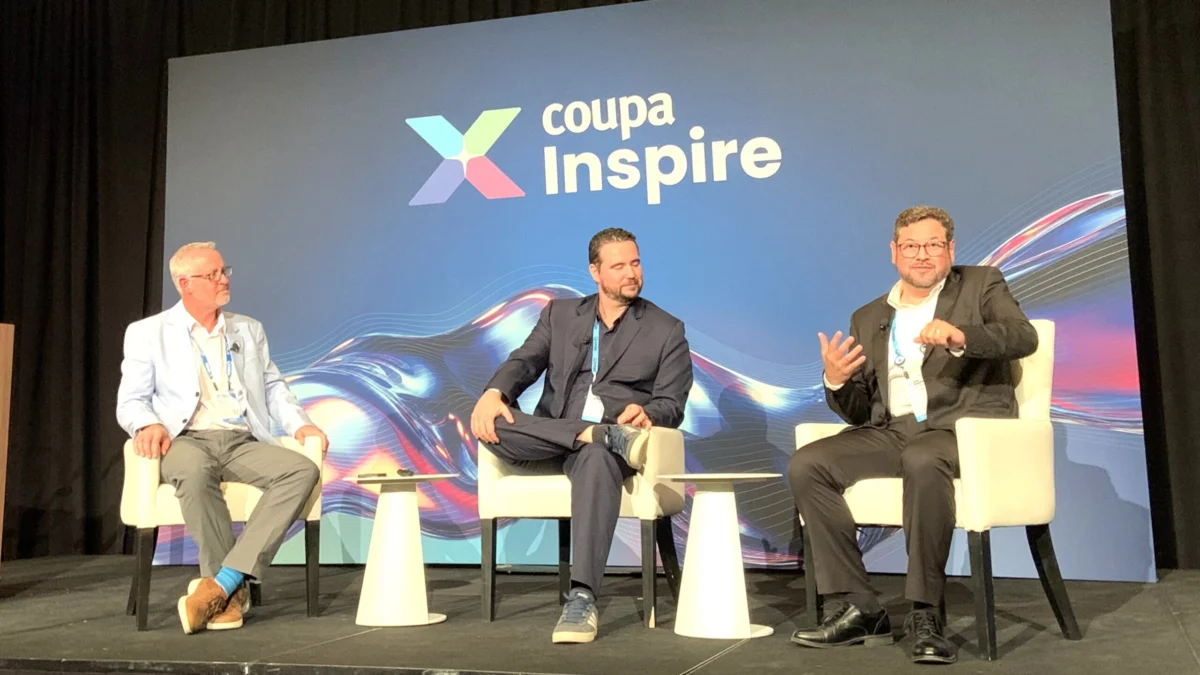
LAS VEGAS — The global landscape of procurement and supply chain management is undergoing a fundamental shift, moving away from manual, spreadsheet-driven processes toward an era defined by autonomous agents and machine-led decision-making. This transformation took center stage this week at the Coupa Inspire 2026 conference, where the cloud-based spend management platform unveiled a suite of artificial intelligence (AI) innovations designed to redefine how the world’s largest manufacturers navigate volatility.
As trade policies fluctuate, logistics networks grow more intricate, and global markets demand unprecedented agility, Coupa’s leadership argued that the competitive edge no longer rests on manual labor. Instead, it is being forged through intelligence, orchestration, and automation.
The Dawn of Agentic AI: Coupa’s Strategic Pivot
During the opening keynote at the ARIA Resort & Casino, Coupa CEO Leagh Turner set a visionary tone for the thousands of procurement and finance executives in attendance. Turner emphasized that global supply chains are entering a phase where the "human-in-the-loop" model is being augmented by AI agents capable of performing complex, multi-step tasks.
"In a world of constant change—where global trade is volatile and supply chains are increasingly complex—the advantage no longer comes from hard work," Turner told the audience. "It comes from intelligence, orchestration, and automation."
The conference served as the launchpad for two major initiatives: Coupa Compose and Coupa Catalyst. These tools are engineered to accelerate the deployment of "agentic AI"—systems that do not merely analyze data but take proactive steps to execute business workflows. Coupa Compose, specifically, provides a centralized environment for companies to build and manage a digital workforce of AI agents, effectively allowing procurement teams to automate end-to-end workflows without the need for custom coding or cumbersome IT migrations.
The Acquisition of Rossum
Parallel to these product launches, Coupa announced the acquisition of Rossum, a leader in intelligent document processing. By integrating Rossum’s proprietary T-LLM (Transaction Large Language Model) technology, Coupa aims to eliminate the reliance on legacy Optical Character Recognition (OCR) systems.
"The combined value of Coupa and Rossum has been proven in AP and invoicing," Turner noted. "With Rossum, we believe we can help our customers save the next $300 billion in five years. This is a system of decision and intelligence that is truly unrivaled."
Chronology of the Shift: From Spreadsheets to Scenario Planning
The evolution of supply chain technology, as showcased at the event, has been rapid. Historically, the procurement function relied on static tools and decentralized data. However, the sessions at Inspire 2026 illustrated a clear timeline of progress:
- The Era of Manual Aggregation (Pre-2015): Procurement teams spent weeks manually compiling data from disparate spreadsheets to conduct basic sourcing events.
- The Era of Cloud Visibility (2015–2022): Platforms like Coupa provided a "single source of truth," allowing for better spend visibility but still requiring significant human intervention to parse documents and make sourcing decisions.
- The Era of Intelligence and Orchestration (2023–2026): The current phase, characterized by the integration of AI agents, automated document processing, and real-time network optimization.
This chronology was reflected in the success stories shared by manufacturing giants throughout the three-day event.
Supporting Data: Real-World Impacts of Digital Optimization
The promise of AI is often met with skepticism, but the case studies presented at Inspire 2026 offered hard data to back the transition.
Grupo Bimbo and M. Dias Branco: Taming Complexity
For global bakery giant Grupo Bimbo, managing a network of 200 manufacturing sites and 157,000 delivery routes is an exercise in extreme logistics. Jose Ramos, the company’s director of supply chain transformation, noted that the complexity of serving 3 million points of sale globally necessitated a departure from traditional management styles.
Similarly, M. Dias Branco, a leading Brazilian food producer, has utilized digital modeling to navigate the challenges of rapid inorganic growth. Having completed seven acquisitions since 2003, the company faced a fragmented ecosystem of disparate corporate cultures and legacy systems. By implementing Coupa’s optimization tools, M. Dias Branco reported significant efficiency gains, including a 14% reduction in cost-to-serve for cookies and a 24% reduction for pasta products.

Jabil: The Power of Sourcing Optimization
Perhaps the most striking example of the transition from manual to automated work was provided by Jabil, a manufacturing services provider with over 100 facilities across 25 countries. Ryan Johnson, director of indirect procurement technology, detailed how the company’s adoption of Coupa’s Sourcing Optimization (CSO) tool reduced cycle times from weeks to hours.
"We can now do 50-plus scenarios as we see fit within our different sourcing events," Johnson explained. By moving away from manual analysis, Jabil achieved roughly $25 million in logistics savings and cost avoidance, while simultaneously cutting sourcing cycle times by an entire month.
Official Responses and Philosophical Shifts
A recurring theme throughout the keynote sessions was the human element. Executives were careful to clarify that the surge in AI deployment is not intended to displace the workforce, but to elevate it.
"This is not about replacing people," Turner said. "This means that we are going to eliminate the work that nobody should have ever done in the first place."
By offloading the repetitive, document-heavy tasks—such as invoice processing and basic data entry—to AI agents, procurement professionals are freed to focus on high-value strategic decision-making. Salvatore Lombardo, Coupa’s chief product and technology officer, echoed this sentiment, emphasizing that the platform’s strength lies in its ability to generate business outcomes grounded in proprietary datasets.
"We are empowering our customers to easily build, deploy, orchestrate, and connect agentic AI through our core platform—no migrations, no new code," Lombardo said. "It is just instant AI agent activation."
Implications: The Future of the "System of Decision"
The implications of the developments at Coupa Inspire 2026 are far-reaching. As businesses move toward a "system of decision," the gap between early adopters of AI-native platforms and those clinging to legacy software is expected to widen significantly.
1. The Death of the Static Supply Chain
The traditional annual or quarterly supply chain planning cycle is becoming obsolete. With the tools demonstrated at the conference, companies are moving toward "continuous planning," where AI agents monitor logistics data 24/7 and suggest adjustments to inventory placement, transport routes, and plant allocations in real-time.
2. The Standardization of Data
The acquisition of Rossum signals that the "last mile" of data ingestion—extracting information from unstructured documents—is being solved. When combined with the $10 trillion in cumulative spend data that Coupa has processed over the last two decades, the platform is creating a network effect. As more companies plug into this ecosystem, the AI models become more accurate, creating a virtuous cycle of intelligence.
3. Resilience as a Service
For manufacturers like Grupo Bimbo and Jabil, the ultimate goal is not just cost reduction, but resilience. In a world where geopolitical instability and climate-related disruptions are the "new normal," the ability to run multiple "what-if" scenarios in hours rather than weeks provides a profound strategic advantage.
Conclusion
As the curtain falls on Coupa Inspire 2026, the message is clear: the future of supply chain management is not just about visibility—it is about action. By blending deep transactional data with agentic AI, Coupa is positioning itself as the central nervous system for global procurement.
For the attendees in Las Vegas, the takeaway was not a distant promise of future technology, but a roadmap for immediate implementation. As the manufacturing sector navigates a complex future, the transition from "hard work" to "intelligent orchestration" is no longer an option; it is the prerequisite for survival in the global economy. With over $300 billion in savings already delivered to customers, Coupa is betting that its new AI-first architecture will define the next chapter of corporate efficiency.