The North American trucking industry is entering a transformative period of fiscal correction. J.B. Hunt Transport Services (NASDAQ: JBHT), one of the nation’s largest supply chain solutions providers, has signaled a tectonic shift in the freight landscape, projecting a 20% increase in truckload (TL) rates over the next two years. This anticipated surge is not a byproduct of an unprecedented demand boom, but rather a necessary structural realignment driven by aggressive regulatory enforcement and the urgent need for carriers to recover margins following years of stifling cost inflation.
As the industry navigates this transition, the narrative has shifted from volume-driven growth to supply-side discipline. With stricter federal oversight removing significant capacity from the market, carriers are increasingly leveraging their bargaining power to pass operational costs—including rising driver wages—directly to the shipper.
The Genesis of the Rate Upcycle: A Supply-Side Phenomenon
Historically, the cyclical nature of the truckload market has been tethered to consumer demand. However, the current "upcycle" is primarily a supply-side phenomenon. During the Bank of America Industrials Conference in New York, leadership from J.B. Hunt confirmed that while first-quarter demand exceeded expectations and has remained stable, the primary driver of pricing power is the contraction of available fleet capacity.
The Impact of Regulatory Enforcement
Stricter regulatory environments have acted as a filter, removing inefficient or non-compliant operators from the market. For the survivors, this has meant a more disciplined operational environment. Carriers are no longer willing to accept razor-thin margins to secure volume. Instead, they are prioritizing profitability, leading to a tightening of available capacity that naturally forces contract rates upward.
Market Segment Disparities
J.B. Hunt’s leadership noted that the industrial and food-related segments are performing with resilience, reflecting a stable baseline of essential commerce. Conversely, the housing sector remains a significant headwind. High interest rates and volatile construction activity continue to dampen demand in this specific vertical, creating a bifurcated market where some lanes see intense pressure while others remain sluggish. Despite these sector-specific challenges, Brad Hicks, president of dedicated contract services, summarized the broader outlook as "steady as she goes," reinforcing the company’s confidence that the upward trajectory of rates is inevitable.

Chronology of the Shift: From Single Digits to Double Digits
The transition toward higher rate expectations has been rapid. During the first-quarter earnings season, the industry consensus for bid season rate increases shifted from a modest "low-to-mid single-digit" range to a more aggressive "mid-to-high single-digit" expectation.
The Escalation Path
- Early Q1 2026: Market expectations for contract renewals hovered around 3-5%.
- Mid Q1 2026: As capacity tightened, major carriers, including J.B. Hunt, began signaling that transactional-oriented customers—those who rely on the spot market rather than locked-in contract capacity—should prepare for double-digit rate hikes.
- The Forecast: J.B. Hunt’s long-term outlook now incorporates a two-year-stacked 20% rate increase. This includes the expectation that the industry will hit a "double-digit run rate" by the second half of this year.
This acceleration is supported by an influx of "off-cycle" bid activity. Shippers, sensing that capacity is becoming increasingly scarce and expensive, are initiating contract negotiations outside of the traditional annual cycle to lock in favorable rates before the market reaches its next peak.
Supporting Data: The Tightening Market
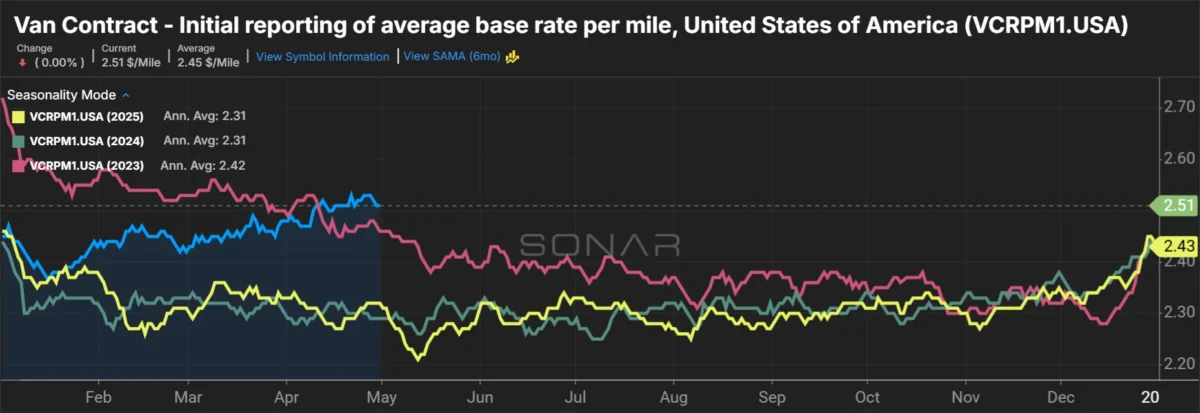
Data provided by SONAR underscores the reality behind these projections. The Outbound Tender Rejection Index (OTRI), a reliable proxy for truck capacity, shows a clear trend of tightened supply. When carriers reject a higher percentage of tenders, it is a definitive sign that they have sufficient volume and leverage to pick and choose the most profitable lanes.
Operational Cost Pressures
The necessity for rate hikes is further cemented by the rising cost of human capital. In regions such as Ohio, Indiana, Michigan, and Texas, J.B. Hunt has observed the necessity of implementing sign-on bonuses to attract and retain drivers. These incentives, while essential for maintaining service levels, add a layer of cost that must be passed through to the consumer to maintain sustainable yield.
Dedicated Contract Escalators
J.B. Hunt’s dedicated contract services typically include consumer-price index (CPI) escalators ranging from 2% to 4%. In the current inflationary climate, the company expects the run rate to hover at the higher end—between 3% and 3.5%. However, where labor market fluctuations are radical, these escalators are often supplemented by ad-hoc adjustments to ensure the contract remains economically viable for the carrier.

Internal Initiatives and Operational Efficiency
While external market conditions are driving rates, J.B. Hunt is not a passive participant. The company has embarked on a significant internal turnaround strategy aimed at protecting margins even in the face of macroeconomic headwinds.
The Intermodal Advantage
A cornerstone of this strategy is the expansion of the intermodal business. J.B. Hunt has significantly outgrown the Eastern intermodal market, with volumes up 20% on a two-year-stacked comparison. While this growth has been impressive, it has come with a mix-shift challenge; shorter hauls in the East have pressured yields.
Management remains optimistic about modal conversion. With domestic intermodal currently running at a 20% to 25% discount to traditional truckload, the company sees a clear runway to convert shippers to rail-based freight. Data from FreightWaves confirms that intermodal is approximately 25% cheaper than over-the-road transport, providing a compelling value proposition that J.B. Hunt intends to leverage in the next bid cycle.
Cost-Takeout and Automation
J.B. Hunt has aggressively pursued a $130 million annual cost-takeout initiative. By leveraging AI-led automation and rigorous "belt-tightening" across its administrative and operational functions, the company is successfully lowering its cost-to-serve. This internal efficiency is critical, as it allows the firm to remain competitive while still achieving the margin restoration necessary to satisfy shareholders.
Implications for Shippers and the Broader Industry
The implications of J.B. Hunt’s outlook are profound for shippers. The era of cheap, readily available capacity is nearing its end. Companies that rely on trucking must prepare for a fundamentally different cost structure.

Navigating the New Normal
- Shift to Long-Term Planning: With bid cycles becoming more volatile and "off-cycle" requests becoming common, shippers must move toward more collaborative, long-term relationships with their carriers rather than treating transportation as a commodity.
- Modal Diversification: As TL rates climb, the case for intermodal conversion becomes undeniable. Shippers who have historically shunned rail due to perceived service gaps may find that the 25% cost savings outweigh the minor transit-time trade-offs.
- Investment in Technology: As the industry moves toward AI-driven dispatch and automated procurement, shippers who lack the technological infrastructure to integrate with carrier systems will likely face the highest costs and the lowest service levels.
The Future of Freight
The industry’s current trajectory suggests that the "easy money" phase of post-pandemic shipping is over. The next two years will be defined by a "flight to quality," where shippers prioritize carriers with the scale and technology to navigate the regulatory and labor-related headwinds.
For the trucking industry at large, J.B. Hunt’s forecast serves as a bellwether. The message to the market is clear: margins are being reclaimed, costs are being passed through, and the capacity that remains will command a premium. For those operating within the supply chain, the coming months will require agility, foresight, and a willingness to adapt to a high-rate, supply-constrained reality.