In the rapidly digitizing landscape of global trade, artificial intelligence has emerged as the ultimate panacea for supply chain complexity. Modern sourcing teams now leverage AI to scan thousands of audit reports, reconcile complex purchase orders, and cross-reference supplier declarations in seconds. Where once humans spent days manually verifying compliance certificates, software now flags discrepancies with surgical precision.
Yet, as supply chains grow more opaque, a fundamental tension has emerged: the gap between the "digital twin" of a factory and the physical reality on the shop floor. For Shailja Agrawal, Vice President of Production and Sourcing for a major international apparel firm, this is not merely a technical challenge—it is a existential risk for global brands. As she argues, while AI is a powerful tool for monitoring, it is fundamentally incapable of replacing the boots-on-the-ground intuition required to ensure true ethical and operational compliance.
The Mirage of the Perfect Audit
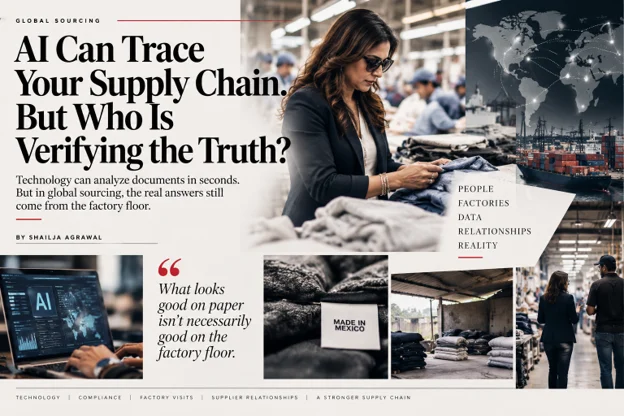
The danger of over-reliance on digital dashboards is best illustrated by a personal account from Agrawal’s tenure in the apparel industry. During an inspection of a manufacturing operation in Mexico, the facility’s paperwork was pristine. Every compliance certificate was signed, dated, and verified; every audit report painted a picture of a well-oiled, efficient machine.
However, upon arrival, the reality diverged sharply from the documentation. The primary facility was merely the "front" for a fragmented network of shadow operations. Garments were being shuttled between unauthorized locations for washing, printing, and storage. In some instances, raw goods were found languishing in makeshift, unsheltered areas, while finished products were stored in off-site rooms that failed to meet even basic safety or security standards.
The primary facility had failed to disclose these subcontractors, rendering the "perfect" audit reports entirely moot. The consequences were immediate: inventory shrinkage, recurring quality defects, and a total collapse in communication. The data in the headquarters’ dashboard remained green, while the physical supply chain was hemorrhaging value and integrity.
Chronology of a Compliance Failure
To understand how such discrepancies persist despite sophisticated monitoring, one must look at the lifecycle of a typical compliance oversight:
- Phase 1: The Documentation Stage: The supplier submits audit documentation, which is processed by AI-driven compliance software. Because the documents are internally consistent and align with established standards, the system issues a "green light."
- Phase 2: The Operational Drift: As production demands scale or capacity constraints arise, the factory quietly offloads processes to undisclosed subcontractors to meet deadlines. This shift is never recorded in the formal documentation.
- Phase 3: The Symptomatic Stage: The brand begins to see "noise" in the data—minor quality complaints or slight shipping delays. AI flags these as individual anomalies rather than systemic failures, treating them as localized issues.
- Phase 4: The Discovery Gap: Because the system only reviews data provided by the supplier, it remains blind to the "shadow factory." The discrepancy between the official report and the actual production network remains invisible until a major shipment fails or a regulatory breach occurs.
Supporting Data and the Limits of AI
While AI is an essential evolution in trade, it is crucial to recognize that it is a diagnostic tool, not an investigative one. It operates on the principle of "garbage in, garbage out."
If a supplier provides fabricated information, an AI model will treat that data as ground truth. In recent studies, companies utilizing AI for supply chain oversight noted a 30% reduction in administrative time, yet those same companies reported that "unauthorized subcontracting" remained their top persistent risk factor.
The issue is that AI excels at identifying symptoms—missing units in a shipment, a discrepancy in weight, or a mismatch in invoice totals. However, it cannot identify the root cause of those symptoms. It cannot determine if a product was made in a forced-labor environment or if a factory is using illegal, unventilated chemical processing, because these realities do not exist in the digital metadata.
Regulatory Implications and the "Traceability" Mandate
The stakes for failing to look beyond the dashboard have never been higher. Legislative frameworks such as the Uyghur Forced Labor Prevention Act (UFLPA) have shifted the burden of proof entirely onto the importer. Regulators are no longer satisfied with certificates of origin; they demand granular traceability that accounts for every stage of production, down to the raw material level.
During the October 14, 2026, American Apparel & Footwear Association (AAFA) webinar, Traceability as a Management System, experts emphasized that technology is merely a layer on top of sound management practices. A digital system is only as robust as the due diligence that feeds it.
If a company is found to be sourcing from an undisclosed, non-compliant facility, "the dashboard said it was fine" is not a defense that will satisfy customs authorities or consumers. A missing facility is both a quality control catastrophe and a significant legal liability.
Bridging the Gap: A Management Responsibility
The solution, according to industry veterans, is not to discard AI, but to integrate it into a broader framework of physical accountability. True traceability is a management philosophy that treats site visits as non-negotiable.
Key Pillars for Modern Sourcing Teams:
- Mandatory Site Verification: Compliance teams must move beyond the "audit cycle" and implement frequent, unannounced site visits.
- Worker Engagement: Technology cannot interview a sewing machine operator. Only by speaking with workers can an executive learn about actual working conditions, hidden overtime, or safety concerns.
- Holistic Risk Mapping: Brands must map the entire network, including the storage lockers and print shops, rather than just the primary tier-one factory.
- Cultural Intelligence: Understanding local holidays, economic pressures, and regional labor dynamics provides context that no algorithm can capture.
The Human Imperative: Get Out of the Office
For sourcing executives, the reliance on remote, screen-based management is a dangerous comfort. To truly understand a supply chain, one must be present within it.
"Get up. See the world," advises Agrawal. "Don’t just invite suppliers to your office. Go see their world, and stay long enough to understand how production actually runs."
When an executive spends time on the factory floor, they build the relational capital necessary to solve problems before they escalate. They gain an understanding of the supplier’s capacity, their honest struggles, and their operational nuances. This relationship-based management is what separates high-performing, resilient supply chains from those that rely on the fragile veneer of digital documentation.
AI provides us with extraordinary visibility—a map of the global supply chain that was unimaginable twenty years ago. But visibility is not understanding. A map shows you the roads, but it doesn’t tell you the conditions of the journey. As global trade continues to face unprecedented scrutiny and complexity, the most successful firms will be those that use AI to optimize their data, while relying on the human element to ensure that the reality on the factory floor matches the integrity of the mission.