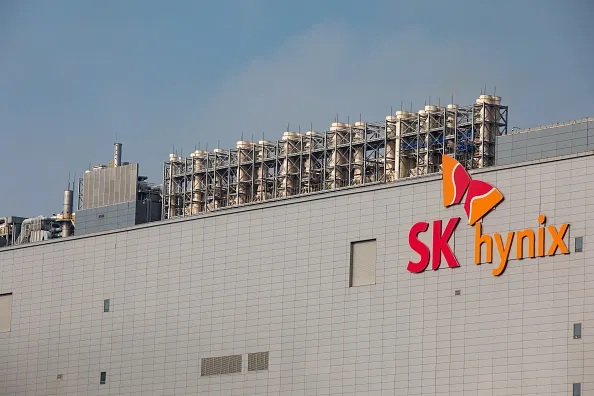
In the high-stakes arena of global semiconductor manufacturing, South Korean giant SK Hynix finds itself navigating a labyrinthine path between American industrial policy and the stark realities of its existing supply chain in China. As the global demand for AI-driven data centers creates an insatiable hunger for memory storage, the company’s flash memory subsidiary, Solidigm, has emerged as a focal point in a complex negotiation with the U.S. government.
Recent reports indicate that Solidigm is seeking critical U.S. regulatory approval to export advanced chipmaking equipment to its Dalian facility in China. This request is not a standalone plea; rather, it is reportedly being positioned as a strategic condition for the firm’s proposed expansion of manufacturing capabilities within the United States. This delicate maneuver underscores the growing tension between Washington’s desire to "reshore" high-tech manufacturing and the practical, logistical dependencies that global firms still hold within the Chinese market.
The Nexus of Expansion: NAND and the American Market
NAND flash memory, the non-volatile storage technology powering everything from personal smartphones and enterprise-grade laptops to the massive arrays of AI data centers, has become a cornerstone of the modern digital economy. As artificial intelligence models demand exponentially higher data throughput, the necessity for high-speed, high-capacity storage has surged, leading to a global supply crunch.
Industry research firm TrendForce has projected that NAND prices could climb between 15% and 20% in the fourth quarter of 2026, driven largely by the insatiable demand from hyperscale AI providers. Against this backdrop, Solidigm—a subsidiary born from Intel’s non-volatile memory business—is reportedly weighing plans to establish a significant NAND manufacturing presence in the United States, with upstate New York frequently cited as a prime candidate for the facility.
However, the transition of production to the U.S. is not a simple “plug-and-play” scenario. For Solidigm and its parent company, SK Hynix, the economic viability of their global footprint relies heavily on the efficiency of their existing assets, including the Dalian factory in China. Reports suggest that Solidigm is looking to utilize "spare space" within the Dalian plant to install new, more advanced chipmaking equipment to boost production yields, a move that requires the green light from the U.S. Department of Commerce.
A Chronology of Conflict: From Open Trade to Export Controls
To understand the current impasse, one must look at the rapid evolution of U.S. export control policies over the past four years.
- October 2022: The U.S. Department of Commerce implements sweeping restrictions on the export of advanced computing chips and semiconductor manufacturing equipment to China, citing national security concerns regarding the potential for military dual-use.
- 2023: The regulatory framework is tightened further, creating a high barrier to entry for firms attempting to modernize or maintain sophisticated production lines within Chinese borders.
- September 2025: The Trump administration makes a definitive move, revoking the special export exemptions that had previously allowed firms like SK Hynix, Samsung, and Intel to maintain their China-based operations with relative ease.
- Late 2025 – Present: Acknowledging the vital role these firms play in the global supply chain, the U.S. government shifts toward a system of annual licensing. Samsung and SK Hynix have since been granted specific, limited licenses to ship essential equipment to their Chinese plants, though these licenses remain subject to rigorous, ongoing review.
This chronology illustrates a shift from broad, industry-wide cooperation to a granular, case-by-case regulatory environment where every piece of hardware entering China is scrutinized against the backdrop of U.S.-China strategic competition.
The Strategic Importance of the Dalian Facility
The Dalian site is a critical node in SK Hynix’s global strategy. Completed in 2023, the "Mod B" facility was designed to be a state-of-the-art center for high-density NAND production. When the U.S. began restricting the flow of advanced photolithography and etching tools to China, the operational future of such facilities became clouded.
For Solidigm, the ability to upgrade the Dalian facility is not merely about maintaining capacity; it is about keeping pace with the technological curve. If the company cannot install the latest tools, the facility risks becoming a legacy asset, potentially losing its competitive edge in the global NAND market. By requesting the ability to utilize its remaining floor space in Dalian, Solidigm is signaling that it intends to remain a top-tier player in memory technology, provided the U.S. government views these upgrades as compatible with its broader security goals.
Official Responses and Corporate Positioning
In response to inquiries regarding the reports of a "conditional" request for equipment, SK Hynix has maintained a cautious, diplomatic stance. The company explicitly stated to TechCrunch that it is not actively seeking to expand the total production capacity of its Dalian Mod B facility beyond current established parameters.
"The equipment installation is being carried out in consultation with and under authorization from the U.S. government," an SK Hynix spokesperson noted, emphasizing that the company is working within the legal framework established by Washington. This response is calculated to reassure investors and regulators alike that the company is not acting in defiance of export controls, but rather operating within the established, albeit strict, licensing regime.
Meanwhile, the U.S. government’s stance, championed by Commerce Secretary Howard Lutnick, remains focused on the "CHIPS Act" era philosophy: that the future of semiconductor manufacturing must be anchored on U.S. soil. In July, Secretary Lutnick made the administration’s position clear, signaling to both Samsung and SK Hynix that the path to a closer economic partnership with the U.S.—and potential access to subsidies or tax incentives—is through increased domestic production.
Implications for the Semiconductor Landscape
The implications of this standoff are profound, touching on finance, national security, and the future of the global tech supply chain.
1. The IPO Factor
Solidigm is reportedly eyeing a massive U.S. Initial Public Offering (IPO) in 2027, with valuations estimated as high as $100 billion. A successful IPO would be a landmark event for the memory industry, but its success depends on market confidence in Solidigm’s ability to operate without geopolitical interference. If the company’s production lines are perceived as being permanently at risk of U.S. sanctions, the valuation could suffer. Securing a stable, long-term arrangement for its equipment imports is essential for the company’s pitch to Wall Street.
2. The Cost of Bifurcation
The demand for high-speed NAND is skyrocketing, and the industry is currently in a race to build data centers capable of supporting the next generation of AI. If the U.S. forces a complete decoupling of memory production from China, the short-term result will likely be a dramatic increase in costs for end-users, from cloud service providers to consumers. A "bifurcated" supply chain—where products are segmented by their origin—could lead to inefficiencies that further exacerbate the price hikes currently predicted by analysts like TrendForce.
3. A New Era of "Conditional Diplomacy"
The negotiation between Solidigm and the U.S. government represents a new model of corporate diplomacy. It is no longer enough for a multinational firm to simply follow the law; they must now align their global investment strategies with the national interests of the superpower that controls their supply chain technology. The requirement to build in the U.S. in exchange for the right to maintain assets in China is a clear indicator that the "era of globalization" has been replaced by an era of "managed trade."
Conclusion: The Road Ahead
As 2026 winds down, the situation remains fluid. SK Hynix and Solidigm are caught in a classic strategic squeeze: they must appease the U.S. to ensure their long-term growth and market access, while simultaneously managing the sunk costs and operational necessities of their Chinese assets.
For the tech industry, the outcome of these negotiations will serve as a bellwether. If the U.S. grants the requested approvals, it may signal a pragmatic willingness to allow for "managed coexistence" in the semiconductor space. If the request is denied, it will solidify the trend toward total supply chain separation, forcing companies to make increasingly difficult decisions about where to park their capital and their technology.
Ultimately, the story of Solidigm is a microcosm of the 21st-century economy—a world where the lines between corporate strategy, national security, and technological innovation have blurred, leaving companies like SK Hynix to navigate an increasingly choppy sea.