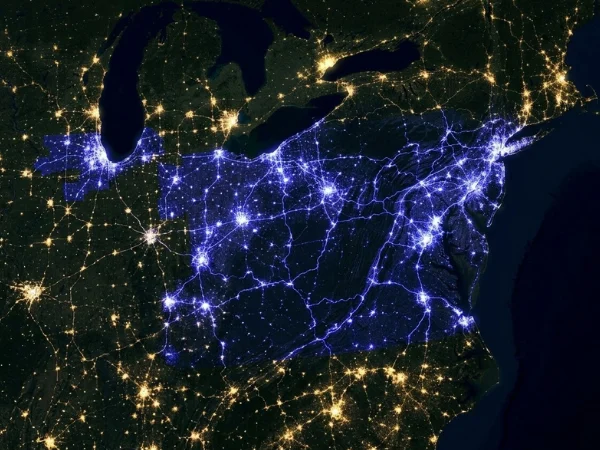
PJM Interconnection, the massive regional transmission organization (RTO) that coordinates the movement of wholesale electricity across 13 states and the District of Columbia, is facing a challenge of unprecedented scale. Tasked with managing the largest competitive electricity market in the United States, PJM is currently navigating a "perfect storm" of surging demand, a stagnant generation pipeline, and an aging infrastructure framework struggling to adapt to the 21st-century realities of artificial intelligence and decarbonization.
As the grid operator braces for a projected 6.8-gigawatt (GW) capacity shortfall as early as 2028, stakeholders ranging from clean energy developers to tech giants are sounding the alarm. The situation has prompted a fundamental re-examination of PJM’s governance, its market mechanisms, and its long-standing interconnection processes.
The Anatomy of the Capacity Crisis
The current tension stems from a rapid divergence between supply and demand. For years, the power grid enjoyed a relatively predictable growth curve. Today, that trajectory has been shattered by the meteoric rise of energy-intensive AI data centers and the concurrent electrification of the economy.
While demand is scaling at record speeds, the supply side has been hampered by a slow-moving transition. Older, dispatchable thermal power plants are retiring, and while they are being replaced by renewable energy, the pace of these new connections has been throttled by administrative bottlenecks.
In recent capacity auctions, the scarcity of available power became so pronounced that prices spiked to levels that necessitated federal intervention. The Federal Energy Regulatory Commission (FERC) eventually approved measures to cap these auctions, yet the underlying issue—a fundamental lack of physical generation—remains unaddressed.
Chronology of the Bottleneck
- The Pre-2020 Era: PJM’s interconnection queue, once a manageable administrative process, began to buckle under the weight of thousands of solar and wind applications.
- 2021-2023: As PJM sought to clear the massive backlog, the "queue" became a black box. Developers found themselves waiting years to receive cost estimates for grid upgrades, creating a state of investment paralysis.
- 2024: The "Capacity Cliff" becomes a mainstream concern. PJM publicly forecasts a 6.8 GW deficit for 2028, forcing regulators and the operator to fast-track emergency policy adjustments.
- Late 2024: The emergence of "Bring Your Own Capacity" (BYOC) models and proposals to create specialized "interruptible" service classes for data centers begin to dominate stakeholder discussions.
Supporting Data: The Math Behind the Emergency
The numbers underscore the severity of the situation. PJM currently serves approximately 67 million customers. To maintain reliability, the grid must possess a reserve margin—a buffer of extra capacity to account for unforeseen outages or weather events.
The 6.8 GW shortfall is significant because it represents a substantial percentage of the peak load requirement. To put this in perspective, 1 GW is enough to power roughly 750,000 homes. A loss of 6.8 GW of capacity during a heat wave or polar vortex could force the operator to implement load shedding, a scenario that is the antithesis of the reliability mandate for an RTO.
Furthermore, the "cost discovery" problem described by industry experts highlights the inefficiency of the current market. Because developers cannot accurately predict the cost of transmission upgrades until they are already deep into the queue, many viable projects are abandoned, further stifling the arrival of new, low-cost renewable energy.
Expert Perspectives: The Factor This Policycast
In a recent episode of the Factor This! Policycast, presented in partnership with Advanced Energy United, host Paul Gerke sat down with industry veterans to dissect the crisis. The panel included Adam Stern of Clearway Energy, Kimaya Abreu of Voltus, and Jon Gordon of Advanced Energy United.
The Interconnection Dilemma
Jon Gordon, a senior director at Advanced Energy United, described the situation as a slow-motion collision. "PJM is in a tight spot. We’ve seen fossil fuel retirements slow down, yet the demand for electricity is surging. We are essentially running a marathon at a sprinter’s pace, and the infrastructure just isn’t catching up."
Adam Stern emphasized that the core failure lies in the predictability of the interconnection process. "Developers need cost certainty. When you enter a queue as a cost-discovery tool rather than a queue for construction, you lose time and capital. PJM must transition to a model where developers know their interconnection costs before they are locked into multi-year commitments."
The Promise of Distributed Energy
One of the most promising avenues for relief comes from Virtual Power Plants (VPPs). Unlike massive, multi-year utility-scale projects, VPPs aggregate distributed energy resources (DERs)—such as smart thermostats, battery storage, and localized solar—to reduce the load on the grid in real-time.
Kimaya Abreu of Voltus highlighted the success of a recent 100 MW deal between Voltus and Google. "By leveraging ‘bring your own capacity’ pathways, we can incentivize large loads to fund the solutions they need to operate. This isn’t just about adding more power; it’s about making the grid more flexible. If we can use the infrastructure we already have more efficiently, we avoid the astronomical costs of building new, redundant lines."
Official Responses and Governance Debates
PJM has acknowledged the need for reform. The operator has introduced the Interim Resource Adequacy Service (IRAS) to better facilitate these new capacity pathways. However, the governance of these changes is a point of contention.
There is an ongoing debate regarding whether PJM states should have a larger role in determining the energy mix or if the RTO should remain strictly a market-clearing entity. Critics argue that PJM’s current governance structure is too bureaucratic to move at the speed of the AI boom, while supporters contend that federal oversight is necessary to prevent states from engaging in protectionist energy policies.
Implications for the Future: A New Customer Class?
Perhaps the most controversial proposal involves the treatment of large-scale data centers. PJM is considering whether these facilities should be classified as "interruptible."
Under this framework, data centers could secure a connection more quickly, but with the caveat that during times of extreme grid stress, their power could be throttled or cut to ensure residential and critical infrastructure remains energized.
"This is unprecedented," Gordon noted. "Traditionally, we don’t pick and choose which sectors go dark during a shortage. But when you have a facility that consumes as much power as a small city, the conversation changes. The problem is that data centers require 24/7 reliability. For them, being interrupted is an existential business risk."
Conclusion: The Path Forward
The PJM energy emergency is a litmus test for the American power grid. Can an institution designed in the late 20th century adapt to the volatile, high-speed energy requirements of the 2020s?
The solution likely requires a three-pronged approach:
- Administrative Speed: Overhauling the interconnection queue to provide cost certainty and prioritizing projects that can be brought online in the short term.
- Market Innovation: Expanding the role of VPPs and DERs to treat "load-side" flexibility as a grid asset equal in value to generation.
- Governance Reform: Balancing the need for rapid, data-driven decisions with the input of state regulators who are ultimately responsible for the well-being of their constituents.
As the 2028 deadline looms, the decisions made in the boardrooms of PJM and the halls of FERC will determine whether the U.S. grid remains the engine of the global economy or becomes a bottleneck to innovation. The "capacity cliff" is no longer a distant theoretical threat; it is an active variable in the future of the nation’s energy landscape.