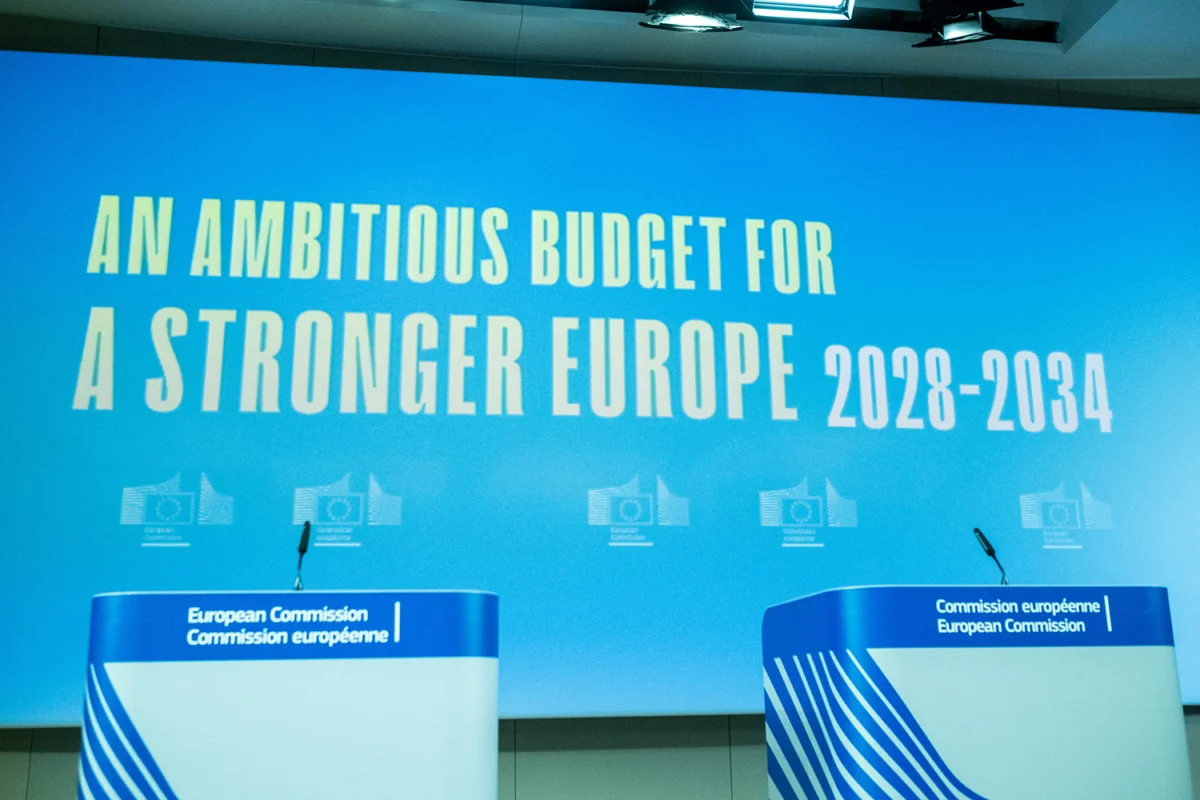
Every seven years, the European Union enters a period of intense, often acrimonious, financial negotiation. The Multiannual Financial Framework (MFF)—the bloc’s long-term budget—serves as the ultimate stress test for the 27-member union. It is a process that pits national sovereignty against supranational ambition, frequently descending into bitter mudslinging. Accusations of "profligate financial leaching," elite corruption, and violations of international law are common currency in these halls.
However, the current budget cycle for 2028–2034 feels different. Behind the closed doors of Brussels, Eurocrats are projecting a quiet confidence. They believe that the convergence of existential threats—from crumbling security architectures to persistent national fiscal crises—has created a rare window of opportunity. The goal is no longer just a ledger of accounts; it is the achievement of a "political maturity" that could transform the EU into a cohesive, federalized superpower capable of standing toe-to-toe with the United States and China.
The Proposal: A Record-Breaking Fiscal Expansion
The European Commission, the EU’s executive arm, has unveiled an ambitious proposal for the 2028–2034 period: a staggering €2 trillion. This figure represents the largest multiyear budget in the history of the bloc, dwarfing the €1.2 trillion agreed upon for the 2021–2027 cycle.
The logic behind this massive injection of capital is strategic autonomy. Brussels aims to build an industrial and defense base that can sustain itself in an increasingly multipolar world. Of this €2 trillion, €451 billion is specifically earmarked for a "Competitiveness Fund." This massive pot is subdivided into:
- €175 billion for scientific and technological research.
- €131 billion for defense and space infrastructure.
- €144 billion for digital leadership, green transitions, healthcare, and agricultural modernization.
Furthermore, the Commission has proposed a €200 billion allocation for global engagement, covering crisis response, international security, and the promotion of the rule of law. Notably, €100 billion of this is set aside for Ukraine, signaling the bloc’s long-term commitment to a nation currently fighting for its sovereignty and, by extension, the security of the European continent.
Chronology of a Shifting Union
The journey to this record-breaking proposal did not happen in a vacuum. It is the culmination of a decade of external shocks that have forced the EU to abandon its traditionally modest fiscal posture:
- 2016–2020: The shock of Brexit and the rise of populist movements forced the EU to reconsider its internal cohesion.
- 2020–2022: The COVID-19 pandemic necessitated the NextGenerationEU recovery fund, marking the first time the bloc engaged in large-scale common debt issuance. This broke a major taboo and set a precedent for future fiscal integration.
- 2022–2025: The Russian invasion of Ukraine fundamentally altered Europe’s security landscape. The realization that the U.S. "security umbrella" could no longer be taken for granted—particularly under the specter of shifting American domestic politics—accelerated calls for a European defense union.
- 2026–Present: As the 2028 budget cycle takes shape, the focus has shifted from mere "recovery" to "geopolitical survival." The EU is now drafting policies intended to shield its industries from the aggressive trade practices of both Washington and Beijing.
Supporting Data: Why the Numbers Matter
Critics in Washington might view a €2 trillion figure as modest compared to the U.S. federal budget. However, such comparisons fail to account for the unique structure of EU finances.
First, the MFF is not a singular, exhaustive account of European spending. It functions as a catalyst. Member states continue to spend unilaterally, and the EU operates various ancillary financial instruments, loans, and grants that exist outside the central budget. When one adds the combined defense spending of EU-NATO members—which exceeded $450 billion in 2025—the picture changes significantly.
The "cohesion" factor is the second, and arguably most important, data point. In Brussels, "cohesion" is the diplomatic term for ensuring that poorer member states receive enough investment to prevent them from slipping into economic despair—a breeding ground for the Euroskepticism that threatens the bloc’s unity. By centralizing digital and energy programs, the Commission hopes to make the benefits of European integration tangible to citizens in every corner of the union, from the Baltic states to the Mediterranean.
Official Responses and Internal Discord
The proposal has sparked a complex, often fractious, debate within the EU. While the Commission pushes for expansion, a growing coalition of "frugal" member states is urging caution.
"The cohesion stuff has to happen," noted one EU diplomat who requested anonymity. "We want to see the overall figure come down. Two trillion euros is too high. But the group of realists and pragmatists is growing. To address the bigger stuff as a whole, we need cohesion."
The internal political landscape is further complicated by the domestic instability of the EU’s two traditional power brokers: France and Germany. With far-right parties making significant inroads in both nations, and French presidential elections looming, the pro-European establishment is in a defensive crouch.
"With Germany and France looking as weak as they are, the smaller nations who are realistic are clubbing together," a Brussels official observed. The strategy for the Commission is clear: if they can secure this budget now, it could serve as a "locked-in" legacy that survives the potential rise of Euroskeptic governments. Even historically profligate France, under the right political pressure, may be forced to align with the "frugal" camp to ensure that the broader European project survives.
Implications: A New Era of Self-Determination
The implications of this budget are profound. Should the Commission succeed in securing this funding, the EU will move closer to a federalized superpower. This transition carries both promise and peril.
1. The Security Paradigm
The existential threat posed by Russia has stripped away the luxury of complacency. Europeans are beginning to understand that their security is not a guaranteed byproduct of the transatlantic alliance. If the EU can successfully coordinate a continental defense strategy, it will mark the end of an era where Europe was merely a junior partner in the U.S. security architecture.
2. Economic Sovereignty vs. Protectionism
The focus on "competitiveness" is, in reality, a response to the fear of being dominated by the U.S. and China. By centrally coordinating investments in AI, green energy, and infrastructure, Brussels hopes to prevent the "hollowing out" of the European industrial base. However, this risks igniting trade disputes with partners who may view these subsidies as protectionist measures.
3. The Democratic Deficit
The most significant hurdle remains the "democratic deficit." Many factions within the European Parliament remain deeply skeptical of the Commission’s desire to spend taxpayer money on such a massive scale. For many voters, ceding further power to Brussels is synonymous with losing local autonomy. The Commission must navigate this carefully; if they push too hard for centralization, they risk fueling the very populism they seek to combat.
Conclusion: The Choice Between Two Worlds
Europe stands at a crossroads. For decades, the continent has oscillated between the spheres of influence of Washington and Beijing, often relying on the former for security and the latter for trade. The 2028–2034 budget represents an attempt to break this cycle.
By choosing to invest in its own defense, its own scientific advancement, and its own internal cohesion, the EU is making a bid for self-determination. It is a high-stakes gamble that requires not just money, but a fundamental shift in political will. If the European Commission secures this budget, the bloc may finally cease to be a collection of disparate states and begin to act as a unified, global power. If they fail, the cracks in the union may become chasms, leaving the continent vulnerable to the winds of a volatile and unforgiving international order. The next seven years will not just determine the budget of the EU; they will determine its relevance in the 21st century.