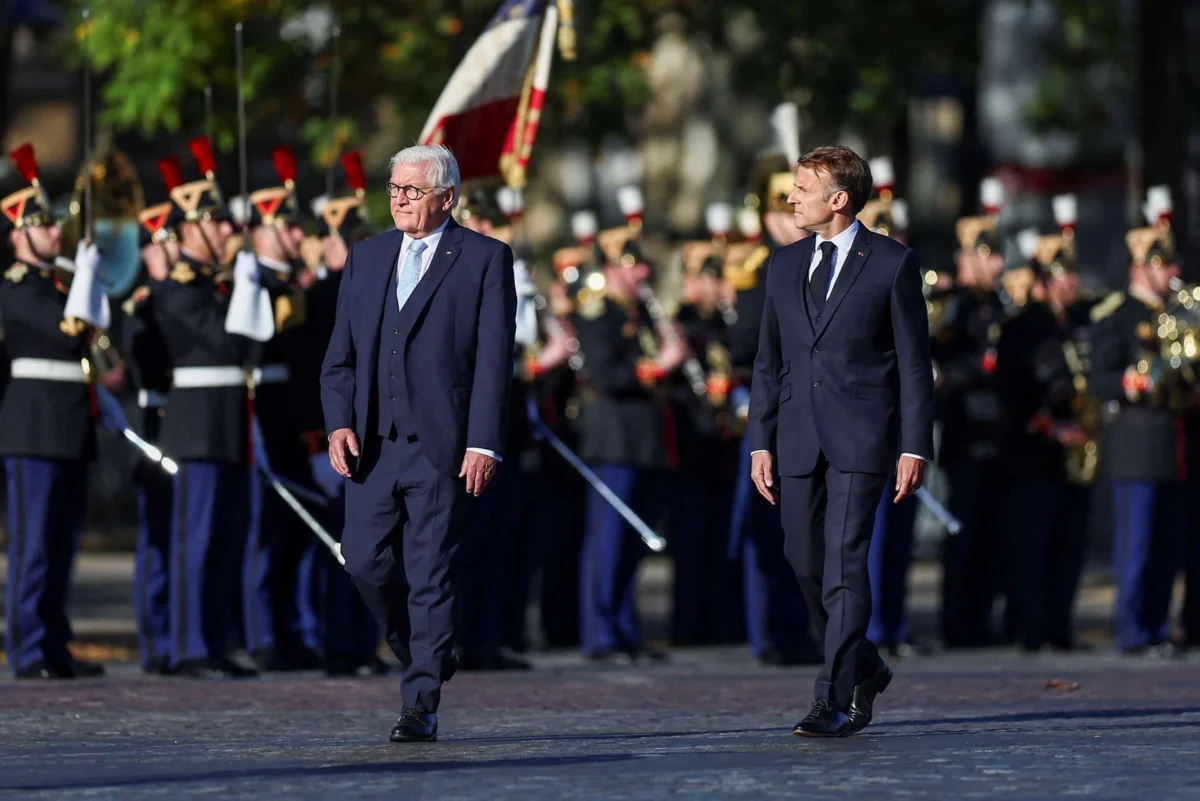
On the morning of October 8, the familiar rhythms of European diplomacy played out with characteristic grandeur. Beneath the towering stone arches of the Arc de Triomphe, French President Emmanuel Macron stood alongside his German counterpart, Frank-Walter Steinmeier, to receive full military honors. The imagery was designed to project unity, marking the first state visit by a German president to France in over a decade. It was a tableau of continuity, signaling that the "Franco-German engine"—the historical bedrock of the European Union—remains the continent’s most vital bilateral axis.
Yet, as the ceremonial trumpets faded, a far more sobering reality began to emerge on the other side of the Seine. Within hours, the carefully curated optics of diplomatic harmony were punctured by reports from the National Assembly, where France’s top military brass delivered a stinging assessment of the bilateral relationship. Simultaneously, across the border in Berlin, the digital sector provided its own critique, as the search engine Ecosia announced a pivot away from its reliance on Mistral AI, France’s premier artificial intelligence champion.
Taken together, these events provide a stark, condensed portrait of a partnership where the pageantry of cooperation remains polished, even as the substance beneath it continues to thin.
Chronology of a Fracturing Alliance
The week of October 8 was not merely a collection of coincidental news items; it was a snapshot of a deeper, systemic drift.
- October 8, Morning: President Steinmeier arrives in Paris, marking the first German state visit in 13 years. The visit is framed by the Élysée as a celebration of "irreversible" friendship.
- October 8, Afternoon: General Fabien Mandon, Chief of the Defense Staff, testifies before the National Assembly’s defense committee. He drops a bombshell: Germany has effectively withdrawn from the core development phase of the Main Ground Combat System (MGCS), the project intended to replace the iconic Leopard 2 and Leclerc tanks.
- October 9–10: News breaks regarding the Berlin-based search engine Ecosia. After a high-profile partnership aimed at fostering European digital sovereignty, Ecosia shifts its strategy, opting to abandon the French-made Mistral AI models in favor of alternative technologies, citing concerns over technical alignment and strategic direction.
- October 11: Analysts across Europe begin to synthesize these events, suggesting that the "Franco-German Engine" is struggling to translate political rhetoric into industrial reality.
The MGCS Collapse: A Case Study in Industrial Discord
At the heart of the current tension is the Main Ground Combat System (MGCS). Launched with much fanfare in 2017, the program was designed to be the crown jewel of European defense integration. The vision was ambitious: to jointly develop a next-generation tank that would not only replace the aging French Leclerc and German Leopard 2 but also establish a standard for European land warfare for the next half-century.
However, the program has been plagued by "industrial nationalism" from its inception. France, with its preference for sovereign control and military independence, has frequently clashed with Germany’s more commercially driven and export-oriented approach to defense manufacturing.
General Fabien Mandon’s testimony was the most candid admission to date of the program’s failure to maintain a unified front. By informing lawmakers that Germany had effectively decided to "quit the project" of a common future tank, Mandon did more than report a technical setback; he signaled a profound strategic divorce. For years, Berlin and Paris have argued over work-sharing, intellectual property rights, and the tactical requirements of the tank itself. Germany’s focus on near-term modernization and its pursuit of alternative partnerships—such as the "European Sky Shield Initiative," which favors American and Israeli missile defense systems—have left France feeling sidelined and disillusioned.
The Digital Divide: Mistral and Ecosia
While the defense sector deals with the collapse of hardware collaboration, the technology sector is facing a similar erosion of trust. The partnership between France’s Mistral AI and Germany’s Ecosia was originally heralded as a breakthrough in the quest for "European Digital Sovereignty." The goal was to provide an alternative to the dominance of Silicon Valley giants by utilizing European-grown, open-source-adjacent AI.
The decision by Ecosia to drop Mistral as its primary partner is a significant blow to the narrative of a united European tech ecosystem. Reports indicate that Ecosia’s pivot was driven by a mismatch in priorities; while France is pushing for high-performance, proprietary-leaning models, German stakeholders are increasingly prioritizing transparency, cost-efficiency, and different open-source benchmarks. This departure suggests that even in the digital age, where cross-border collaboration should theoretically be easier, the same protectionist instincts that haunt the defense industry are manifesting in the software sector.
Official Responses and Strategic Implications
The silence from the Élysée following General Mandon’s testimony was telling. When official channels do speak on these issues, the tone is invariably one of "recommitment to common goals." German officials have largely downplayed the "withdrawal" from the MGCS, framing it instead as a "restructuring" or an "evolution of the program to meet changing threats."
However, defense analysts are less optimistic. The implication of these developments is twofold:
- The End of "Strategic Autonomy": France, led by President Macron, has been the primary architect of the "strategic autonomy" doctrine, which calls for Europe to reduce its reliance on external powers, particularly the United States. When the two largest EU powers cannot agree on a tank or an AI model, the dream of an autonomous European power bloc becomes increasingly difficult to sustain.
- Increased Reliance on Non-European Partners: As Franco-German initiatives stall, both nations are showing an increased willingness to look elsewhere. Germany has deepened its procurement ties with the U.S. and regional partners, while France is increasingly looking toward its own domestic industrial base and non-traditional partners in the Middle East and Asia.
The Substance of the Thinning Partnership
The core issue remains a misalignment of strategic culture. France views the European project through the lens of a "Great Power" strategy, prioritizing military strength and geopolitical independence. Germany, hampered by its post-WWII pacifist legacy and a political system that requires broad consensus, views the EU primarily as a platform for economic integration and multilateral rule-based order.
When these two philosophies clash on the floor of a defense committee or the boardrooms of a tech company, the results are rarely productive. The "pageantry" mentioned in the opening—the state visits, the handshakes, the declarations of unity—serves a necessary function: it keeps the diplomatic machinery moving even when the gears are grinding. Yet, the week of October 8 serves as a warning. Diplomatic theater cannot indefinitely mask the absence of shared industrial and strategic purpose.
Moving Forward: Can the Engine Be Rebuilt?
For the Franco-German partnership to survive the coming decade, it must undergo a fundamental shift in how it approaches "cooperation." The current model—characterized by massive, monolithic projects that require decades of negotiation—is clearly failing.
Experts suggest that the future of European integration may not lie in these "flagship" programs, but in smaller, more modular collaborations that allow for flexibility. If Germany and France cannot build a single tank together, perhaps they can coordinate the software that guides a fleet of different tanks. If they cannot agree on a single AI platform, they could perhaps harmonize the regulatory frameworks that govern all AI development in Europe.
However, this would require a level of humility that has been absent in the recent, often heated, negotiations. It would require France to accept that its vision of sovereignty is not always shared by its partners, and it would require Germany to acknowledge that its reliance on American security guarantees and external tech giants is not a sustainable path for a continent that aspires to be a global player.
Conclusion
The events of October 8 were a microcosm of the broader European struggle. As the world becomes increasingly multipolar and volatile, the necessity for a strong, united Europe has never been greater. Yet, the divergence seen in the MGCS program and the tech sector suggests that the foundational alliance of that union is under unprecedented strain.
The Arc de Triomphe remains a symbol of the shared history and enduring friendship between France and Germany. But symbols, no matter how grand, cannot carry the weight of modern statecraft on their own. The substance of the partnership must be rebuilt, not with speeches and ceremonies, but with the difficult, unglamorous, and often contentious work of aligning industrial policy, strategic ambition, and digital infrastructure. Until that happens, the Franco-German engine will continue to run, but it will be a vehicle that is slowly, but surely, running out of fuel.