When a user submits a prompt to a Large Language Model (LLM) like ChatGPT or Claude, there is a perceptible, albeit brief, moment of silence before the text begins to stream. This delay is not merely a quirk of the internet; it is the physical manifestation of a massive computational choreography happening deep within a GPU. To developers and architects, this "silence" is the inference pipeline—the critical process of translating static model weights into dynamic, conversational intelligence.
Understanding the mechanics of LLM inference is no longer a niche academic pursuit; it is the fundamental requirement for building AI applications that are responsive, scalable, and economically viable.
1. The Core Mechanics: What is LLM Inference?
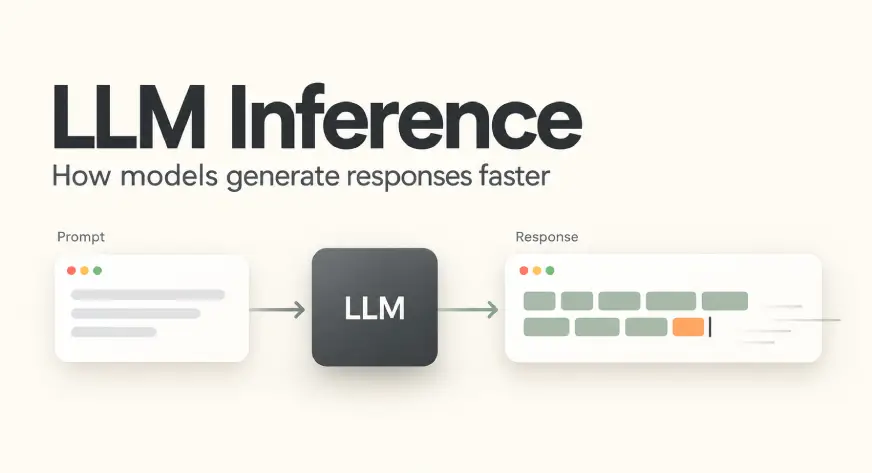
At its simplest, LLM inference is the process of using a pre-trained neural network to generate output based on new, unseen input. Unlike the training phase, where a model undergoes backpropagation to adjust billions of internal parameters (weights) to learn patterns, inference is a read-only operation. The model’s "knowledge" is frozen; the goal is to predict the next token in a sequence with maximum speed and accuracy.
The Two-Phase Pipeline
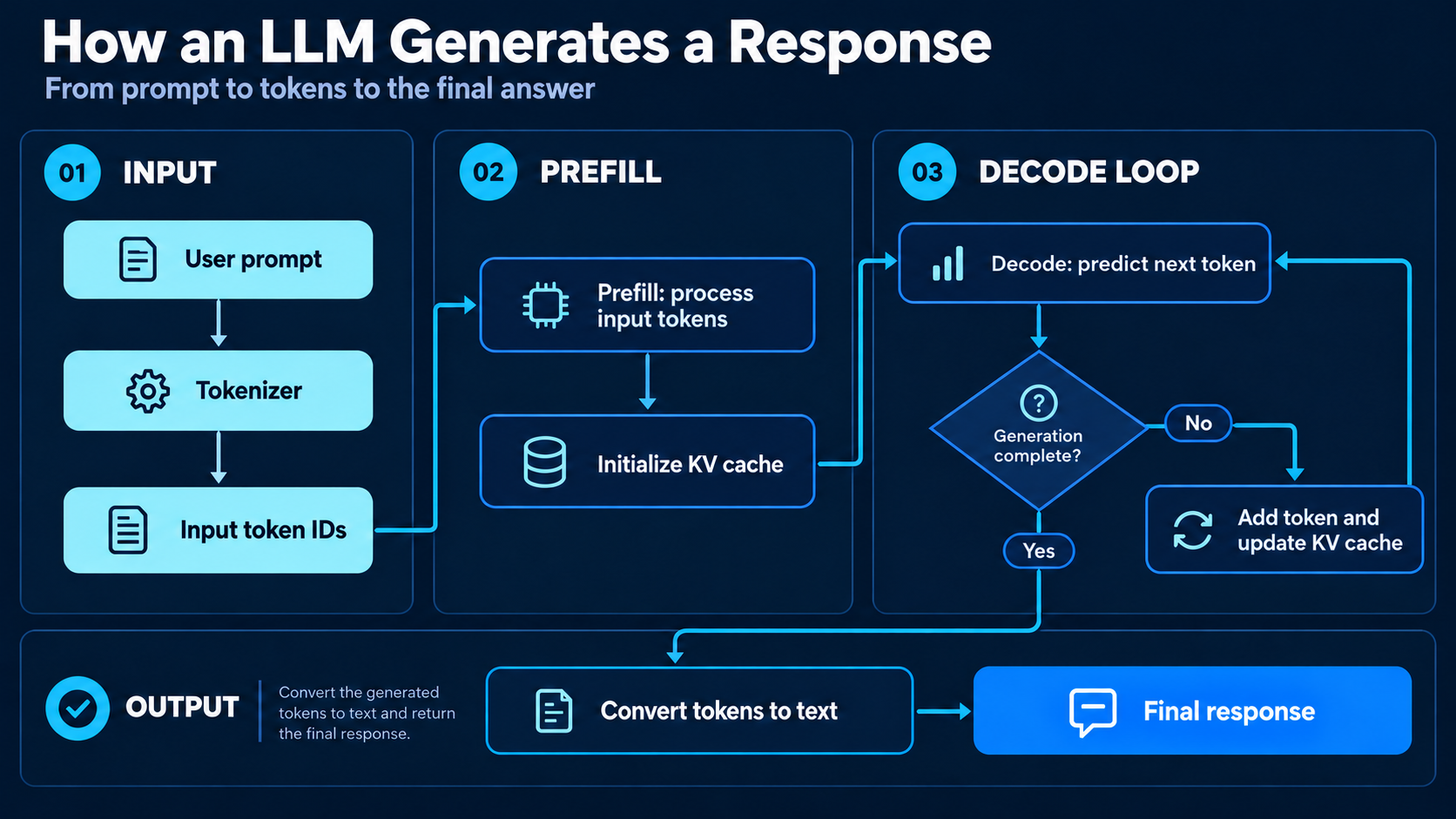
The inference process is split into two distinct operational phases, each placing different demands on hardware:

- Prefill (Prompt Processing): The model ingest the user’s input. If you provide a 2,000-token prompt, the model processes these in parallel. This is a compute-intensive phase that initializes the Key-Value (KV) Cache—a critical data structure that stores the attention representations of the input tokens.
- Decoding (Token Generation): Once the prompt is processed, the model shifts to generating output tokens one by one. This is a sequential process; the model must know the previous token to predict the next. Because the model must access the KV cache and model weights for every single token, this phase is typically memory-bandwidth bound.
| Feature | Prefill | Decoding |
|---|---|---|
| Process | Parallel computation | Sequential (Auto-regressive) |
| Bottleneck | Compute (GPU TFLOPS) | Memory Bandwidth |
| Priority | Low TTFT (Time to First Token) | High Throughput (Tokens per second) |
2. The Memory Problem: The Role of the KV Cache
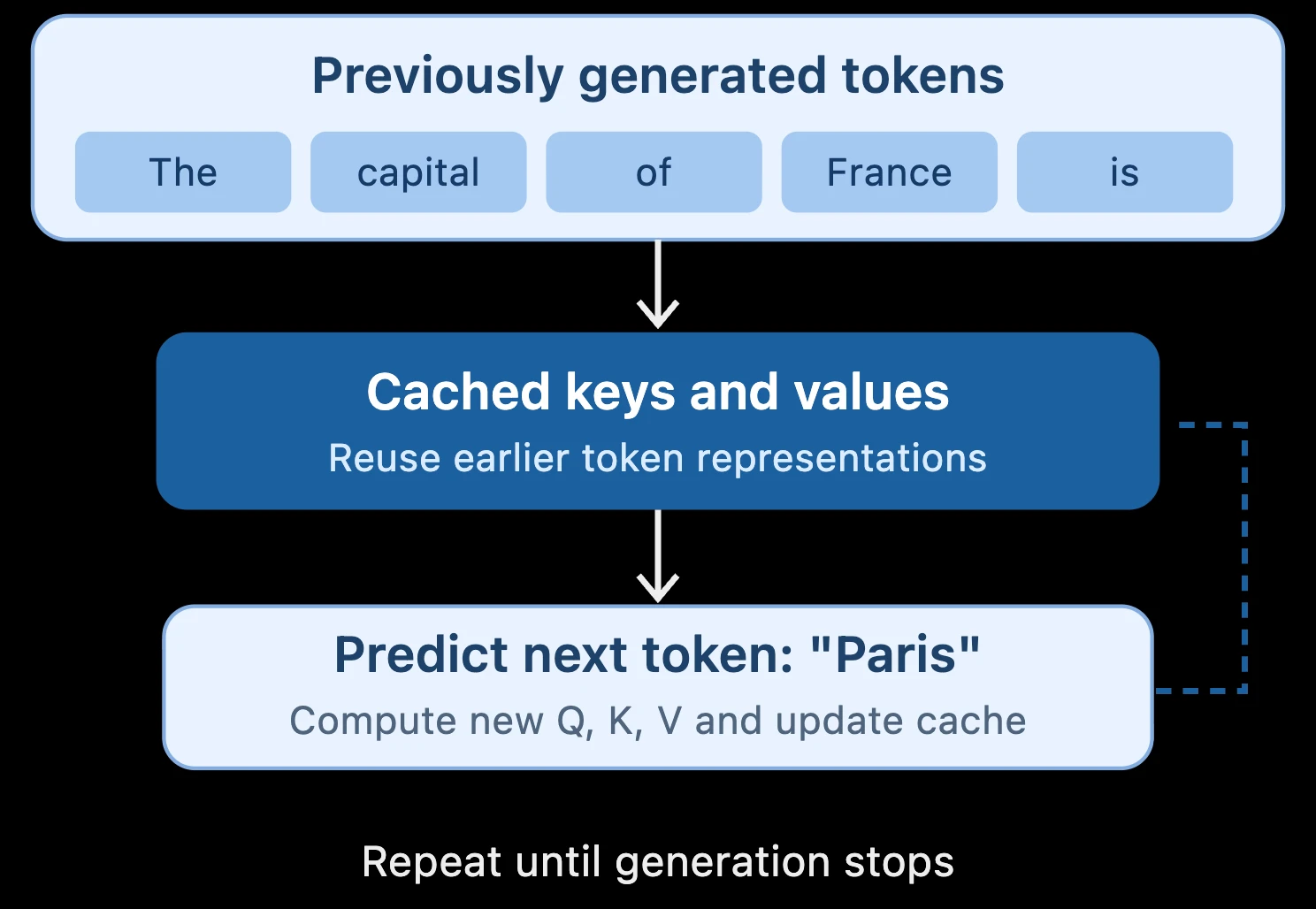
To understand why LLMs can be slow, one must understand the "memory tax." Without a KV cache, the model would be forced to re-calculate the mathematical representation of every previous word in the conversation every time it generated a new one. This would be computationally ruinous.
The KV cache stores the "context" of the conversation. However, as the conversation grows, the cache expands. In a production environment serving thousands of users, the KV cache can quickly consume all available VRAM, leading to catastrophic performance degradation. This is where advanced memory management, such as PagedAttention (a hallmark of the vLLM engine), becomes essential. By partitioning the cache into non-contiguous blocks—much like a computer’s operating system manages RAM—developers can drastically increase the number of concurrent users a single GPU can support.
3. The Bottlenecks: Why Latency Occurs
A model’s response time is not simply a function of its size. Performance is a tug-of-war between several hardware factors:
- Memory Bandwidth: In the decoding phase, the GPU spends more time moving weights and cache data from memory to the processor than actually performing calculations. If your GPU has a high compute capacity but low memory bandwidth, your generation speed will remain sluggish.
- Context Length: Longer documents require longer KV caches. As the context window expands, the memory pressure increases non-linearly, potentially causing the system to swap data or crash.
- Concurrency: A single user is easy to manage. A hundred users requesting tokens simultaneously requires sophisticated scheduling to prevent "head-of-line blocking," where one massive request stalls the entire queue.
4. Optimization Strategies: Engineering for Scale
Modern AI engineering relies on a suite of techniques designed to squeeze maximum performance out of finite hardware:

Quantization
Large models often run at 16-bit floating-point (FP16) precision. Quantization reduces this to 8-bit (INT8) or even 4-bit precision. This effectively halves or quadruples the number of parameters that can fit into the same amount of VRAM, allowing larger models to run on consumer-grade hardware with minimal impact on output quality.
Continuous Batching
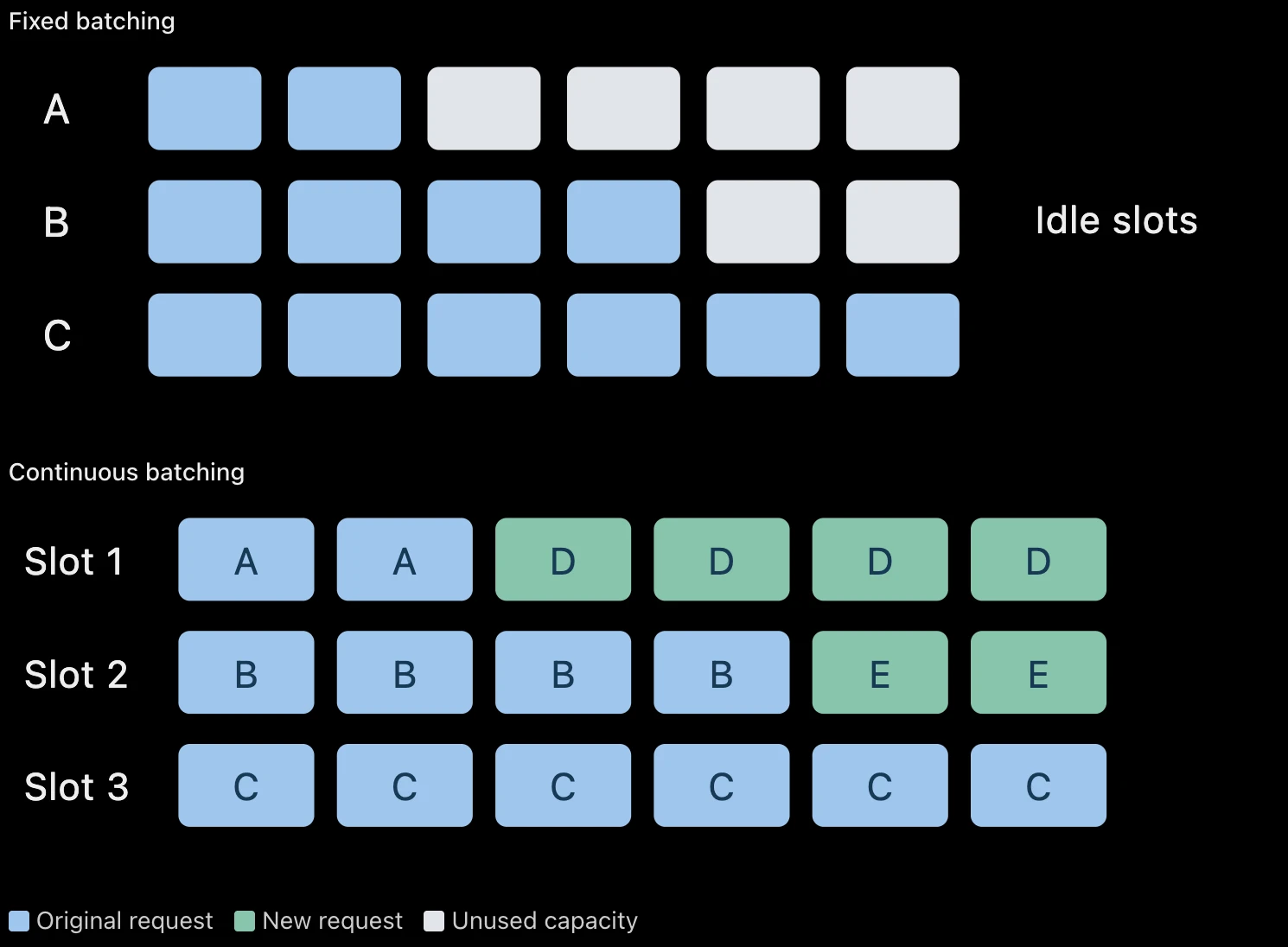
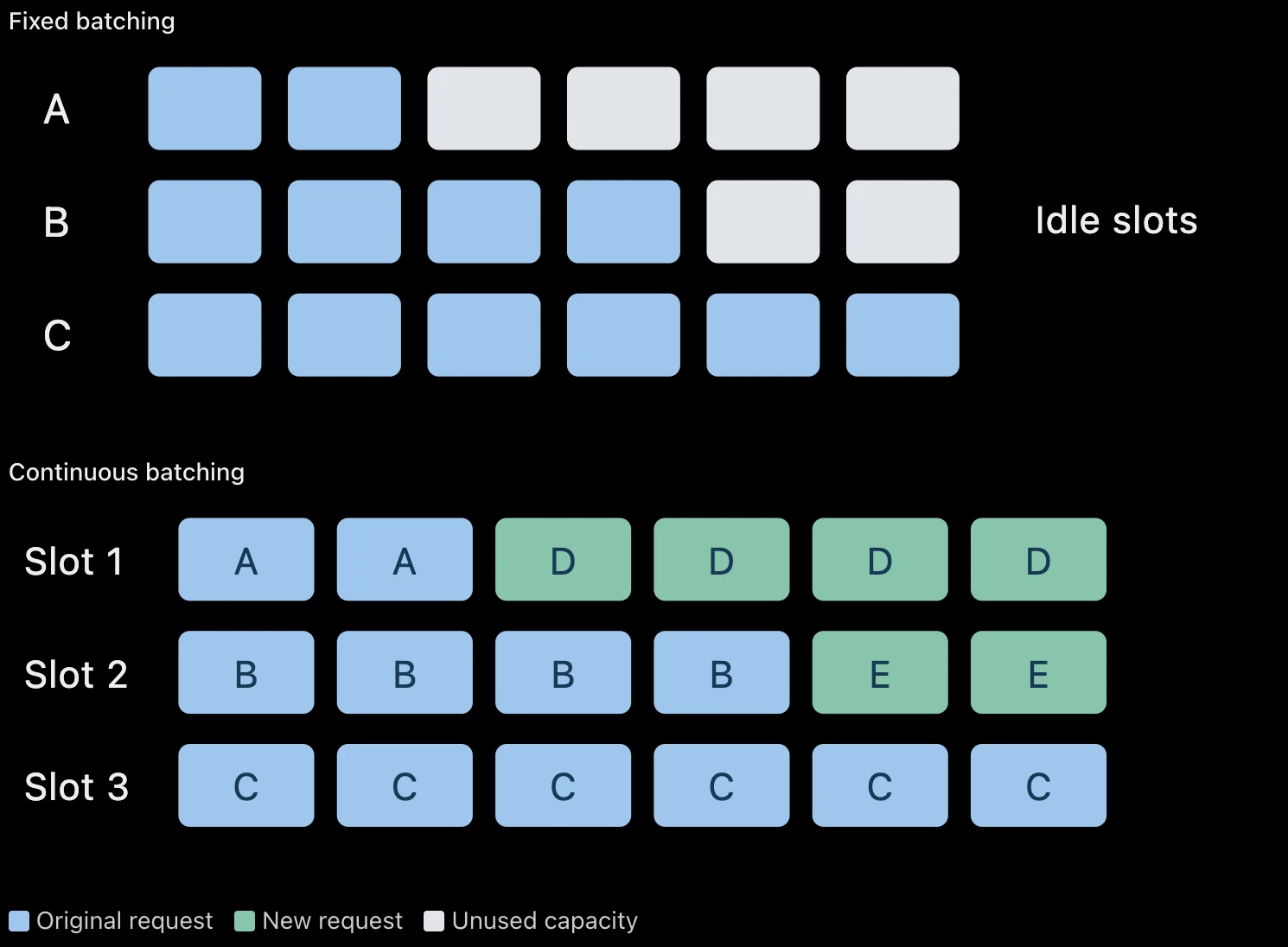
Traditionally, batches were fixed in size. If one request in a batch finished before the others, the GPU would sit idle, waiting for the stragglers. Continuous batching allows the engine to swap out finished requests for new ones in real-time, keeping the GPU’s "compute cores" busy at all times.
Speculative Decoding
This is a clever "guess-and-check" strategy. A small, "draft" model generates a sequence of tokens at lightning speed. A larger, more accurate "target" model then verifies these tokens in parallel. When the draft model is correct, the system achieves a massive boost in effective tokens-per-second.
5. Hands-On Lab: Measuring Your Performance
To truly understand inference, you must measure it. Using a local tool like Ollama, you can benchmark how your hardware handles different workloads.
The Methodology
- Environment Setup: Create a Python virtual environment and install
requests,pandas, andmatplotlib. - The Prompt Test: Send prompts of varying lengths (e.g., 100, 1,000, and 5,000 tokens) to the model.
- Data Capture: Record
prompt_eval_duration(Prefill) andeval_duration(Decoding). - Analysis: Calculate Time to First Token (TTFT). This is the "user perception" metric. If TTFT is high, the application feels broken. If the subsequent generation speed (tokens per second) is low, the application feels tedious.
By simulating multiple concurrent requests using a ThreadPoolExecutor, you will observe the "knee" in the performance curve—the exact point where adding more users causes the latency to spike.
6. The Production Architecture: Beyond the Local Machine
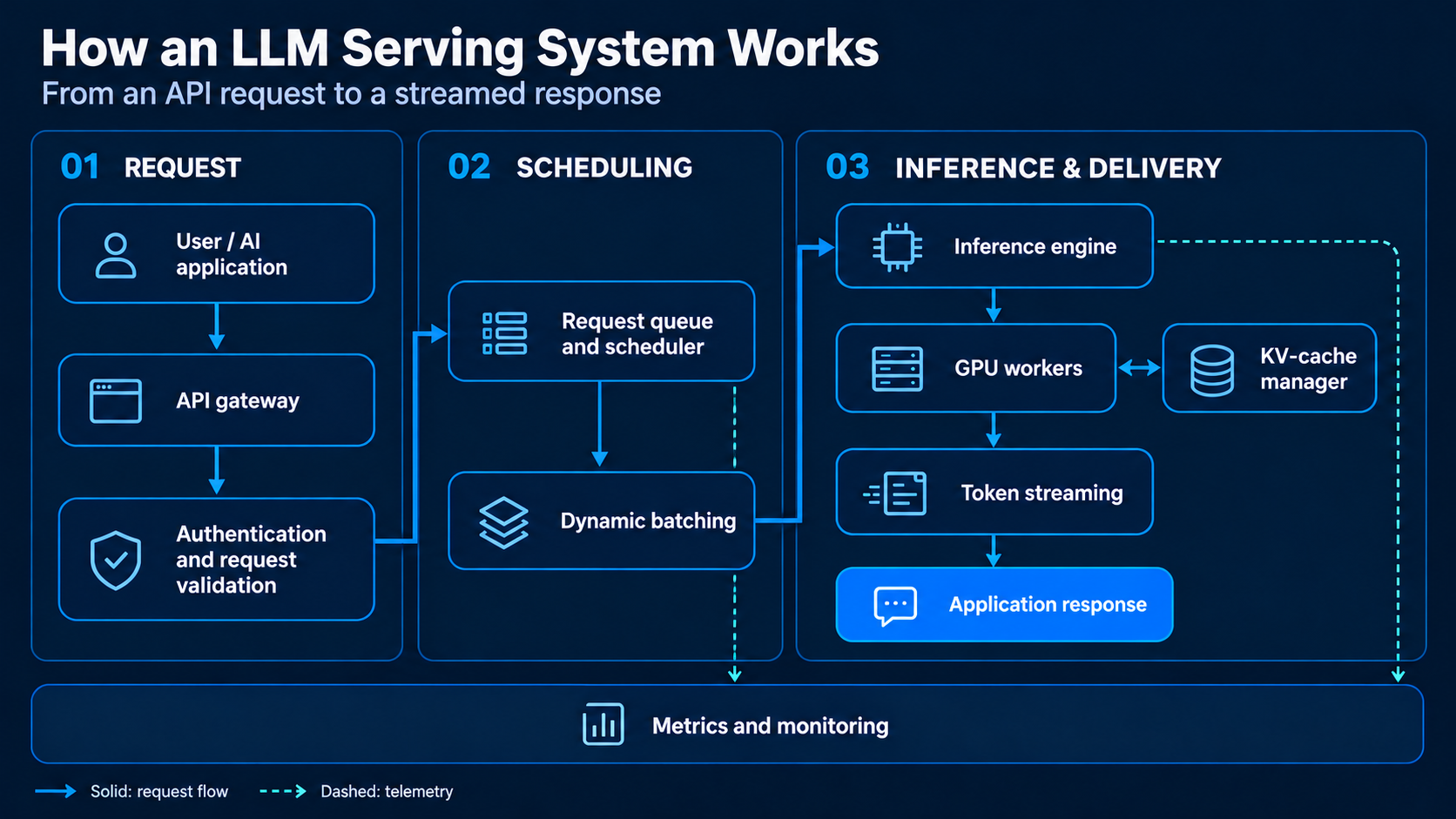
In a production-grade enterprise deployment, the architecture looks like a sophisticated traffic control system:
- API Gateway & Load Balancer: Manages incoming traffic and directs it to the appropriate model worker.
- The Scheduler: This is the "brain" of the inference server. It uses continuous batching and PagedAttention to decide which request gets priority.
- Inference Workers: These nodes hold the model weights in VRAM. Often, the architecture is decoupled so that the prefill stage (which needs high compute) and the decoding stage (which needs high memory bandwidth) can be scaled independently.
- Monitoring Stack: A real-time observability layer (Prometheus/Grafana) that tracks p95 and p99 latency. Monitoring the average is a mistake; production systems must be optimized for the slowest 1% of requests.
7. Implications: The Future of AI Efficiency
The shift in AI development is moving away from "bigger models" and toward "smarter serving." As inference costs become the primary barrier to entry for many startups, the focus has shifted to:
- Model Distillation: Creating smaller, specialized models that perform as well as giants on specific tasks.
- Hardware-Software Co-design: Engines like vLLM, SGLang, and TensorRT-LLM are now as important as the models themselves. These engines act as the "drivers" that allow high-level software to interface with complex GPU architectures.
- Agentic Efficiency: In multi-step agentic workflows, the model may be called 20 times to complete one user request. Optimizing the "inter-call" latency is the next frontier of AI application design.
Conclusion
Inference is the invisible hand that powers the generative AI revolution. While the training of models—with their massive parameter counts and epoch-long runs—captures the headlines, it is the efficiency of the inference pipeline that determines whether an AI tool becomes a daily utility or a cost-prohibitive experiment.
By mastering the balance between compute and memory, leveraging techniques like quantization and continuous batching, and rigorously measuring performance through metrics like TTFT and TPOT, developers can build the next generation of AI applications that are not only powerful but also lightning-fast and economically sustainable. The path to AI scale is not just through bigger models, but through better, faster, and more efficient inference.