Financial institutions have long positioned themselves as the primary fortresses of the global economy, investing billions in firewalls, biometric authentication, and sophisticated transaction monitoring. Yet, despite these gargantuan efforts, a glaring vulnerability remains: the reliance on an "incident-driven" approach. By treating fraud as a series of isolated, manageable errors, institutions are merely pruning the leaves of a tree while the roots—a massive, interconnected, and increasingly industrialized criminal infrastructure—continue to spread.
The latest 2026 Global Financial Crime Report from Nasdaq Verafin paints a sobering picture of this reality. Global financial crime has reached an estimated $4.4 trillion, a staggering figure that has surged by $1.3 trillion since 2023. This represents a 19.2% two-year compound annual growth rate (CAGR), signaling that the mechanisms designed to protect the integrity of the global financial system are being outpaced by the sheer velocity and sophistication of criminal syndicates.
The Evolution of the Threat: Scale Over Innovation
For decades, the banking industry has operated under the assumption that fraud detection is a game of "whack-a-mole." If a new scam typology emerges, institutions patch the hole. However, Greg Williamson, Head of Fraud Commercialization Strategy at Nasdaq Verafin, argues that the fundamental nature of these attacks has not actually changed.
"The fraud types haven’t changed much, and I don’t think they will," Williamson explains. "We still experience the same type of attacks in card, the same type of ACH and wire attacks, and account takeover. All of that is the same. What is changing rapidly is the scale and sophistication of the attacks. The velocity has enabled the attackers to be much more effective; they can execute attacks at a higher rate and are far more targeted in terms of knowing the consumer and the specific weaknesses of their financial institution."
Chronology of an Escalation
- Pre-2023: Fraud was largely characterized by "spray and pray" tactics—mass-market phishing emails hoping for a fractional success rate.
- 2023–2024: The widespread integration of Generative AI allowed criminals to sanitize their communications, removing the grammatical errors and "red flags" that once alerted cautious consumers.
- 2025–2026: The current era of "Industrialized Fraud." Criminal syndicates have adopted corporate-like structures, complete with human-in-the-loop customer support, data-mining units, and specialized departments for obfuscating funds through mule networks.
The Disappearance of Red Flags: AI’s Disruptive Role
The report highlights a critical shift: the "professionalization" of the scammer. Previously, a discerning consumer could identify a phishing attempt through poor formatting, suspicious URLs, or disjointed language. Today, AI-driven content generation ensures that fraudulent correspondence is indistinguishable from legitimate bank communications.
"In a traditional phishing attack," says Williamson, "there were a lot of errors. Today, that can be fully clean, looking exactly as you would expect, following all best-practice guidelines. All those red flags we tell consumers to look for are no longer in that process."
This technological leap is supported by data from 90% of financial professionals surveyed, who report a marked increase in AI-driven attacks at their institutions over the last two years. The result is a surge in authorized push payment (APP) fraud, where victims are socially engineered into moving their own money. These aren’t random attacks; they are highly personalized, leveraging massive caches of data harvested from social media and previous high-profile data breaches.
The Industrialization of Fraud: From Scams to Human Rights Abuses
Perhaps the most alarming aspect of the modern fraud landscape is its intersection with global human rights crises. Fraud is no longer just a digital theft; it is the financial engine for human trafficking, drug trafficking, and state-sponsored terrorism.
The "industrialization" of these operations means that criminal syndicates now function as shadow enterprises. In some regions, victims of human trafficking are forced into labor—not just manual labor, but "cyber-slavery," where they are coerced into managing large-scale scam call centers or processing fraudulent checks for their captors.
"It’s an industrialization of the scam industry," Williamson notes. "You have massive organizations that are trafficking humans and forcing them into labor to execute these scam calls. Each person you add to the operation is a substantial increase in profit. That has been their business model for a number of years."
Because these organizations operate with the efficiency of a legitimate corporation—testing tactics, pivoting strategies, and deploying capital—they can move funds through mule networks and instant payment rails faster than legacy monitoring systems can flag the activity as suspicious.
Implications for Financial Institutions: The "Downstream" Crisis
The agility of these criminal enterprises has forced them to pivot toward the most vulnerable point in the chain: the end user. As banks harden their back-end systems, criminals have turned to the consumer, using social engineering to bypass security protocols.
This shift has created a "downstream" crisis for banks. When a customer is successfully defrauded, the institution is left to handle the financial loss, the reputational damage, and the regulatory fallout. The traditional siloed approach, where each bank operates as an island of defense, is now a liability.
The Need for Shared Intelligence
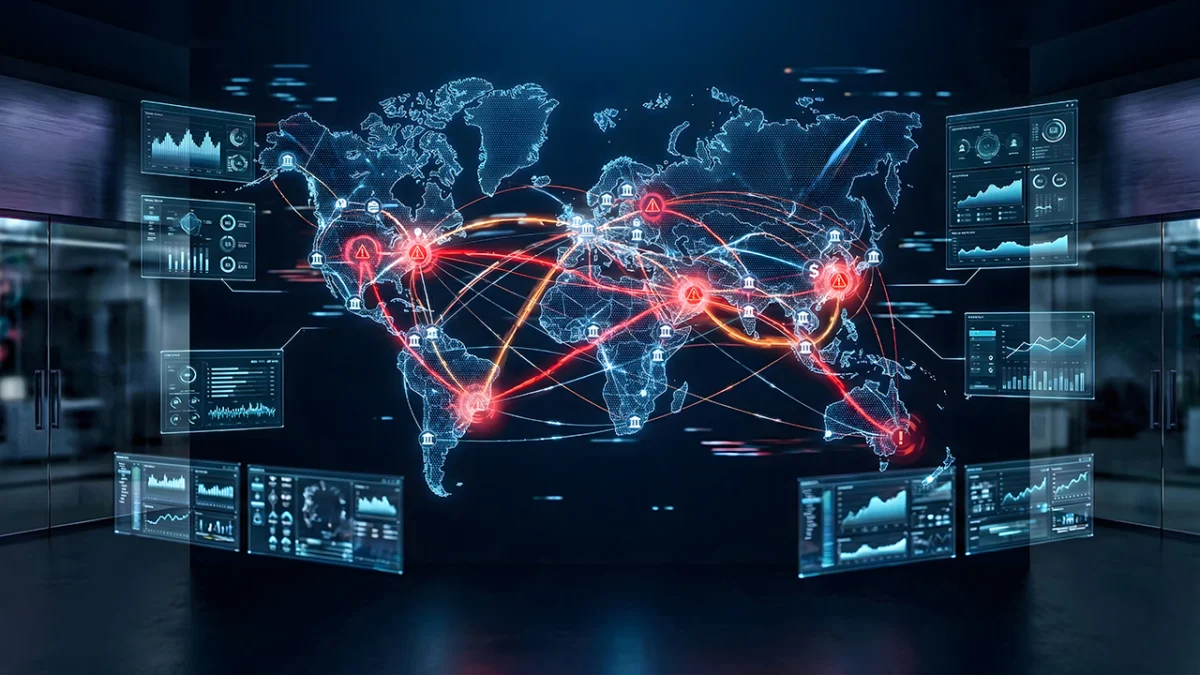
No single institution possesses the data required to track a global criminal enterprise. A fraudster might initiate a scam in one country, use a mule account in another, and launder the funds through a third. If Bank A only sees the transaction at their branch, they see an isolated incident. If the industry saw the movement across the entire network, they would see the syndicate.
The success of the Australian Financial Crimes Exchange (AFCX) serves as a blueprint for the future. By bringing together banks, telecommunications companies, digital asset exchanges, and government agencies, the exchange creates a holistic view of the crime ecosystem. This collaborative model is essential for mapping out how money moves, not just where it lands.
Bringing AI into the Solution: A New Defensive Paradigm
While AI is the primary weapon in the criminal’s arsenal, it is also the only viable defense for financial institutions. The industry must pivot from passive monitoring to proactive, agentic AI solutions.
"We talk a lot about the risk that AI brings, but not enough about the importance of bringing AI into the solution," says Williamson. "The good news is that as fraud fighters, we have access to AI as well."
The Future of Defense:
- Behavioral Analytics: Utilizing AI to move beyond simple rule-based detection to identifying subtle behavioral anomalies that indicate a customer is acting under coercion.
- Agentic AI: Deploying autonomous AI agents that can act as a "scalable workforce," triaging risky activity in real-time and freeing human analysts to focus on the most complex, high-stakes investigations.
- Consortium Intelligence: The most critical differentiator will be data access. AI models are only as good as the data they ingest. By leveraging a consortium-based approach—where institutions securely share insights across a network—banks can create a "global immune system" that recognizes threats across the entire industry.
Conclusion: A Call for Global Coordination
The $4.4 trillion financial crime epidemic is not a problem that can be solved by a single bank, a single regulation, or even a single technology. It requires a systemic rethink of how we view financial security.
As the lines between digital fraud and physical crime continue to blur, the financial sector must embrace radical collaboration. The "industrialization" of the scam industry is a challenge to the foundational trust of the global economy. To restore that trust, financial institutions must stop acting as siloed gatekeepers and start operating as a cohesive, intelligence-sharing network. Only by leveraging the same speed, data, and technological prowess as the syndicates they oppose can the global financial community hope to turn the tide against this unprecedented threat.