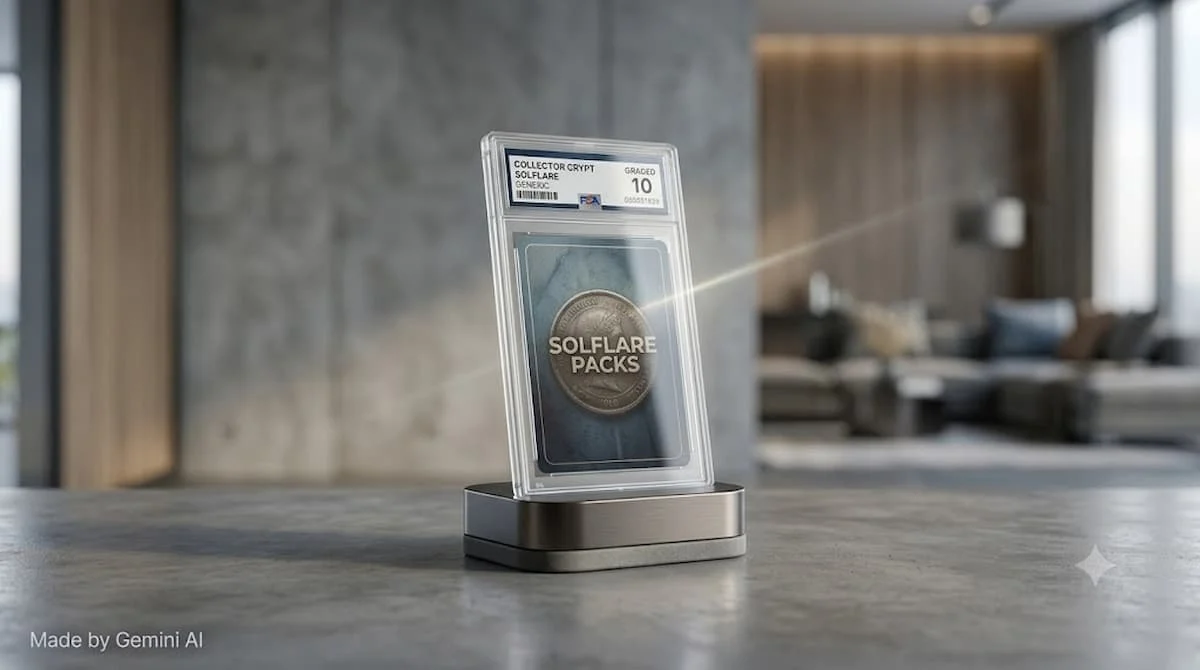
BELGRADE – In a move that signals a significant maturation of the Real-World Asset (RWA) tokenization sector, Solflare, the leading non-custodial Solana wallet, has officially launched "Solflare Packs." Developed in strategic partnership with Collector Crypt, the product introduces a seamless, end-to-end ecosystem for trading card enthusiasts, allowing them to purchase, unbox, and manage physically graded collectibles directly within their digital wallet interface.
With over four million monthly active users, Solflare’s entry into the physical-to-digital (phygital) collectibles market marks a pivotal shift. By integrating the lifecycle of trading cards—ranging from Pokémon and One Piece to high-end sports memorabilia—into a blockchain-native environment, Solflare is attempting to solve the fragmentation that has long plagued the multi-billion dollar collectibles industry.
The Core Mechanics: How Solflare Packs Operate
The architecture of Solflare Packs is designed to remove the friction points inherent in traditional hobbyist markets. Every pack purchased through the interface is linked to a physical, professionally graded card secured in a high-security vault managed by Collector Crypt.
The Lifecycle of a Digital-Physical Asset
- Discovery and Purchase: Users browse available packs directly within the Solflare wallet. The transaction is processed on-chain, ensuring immediate proof of purchase.
- The Digital Unboxing: Upon opening a pack, the contents are revealed as NFTs. These tokens serve as digital twins, representing the underlying physical asset stored in the vault.
- The Three-Fold Choice: Once the reveal is complete, the holder is granted three distinct pathways:
- Physical Redemption: The user can request that the physical card be shipped to their home address.
- On-Chain Retention: The user keeps the NFT, maintaining ownership of the asset within their digital portfolio, where it can be traded or showcased.
- The 72-Hour Buyback: Perhaps the most radical feature, users can sell the card back to Collector Crypt at a pre-determined, published price within 72 hours of the unboxing.
Chronology: From Concept to Wallet Integration
The development of Solflare Packs follows a period of intense RWA experimentation within the Solana ecosystem.
- Q1 2025: Conceptualization of a "frictionless vault" model by Collector Crypt, focusing on high-liquidity assets.
- April 2025: Initial technical integration between Solflare’s non-custodial infrastructure and Collector Crypt’s inventory management system.
- May 2025: Beta testing phase, involving select power users within the Solana and TCG (Trading Card Game) communities.
- June 10, 2025: Official global launch of Solflare Packs from Belgrade, bringing the feature to the entire Solflare user base.
Supporting Data and Market Standing
Collector Crypt brings significant operational weight to this partnership. As a tokenized collectibles marketplace, the firm has reported a cumulative trading volume exceeding $1 billion since its inception. Currently, it oversees a vault containing more than $35 million in tokenized inventory.
However, the efficacy of the model rests on the platform’s ability to maintain liquidity. The 72-hour buyback window, while a major selling point for users, places the burden of price exposure on Collector Crypt. While this model is highly effective for "blue-chip" cards—highly liquid items with stable market demand—it poses a long-term challenge should the vault accumulate lower-demand inventory through the automated pack-opening mechanism.

Official Perspectives: Addressing Market Fragmentation
Vidor Gencel, co-founder and co-chief executive of Solflare, frames the launch as a necessary evolution of the collector’s journey.
"Collecting has always been about discovery, ownership, and liquidity," Gencel stated during the announcement. "But the traditional experience is still painfully fragmented. On platforms like Whatnot or eBay, collectors can wait days for a buyer when they want to sell, or even weeks for shipping when they want to hold the physical item. We are collapsing that timeline."
By moving these processes on-chain, Solflare is not just digitizing a receipt; it is providing provenance and immediate settlement. Gencel emphasizes that the goal is to provide a "consumer-grade" experience that doesn’t require users to be blockchain experts, despite the complex decentralized architecture operating in the background.
Implications: The Future of RWA Tokenization
The Shift Toward Utility-Driven Wallets
For Solflare, the launch is a strategic maneuver to increase user retention. In the competitive landscape of non-custodial wallets, "yield" and "security" are no longer the only metrics of success; "utility" has become the primary battleground. By creating a recurring transaction flow—where users frequently purchase, unbox, and trade—Solflare secures its position as a daily-use application rather than a passive storage tool.
Competitive Landscape and Risks
The current market is dominated by centralized giants: eBay, Whatnot, PWCC, and Goldin. These platforms have scaled through sheer volume and trust in physical third-party grading. Solflare Packs enters this arena as a challenger. While it offers superior settlement speed, it faces two significant hurdles:
- The "Crypto-Native" Barrier: The mainstream collector is often wary of NFT volatility and smart contract risks. Solflare has been careful to release a pointed disclaimer: the wallet acts only as a distribution partner. It is not the custodian, the grader, or the ultimate redeemer of the physical assets.
- Inventory Management: As noted by industry analysts, the success of the $35 million vault relies on the "quality" of the inventory. If the pack-opening mechanism leads to an accumulation of "junk slabs" (lower-value cards), the 72-hour buyback model could become a structural liability for Collector Crypt.
Broader Institutional Context
The year 2025 has been defined by the institutional pivot toward Real-World Assets. While the majority of this capital has flowed into fixed-income instruments and commodity-backed tokens, consumer-facing collectibles represent the next frontier.

The success of Solflare Packs will likely act as a bellwether for the industry. If it succeeds, it proves that the "phygital" bridge is viable for retail consumers. If it struggles, it will highlight the persistent difficulty of reconciling the rapid, volatile nature of blockchain markets with the slow, deliberate nature of physical asset grading and shipping.
Conclusion: A New Standard for Ownership
The partnership between Solflare and Collector Crypt represents a bold attempt to standardize the chaotic world of high-end collectibles. By consolidating the on-chain and off-chain steps into a single, intuitive interface, they are addressing the most critical failure point of modern collecting: the gap between owning an asset and being able to do something with it.
Whether the broader market—outside of the Solana-devoted collector niche—will embrace this remains to be seen. However, as non-custodial wallets continue to evolve into super-apps, Solflare Packs serves as a compelling case study for how blockchain technology can be applied to tangible, everyday goods, transforming the way we hold, trade, and appreciate physical history in a digital age.
Disclaimer: This report is for informational purposes only and does not constitute financial advice. Users should be aware of the inherent risks associated with blockchain-based assets and the secondary market volatility of tokenized collectibles.