By Mark Segal | October 13, 2026
In a landmark development for global corporate sustainability reporting, the Taskforce on Nature-related Financial Disclosures (TNFD) has officially released LEAP 2.0. This major upgrade to the organization’s core assessment and reporting guidance represents a pivotal evolution in how businesses and financial institutions identify, measure, and disclose their impacts and dependencies on the natural world.
As the global economy faces mounting pressure to decouple financial growth from environmental degradation, LEAP 2.0 arrives as a critical tool, providing a standardized, actionable pathway for organizations to integrate nature into their boardroom decision-making processes.
1. Main Facts: Understanding LEAP 2.0
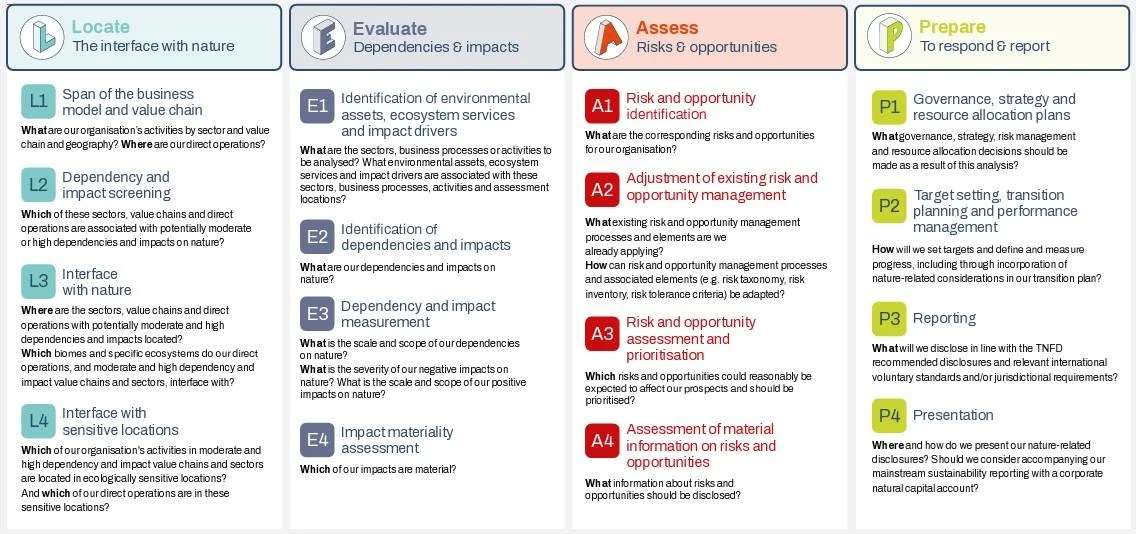
The LEAP approach—an acronym for Locate, Evaluate, Assess, and Prepare—has served as the cornerstone of the TNFD’s recommendations since their inception. The 2.0 version is not merely a minor revision; it is a comprehensive refinement based on years of market feedback and real-world implementation.
At its core, LEAP 2.0 provides a structured methodology for organizations to:
- Locate: Identify where the organization interacts with nature across its direct operations and upstream/downstream value chains.
- Evaluate: Quantify the dependencies and impacts on ecosystems and biodiversity.
- Assess: Determine the material risks and opportunities arising from these interactions, including regulatory, physical, and reputational risks.
- Prepare: Develop disclosures that satisfy investor demand for transparency while informing internal strategic transition planning.
This update introduces critical enhancements, including deeper guidance for financial institutions assessing investment portfolios, specialized metrics for invasive alien species, and integration with the "State of Nature" indicators developed by the Nature Positive Initiative (NPI).
2. Chronology: The Evolution of Nature-Related Disclosures
The journey toward a standardized nature-related framework has been swift, mirroring the rapid escalation of biodiversity loss as a top-tier financial risk.
- 2021: The Launch: Following the success of the Task Force on Climate-related Financial Disclosures (TCFD), the TNFD was established to address the "missing link" in ESG reporting: the material impact of corporate activity on nature.
- September 2023: Final Recommendations: The TNFD published its landmark disclosure framework, setting the global standard for how organizations report on nature-related risks.
- 2025: Global Adoption: With over 1,000 organizations across 56 countries adopting the recommendations, the framework moved from a niche sustainability practice to a mainstream corporate reporting expectation.
- Late 2026: The Transition Phase: The TNFD announced a strategic pivot. Recognizing that the International Sustainability Standards Board (ISSB) is poised to take over the mantle of setting global nature-related disclosure standards, the TNFD began preparing to sunset its technical work program.
- October 2026: The Release of LEAP 2.0: This release marks the culmination of the TNFD’s technical development, designed to serve as a bridge for the ISSB’s future standard-setting and to inform the development of formal ISO standards.
3. Supporting Data and Technical Enhancements
The sophistication of LEAP 2.0 lies in its focus on granular, scientifically backed data. The framework now incorporates specific "State of Nature" indicators, which allow firms to move beyond general qualitative statements and toward quantitative, science-based reporting.
Key Technical Upgrades:
- Financial Institution Portfolios: Recognizing that banks and asset managers face unique challenges, the 2.0 update provides a dedicated module for assessing nature-related risks across vast, multi-sector investment portfolios.
- Environmental Crime: The framework now addresses the growing necessity for firms to account for environmental crimes—such as illegal deforestation or unregulated extraction—within their supply chains, a move that aligns with increasing global regulatory oversight.
- Nature in Transition Planning: As companies commit to "Nature Positive" goals, they require a roadmap. LEAP 2.0 integrates specific guidance on how to build nature into corporate transition plans, ensuring that environmental targets are as robust as decarbonization strategies.
- Invasive Alien Species (IAS): A major addition to the framework, this provides standardized metrics for measuring the impact of invasive species, a leading driver of biodiversity loss that has historically been overlooked in corporate reporting.
4. Official Responses and Industry Sentiment
The release of LEAP 2.0 has been met with broad acclaim from the investment community and sustainability advocacy groups.
TNFD CEO Tony Goldner emphasized the urgency of the moment in a recent statement:

"The market has moved quickly in recent years, with thousands of organizations now working to understand and respond to their nature-related issues. As implementation accelerates, it is essential that assessment, target-setting, and reporting approaches work together in a practical and mutually reinforcing way."
Industry observers note that by aligning with the Science Based Targets Network (SBTN) and the Nature Positive Initiative (NPI), the TNFD is successfully creating an "ecosystem" of standards. Rather than functioning in silos, these tools now allow a company to measure its impact via TNFD, set targets via SBTN, and report progress using standardized, global metrics.
5. Implications: What This Means for Corporate Strategy
The transition to LEAP 2.0 has profound implications for how corporations will function over the next decade.
A New Era of Accountability
With the ISSB preparing to incorporate these findings into its global baseline, "nature-related" is shifting from a voluntary disclosure topic to a mandatory regulatory requirement in many jurisdictions. Companies that have already begun using the original LEAP approach will find themselves at a distinct competitive advantage, having already mapped their dependencies and built the internal data infrastructure required for compliance.
The Financial Sector’s Role
For financial institutions, the implications are arguably the most significant. The ability to accurately assess nature-related risk is no longer an exercise in environmental stewardship; it is a fiduciary duty. As climate-related risks (such as water scarcity or crop failure) become inextricably linked to biodiversity loss, the LEAP 2.0 framework provides the necessary tools for risk-adjusted capital allocation.

The Path Toward ISO Standardization
Perhaps the most enduring legacy of the TNFD will be its contribution to the International Organization for Standardization (ISO). By contributing its assessment logic to the ISO process, the TNFD is ensuring that its methodology will remain the global "gold standard" for decades to come, even after the TNFD organization itself concludes its current mandate.
A Holistic Approach to Sustainability
Finally, LEAP 2.0 signals the end of the era where "climate" and "nature" were viewed as separate silos. The framework encourages organizations to see the interconnectedness of the two, recognizing that the transition to a low-carbon economy must be nature-positive to be truly sustainable.
Conclusion
As we look toward the upcoming COP 17 UN biodiversity conference, the release of LEAP 2.0 stands as a testament to the progress made by the global private sector. While the challenge of reversing biodiversity loss remains daunting, the existence of a clear, actionable, and universally recognized assessment framework provides the transparency required to catalyze capital flows toward restoration and sustainable management.
For businesses and investors, the message is clear: the data is now available, the metrics are defined, and the expectation for disclosure is no longer a question of "if," but "how soon." With LEAP 2.0, the tools for a nature-positive future are officially in the hands of the market.
For more information on the updated guidance and to access the full LEAP 2.0 documentation, visit the TNFD official portal.