The decentralized cloud computing landscape is bracing for a tectonic shift as the Akash Network [AKT] initiates a formal governance process to migrate its operations from its long-standing home on the Cosmos [ATOM] ecosystem to the Solana [SOL] blockchain. This bold proposal, which has sent shockwaves through the Decentralized Physical Infrastructure Network (DePIN) sector, highlights a growing industry realization: the immense overhead costs of maintaining a sovereign blockchain may no longer be sustainable for mid-market infrastructure projects.
With a market capitalization exceeding $200 million and a recent 315% surge in social mindshare, AKT has captured the undivided attention of the crypto community. As the voting window nears its November 2nd conclusion, stakeholders are weighing the potential for massive liquidity access against the risks of transitioning a complex decentralized protocol.
The Core Proposal: Bridging to the Solana Advantage
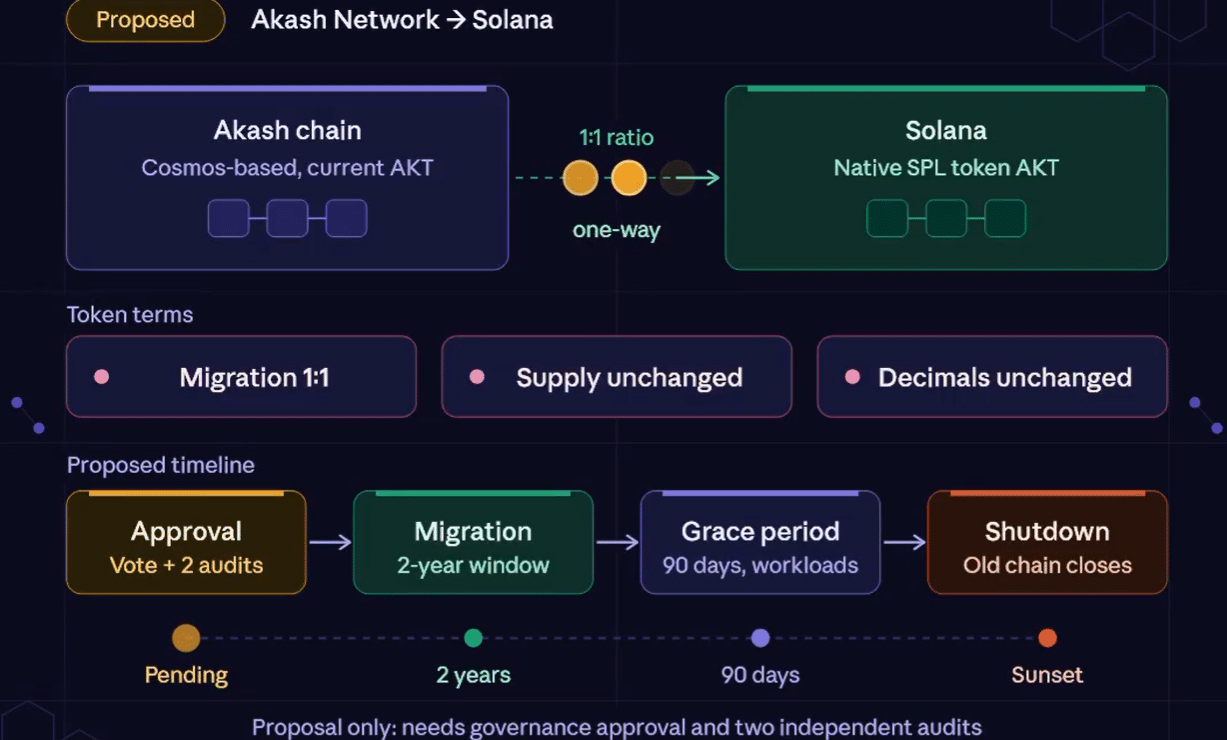
At its heart, the proposal is not a technical overhaul of how Akash processes workloads, but a strategic relocation of its tokenomics and governance structure. The initiative seeks a 1:1 migration of AKT tokens to the Solana Program Library (SPL) standard.
Key Technical Parameters:
- Asset Continuity: The total supply and decimal precision of the AKT token will remain unchanged.
- Migration Timeline: A two-year window is planned for token holders to swap their assets to the new chain.
- Operational Sunset: Current network workloads will continue to function on the existing Cosmos-based chain for a 90-day transition period following the migration, after which the legacy chain will be formally deprecated.
- Governance Requirements: The transition is contingent upon the successful passage of the current vote, followed by two independent, rigorous security audits to ensure the integrity of the migration smart contracts.
The move is largely driven by the perception that Solana has become the premier hub for high-performance DePIN projects. By aligning itself with a network that already hosts industry giants like Helium [HNT] and the Render Network [RENDER], Akash aims to tap into Solana’s superior liquidity, lower fee structure, and rapidly expanding user base.

Chronology of a Major Transition
The journey toward this migration did not happen overnight. It represents the culmination of months of internal debate regarding the cost-to-benefit ratio of sovereign chain maintenance.
- Early October: Initial discussions regarding network efficiency and infrastructure overhead began circulating within the Akash community forums.
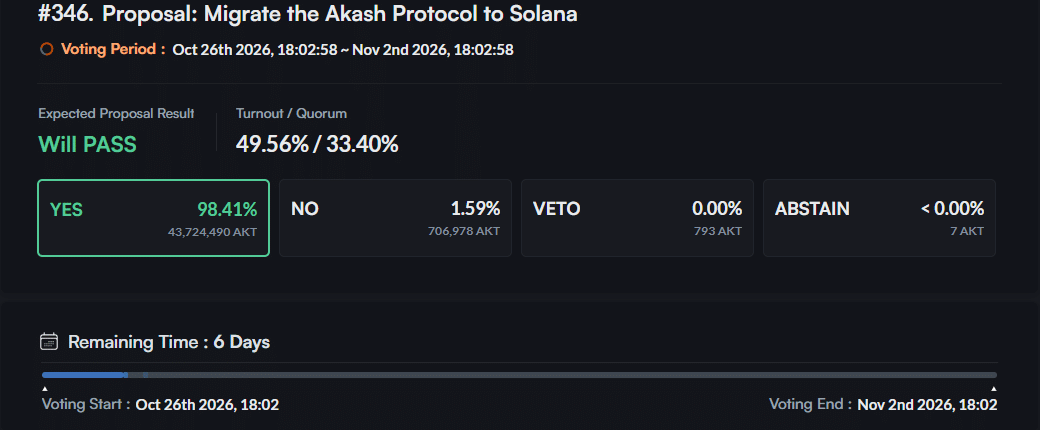
- Late October: The formal governance proposal was submitted to the Akash community. As of the latest reporting, the "Yes" vote commands a dominant 98.41% majority.
- November 2, 2026: The definitive deadline for voting. Should the current trend hold, this will mark the official greenlight for the development team to begin the implementation phase.
- Mid-November 2026: Official announcements regarding the marketplace cutover and the cessation of legacy staking rewards are scheduled to follow the vote’s ratification.
- Post-Vote Implementation: The protocol’s founder, Greg Osuri, has indicated that the actual migration of token assets is expected to begin within two weeks of the final vote count.
The Founder’s Perspective: Caution Amidst Consensus
Despite the overwhelming support from the community, Akash Network founder Greg Osuri has maintained a grounded stance. While the voting numbers suggest an near-unanimous mandate, Osuri has publicly acknowledged the inherent risks of such a migration.
In a statement released via social media, Osuri remarked: "There is still a small chance voters can change their decision, but it is unlikely." His tempered enthusiasm reflects a broader understanding of the complexity involved in moving a live, production-grade cloud protocol. The primary concern is not just the token migration, but the secondary votes required to finalize the marketplace cutover and the termination of staking rewards on the Cosmos chain.
For the Akash leadership, this is a "do-or-die" moment for efficiency. The reality of the current market is that managing one’s own sovereign chain incurs significant operational expenditure—resources that the team argues could be better spent on core product development and user acquisition if offloaded to a high-throughput chain like Solana.
Market Sentiment and Technical Analysis
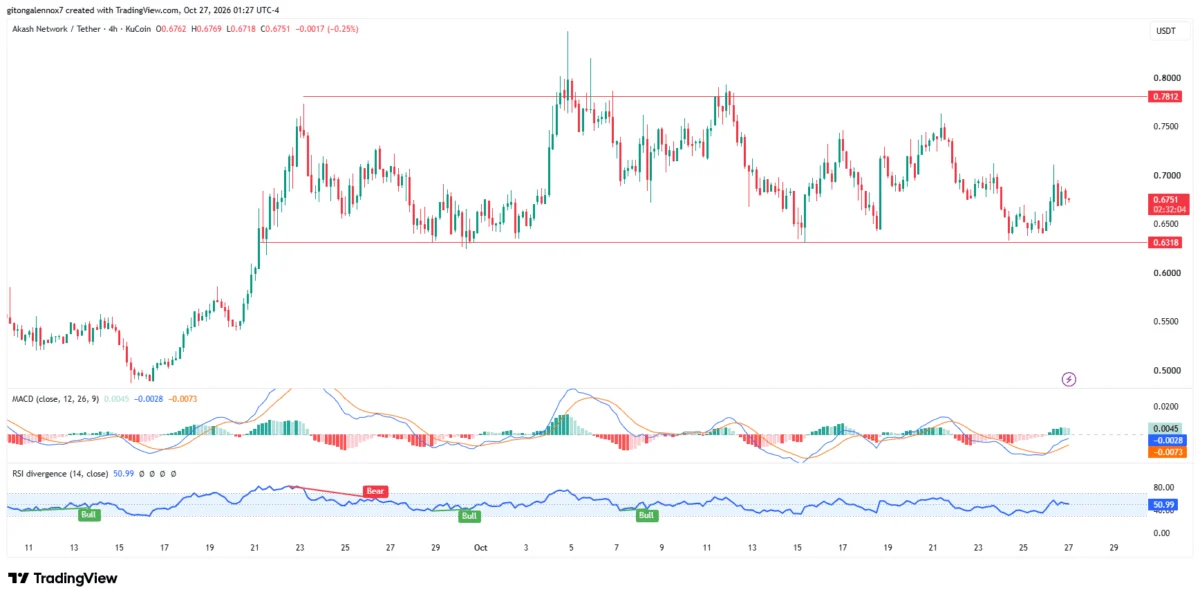
The market’s reaction to this news has been a study in consolidation. Despite the massive 315% spike in social media engagement, the price of AKT has remained confined within a horizontal trading channel between $0.63 and $0.78.
Current Market Indicators:
- Bullish Divergence: While price action has been stagnant, the Moving Average Convergence Divergence (MACD) indicator has flipped to green, suggesting that the recent four-day period of bearish pressure is beginning to dissipate.
- Derivative Data: Data from CoinGlass reveals that the Long/Short ratio for AKT remains elevated at 1.49, indicating that institutional and retail traders alike are positioning for a breakout.
- Support and Resistance: Traders are currently eyeing the $0.78 resistance level as the primary target. A successful breach, coupled with the finalization of the governance vote, could serve as a catalyst for a significant bullish leg up. Conversely, failure to maintain the $0.63 support level could lead to a retest of lower liquidity zones.
The sentiment among market participants is currently rated at 2.85 (Bullish), suggesting that while the immediate price action is cautious, the underlying confidence in the project’s future remains robust.
Implications for the DePIN Ecosystem
The migration of a project as significant as Akash to Solana signals a major shift in the DePIN (Decentralized Physical Infrastructure Network) landscape. It suggests that the "fragmentation of liquidity" is becoming a critical pain point for projects that choose to exist on their own sovereign chains.
1. The Cost of Sovereignty
For many years, the "Cosmos Thesis" was that every application should have its own blockchain. However, as the market matures, the cost of securing, maintaining, and attracting liquidity to a private chain is becoming prohibitive. Akash’s move suggests that "Chain Agnosticism" and the ability to leverage established ecosystems are becoming the new gold standard.
2. The Solana Magnet Effect
Solana’s ability to draw in massive projects is a testament to its technical performance and its aggressive strategy of becoming the "de facto" settlement layer for physical infrastructure. By joining this ecosystem, Akash is positioning itself to be more discoverable, more liquid, and more accessible to the average DeFi user who rarely leaves the Solana interface.
3. Governance as a Stress Test
The transition also serves as a massive stress test for decentralized governance. The ability to successfully migrate a multi-hundred-million-dollar asset from one blockchain to another without disrupting core services will, if successful, set a new benchmark for how blockchain protocols handle large-scale upgrades.
4. Future Outlook
As we look toward mid-November, the focus will shift from the "why" to the "how." The two-year migration window provides a safety net for users, but the market will likely react based on the speed at which the marketplace transition occurs. If the team can execute this migration without a significant service interruption, it could be the catalyst that propels AKT into a new era of growth.
The road ahead is fraught with technical hurdles, including the two independent audits required to ensure the security of the bridge. However, the overwhelmingly positive sentiment from the community and the clear, strategic vision provided by the leadership team suggest that Akash is ready to shed its legacy constraints and embrace a more liquid, high-velocity future on Solana. For investors, the next few weeks will be critical—not just for price action, but for the fundamental restructuring of one of the most promising cloud computing protocols in the blockchain space.