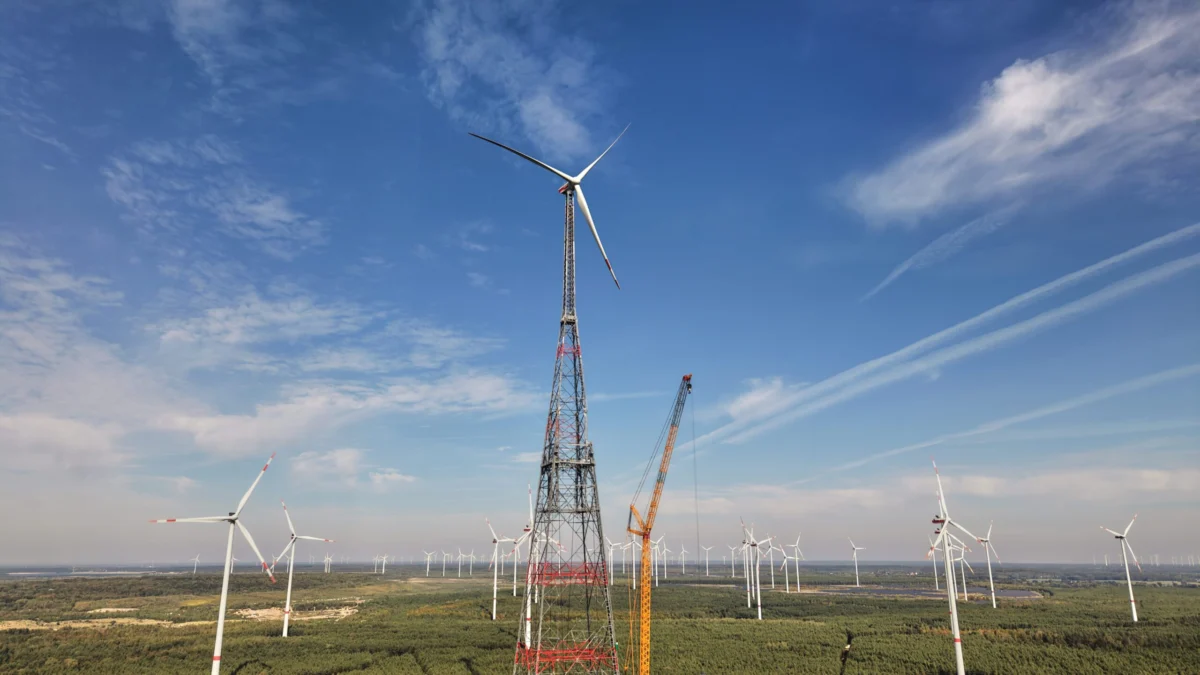
SCHIPKAU, Germany – In the heart of the Lusatia region, a landscape historically defined by the scars of industrial-scale lignite coal mining, a new silhouette has emerged that symbolizes the profound transformation of the European energy sector. Rising 365 meters (1,198 feet) into the sky, a prototype wind turbine has officially claimed the title of the world’s tallest, standing as a towering testament to engineering ambition and the relentless pursuit of energy independence.
The structure, which dwarfs the Eiffel Tower, is more than a mere curiosity of engineering; it is a strategic response to the physical limitations of current wind technology. As Germany accelerates its transition toward a carbon-neutral grid, this turbine, developed by the Dresden-based engineering firm Gicon, serves as a high-altitude laboratory for the future of global wind power.
The Engineering Marvel: Scaling New Heights
The statistics surrounding the Schipkau turbine are staggering. With a hub height of 300 meters (984 feet) and rotor blades that sweep the sky at a peak elevation of 365 meters, the turbine reaches heights previously reserved for skyscrapers and broadcast masts. To put this into perspective, the turbine is only three meters shorter than the Berlin Television Tower, which remains the tallest structure in Germany.
Unlike standard onshore wind turbines, which typically feature hub heights well under 200 meters, this prototype is designed to tap into the "boundary layer" of the atmosphere, where wind speeds are significantly higher and more consistent.
Jochen Grossmann, chief executive of Gicon, articulated the core philosophy behind the project during a press event on Thursday. "At 300 meters, we have access to such constant and strong wind that we can produce more than twice as much electrical energy as with the same facility at today’s heights," Grossmann explained. By positioning the rotor in the more stable, high-altitude airflow, the turbine minimizes the "intermittency problem" that has historically plagued wind energy, allowing for power generation during periods when lower-altitude turbines would remain idle.
A Chronology of Transformation: From Coal to Wind
The location of this engineering feat is no coincidence. Lusatia has served as a cornerstone of Germany’s energy production for decades, primarily through the extraction and combustion of lignite. However, the region has been at the forefront of the Energiewende—Germany’s long-term energy transition policy.
- Pre-2020s: The region’s landscape was dominated by open-pit coal mines and power plants, providing the backbone of German baseload electricity.
- 2023: Germany completed the controversial phase-out of its final nuclear power plants. This transition, accelerated by the energy security crisis triggered by the Russian invasion of Ukraine, created an urgent need for massive, reliable renewable capacity.
- Mid-2026: Construction reached its climax as the tower was finalized. The project was integrated into an existing wind farm, demonstrating how legacy industrial sites can be repurposed for green energy.
- October 2026: The turbine reached its full height, marking a major milestone for the Gicon engineering team.
- November 19, 2026 (Scheduled): The formal inauguration is set to take place, following the completion of complex internal electrical wiring and grid-integration testing.
The transition from coal to wind in Lusatia is not merely a change in technology; it is a socioeconomic pivot. Where once thousands of workers labored in mines, the renewable sector is now fostering a high-tech workforce capable of maintaining and optimizing these massive infrastructure projects.
Supporting Data: The Case for Altitude
The efficacy of the Gicon prototype is backed by significant data regarding atmospheric wind profiles. As one moves higher above the earth’s surface, the friction caused by trees, buildings, and uneven terrain decreases, leading to a "wind shear" profile that favors tall structures.
According to data from the Federal Statistical Office of Germany, renewables accounted for 59.1% of the country’s electricity production in the first half of 2026. Of that, wind energy—the nation’s largest single source—contributed 29.4%. However, the challenge for the German grid remains the storage and consistency of that power.
Gicon’s internal projections suggest that the Schipkau turbine could produce electricity for a significantly higher percentage of the year compared to its shorter counterparts. By extending the operational window, the turbine acts as a quasi-baseload power source, reducing the reliance on battery storage or natural gas peaker plants during lulls in wind activity.

Furthermore, the "two-story" wind farm concept proposed by Grossmann suggests that developers could install standard turbines at lower heights while utilizing these massive towers at the same location. This creates a vertical stacking effect, maximizing the energy density of a single plot of land—a critical factor in a densely populated nation like Germany, where land-use conflicts are common.
Implications for Global Energy Markets
The implications of the Schipkau prototype extend far beyond the borders of Germany. If the performance metrics from the upcoming winter months meet Gicon’s expectations, the industry may see a global shift toward "extra-tall" onshore wind.
1. Spatial Efficiency
In many European nations, land availability is the primary bottleneck for renewable energy expansion. By building up rather than out, developers can produce more energy on less land, reducing the environmental footprint and the aesthetic impact on local communities.
2. Supply Chain and Logistics
Building a 300-meter tower requires innovations in materials science and logistics. Transporting components for such a massive structure, as well as the specialized cranes required to assemble them, presents a logistical challenge that will likely drive innovation in modular tower construction and on-site assembly techniques.
3. Energy Security
The volatility of global fossil fuel markets has taught Germany and its European neighbors that energy sovereignty is a matter of national security. Projects like the Gicon turbine demonstrate that renewables can be scaled to meet industrial demands, potentially lowering the cost of energy and stabilizing electricity prices for manufacturers.
Official Responses and Future Outlook
While the project has been largely celebrated as a triumph of German engineering, it has also sparked discussions about the future of the energy landscape. The government’s mandate to end coal-fired power generation by 2038 remains the North Star for the region’s development.
Critics of the Energiewende have pointed to the high costs associated with such prototypes. However, proponents, including industry analysts, argue that the "first-of-a-kind" costs are necessary to drive down the long-term price of green energy. Gicon has already begun planning a full-scale wind farm consisting of three to five of these extra-tall turbines, pending the final data analysis from the prototype.
"This is not just about height for the sake of records," a representative from the German Renewable Energy Federation noted. "This is about the physics of the atmosphere. If we can capture the consistent, high-velocity winds that exist above the turbulence of the ground, we change the entire economic model of onshore wind."
As the inauguration date of November 19 approaches, the eyes of the global energy industry are firmly fixed on Schipkau. The turbine stands as a silent sentinel over a changing landscape—a monument to the reality that if the world is to meet its climate goals, it must be willing to reach, quite literally, to new heights.
Whether this prototype becomes the template for the next generation of global wind power remains to be seen, but the message from Lusatia is clear: the energy transition is moving upward, and the sky is no longer the limit—it is the destination.