TIRANA, Albania – October 27, 2026 – A heated confrontation has erupted between the Albanian government and a burgeoning student protest movement, with Prime Minister Edi Rama himself becoming embroiled in a public dispute. A 20-year-old medical student, Jon Sinoimeri, has become the focal point of a public smear campaign allegedly orchestrated by the Prime Minister, who has accused the student of having a criminal record and engaging in drug trafficking. This accusation, made during a period of significant student unrest regarding the quality and accessibility of medical education, has drawn widespread condemnation from civil society, legal experts, and the students themselves.
The controversy ignited on Friday, when Prime Minister Rama, addressing the nation, presented a list of 45 individuals he claimed were not genuine students but rather individuals with criminal pasts who had been involved in violence during recent protests, masquerading as students. Among those named was Jon Sinoimeri. Rama displayed a photograph of the young student, with his eyes obscured by a black bar, stating, "We continue with J.S.: 20 years old, but not a student, production and sale of narcotics, registered criminal record."
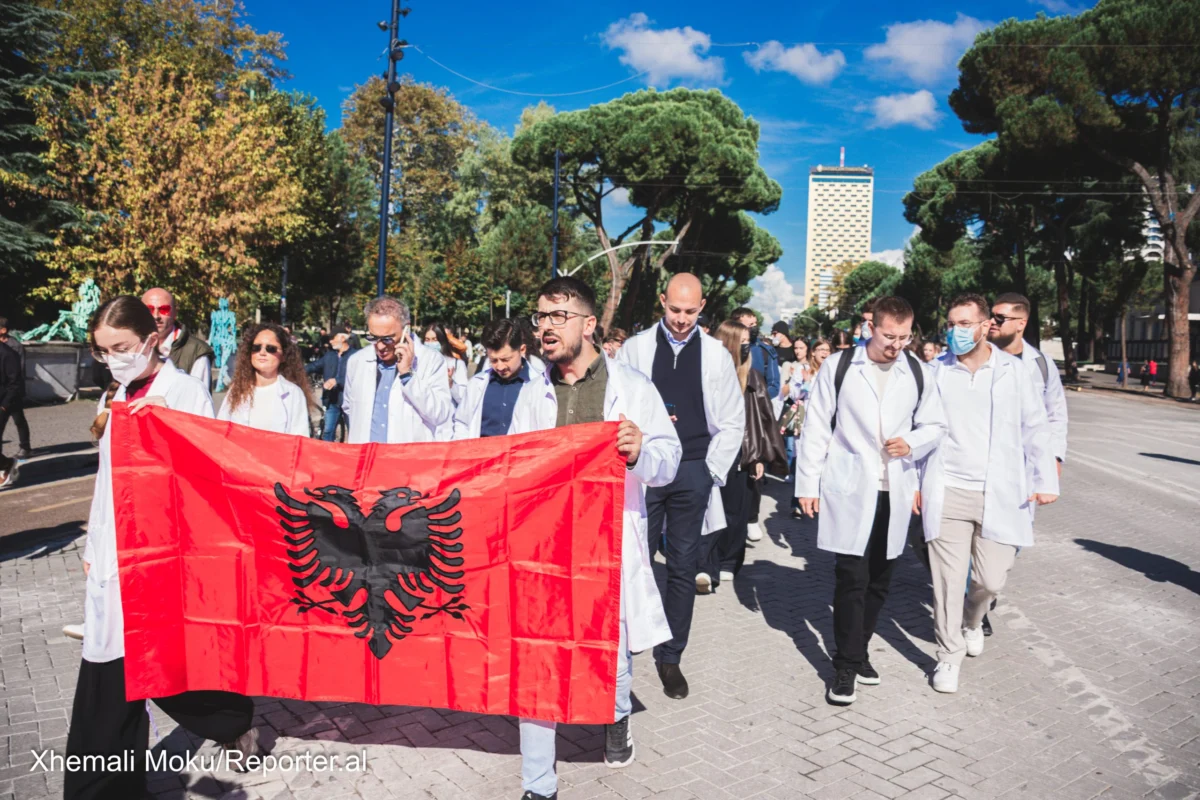
This public denouncement has been vehemently denied by Sinoimeri, who is an acclaimed medical student with a perfect academic record. Speaking from the protest line, where hundreds of medical students and faculty marched towards the Ministry of Education, Sinoimeri directly refuted the Prime Minister’s allegations. "Mr. Prime Minister has come out today and accused me of producing and selling narcotics, but I am a medical student. I have it written here, and I know what legends he invents," Sinoimeri told reporters, presenting his academic transcript which reportedly shows a perfect grade average of 10. He further characterized the Prime Minister’s actions as the "last efforts of a dictator."
Sinoimeri also revealed that his first encounter with the police was on October 13th, when he was detained during a protest and held at the police station for seven and a half hours. He expressed a profound lack of faith in the institutions to address his grievances regarding the baseless public accusations.
The Prime Minister’s office, when pressed for evidence to substantiate these serious allegations, declined to provide specific proof, instead referring to the Prime Minister’s public statement as sufficient "evidence." Manjola Hasa, Director of the Agency for Media and Information, stated to BIRN, "The Prime Minister said the evidence in his speech."
This incident is not an isolated occurrence. Prime Minister Rama has a documented history of employing public defamation strategies against protesters. Similar tactics were employed in June of this year, during the peak of peaceful protests initiated in opposition to a tourism project in the protected area of Zvërnec. The public exposure of protesters’ photographs and accusations of criminal offenses against them has consistently drawn sharp criticism from civil society organizations, who deem such actions as illegal and a violation of fundamental rights.
The Escalation of Public Accusations: A Pattern of Behavior
The current situation represents a concerning pattern of behavior by Prime Minister Rama, who has increasingly resorted to public vilification of dissenters. Civil society actors argue that this strategy not only undermines the democratic process but also poses a direct threat to the presumption of innocence, a cornerstone of any justice system.
Journalist Mentor Kikia, in a strong public reaction on Facebook, stated, "Even when the police arrest suspects for crimes, even for murder, they are prohibited from exposing their photos, because until a final court decision, he/she is presumed innocent." Kikia unequivocally labeled Rama’s actions as a criminal act, delivered through a public statement.
Echoing this sentiment, Afrim Krasniqi, Director of the Institute for Political Studies, also characterized the Prime Minister’s actions as a criminal offense on Facebook. Krasniqi pointed out the irony that Rama, who himself has nominated and seen individuals with past convictions elected to Parliament and local government positions, now employs such tactics against citizens protesting corruption.
"Today, he made a synoptic board/lightning flyer and public trial against citizens who protested against corruption, among them this young man: imagine the life of a 20-year-old student, an excellence in medicine, and the Prime Minister of his country denigrates him with untruths live on all TVs, while government militants continue the denigration on portals and online media," Krasniqi wrote. He urged independent institutions, human rights commissioners, and the Special Prosecution Office (SPAK) to launch serious investigations into such acts.
Chronology of Events: From Protest to Public Denouncement
The current crisis can be traced back to a series of student-led protests that have gained momentum in recent weeks. These demonstrations are primarily focused on perceived shortcomings in the Albanian healthcare system and the quality of medical education. Students have voiced concerns about inadequate resources, outdated curricula, and a lack of opportunities for practical training and specialization.
Early October 2026: Student dissatisfaction begins to coalesce into organized protests. Initial demonstrations are largely peaceful, focusing on academic and systemic issues within the Faculty of Medicine.
October 13, 2026: Jon Sinoimeri is detained by police during one of these protests. He reports being held for over seven hours. This incident appears to be a pivotal moment, marking his first direct interaction with law enforcement in the context of the protests.
Mid-October 2026: The protests escalate in scale and visibility, drawing larger crowds and attracting media attention. Student demands become more vocal, and the scope of their grievances expands to encompass broader concerns about healthcare policy.
October 25, 2026 (Friday): Prime Minister Edi Rama holds a press conference where he unveils a list of 45 individuals he claims are not genuine students but are involved in criminal activities. He specifically targets Jon Sinoimeri, publicly accusing him of drug trafficking and possessing a criminal record. A photograph of Sinoimeri, with his eyes obscured, is presented.
October 25, 2026 (Friday): In response to the Prime Minister’s accusations, Jon Sinoimeri, participating in a large protest march by medical students and faculty towards the Ministry of Education, vehemently denies the allegations. He presents his academic achievements and labels the Prime Minister’s statements as fabricated.
October 26, 2026: Civil society leaders, journalists, and academics begin issuing strong condemnations of the Prime Minister’s actions, labeling them as defamation and a violation of legal principles. Calls for official investigations into the Prime Minister’s conduct emerge.
October 27, 2026: The Prime Minister’s office reiterates its stance, considering the Prime Minister’s speech as sufficient evidence and refusing to provide further substantiation for the accusations.
Supporting Data: The Academic Standing of Jon Sinoimeri
The contrast between Prime Minister Rama’s allegations and Jon Sinoimeri’s documented academic achievements is stark. Sinoimeri is not merely a student; he is reportedly an exceptional student, a fact that amplifies the perceived injustice of the Prime Minister’s public attack.
- Age: 20 years old.
- Academic Institution: Faculty of Medicine, University of Tirana.
- Academic Performance: Reportedly maintains a perfect grade point average of 10.0, signifying excellence in his studies.
- Student Status: Actively participating in student protests, a common right in democratic societies.
- Criminal Record Claim: Publicly accused by Prime Minister Rama of drug trafficking and having a registered criminal record.
- Sinoimeri’s Denial: Vehemently denies all accusations, presenting his academic records as evidence of his commitment to his studies and integrity.
- Police Interaction: States his first encounter with police was during a protest, leading to a 7.5-hour detention.
The presentation of Sinoimeri’s academic credentials by himself and his supporters serves as a direct counterpoint to the Prime Minister’s claims, raising serious questions about the veracity and motivation behind the accusations. The absence of any publicly available, verifiable evidence to support the Prime Minister’s claims further fuels skepticism.
Official Responses and Lack of Substantiation
The official response from the Prime Minister’s office has been characterized by a reliance on the Prime Minister’s own pronouncements as evidence. This approach has been widely criticized as a dismissal of due process and a disregard for the principles of transparency and accountability.
- Prime Minister Edi Rama: Accused Jon Sinoimeri and 44 other individuals of being non-students with criminal records, involved in violence during protests. Presented a photograph of Sinoimeri with his eyes obscured.
- Prime Minister’s Office: When asked for proof of the accusations, the office stated that the Prime Minister’s public address constituted sufficient "evidence." Manjola Hasa, Director of the Agency for Media and Information, confirmed this position to BIRN.
- Student Jon Sinoimeri: Categorically denied all accusations, presented his academic record showing a perfect average, and labeled the Prime Minister’s statements as fabrications and "legends."
- Civil Society and Legal Experts: Have widely condemned the Prime Minister’s actions as defamation, a violation of the presumption of innocence, and a criminal act. They have called for independent investigations by relevant authorities.
- Ministry of Education: Has yet to issue a formal statement addressing the specific accusations against Sinoimeri or the broader concerns raised by the medical student protests.
The lack of tangible evidence presented by the Prime Minister’s office, coupled with the strong denials from the accused student and the chorus of criticism from various sectors, paints a picture of a government potentially overstepping its authority and engaging in tactics that undermine public trust.
Implications and Broader Concerns
The defamation of Jon Sinoimeri and the broader use of public smear tactics by Prime Minister Rama carry significant implications for Albanian democracy, freedom of expression, and the rule of law.
- Chilling Effect on Dissent: Publicly targeting and discrediting protesters, especially young individuals, can create a chilling effect, discouraging others from voicing their concerns and participating in legitimate forms of protest. This is particularly concerning in a country where student activism has historically played a crucial role in demanding social and political change.
- Erosion of Trust in Institutions: When the highest office in the land engages in what are perceived as baseless accusations and potentially illegal defamation, it erodes public trust in governmental institutions, including the judiciary and law enforcement. This can lead to increased cynicism and disengagement from civic life.
- Undermining the Presumption of Innocence: The principle that an individual is innocent until proven guilty is a fundamental tenet of any democratic legal system. By publicly labeling individuals as criminals without due process or verifiable evidence, the Prime Minister appears to be disregarding this crucial safeguard. This sets a dangerous precedent and can lead to a climate of impunity for those in power.
- Weaponization of Information: The use of social media and public platforms to disseminate potentially false or misleading information against political opponents or dissenters can be seen as a form of information warfare. This tactic can be used to manipulate public opinion and discredit legitimate grievances.
- Impact on Student Aspirations: The targeting of a high-achieving medical student like Jon Sinoimeri sends a discouraging message to aspiring professionals and students across the country. It suggests that academic merit and dedication may be overshadowed by political maneuvering and public attacks, potentially impacting the morale and future aspirations of young Albanians.
- Call for Accountability: The strong reactions from civil society and legal experts highlight a growing demand for accountability for the Prime Minister’s actions. The calls for investigations by independent bodies like SPAK underscore the seriousness with which these alleged abuses of power are being viewed. The outcome of such investigations will be crucial in determining the future trajectory of political discourse and the protection of civil liberties in Albania.
The situation involving Jon Sinoimeri and the wider student protests serves as a critical juncture for Albania. It raises profound questions about the boundaries of political discourse, the responsibility of public officials, and the fundamental rights of citizens to express dissent without fear of reprisal or defamation. The international community, as well as domestic observers, will be closely watching how these developments unfold and whether Albania upholds its commitments to democratic principles and the rule of law.