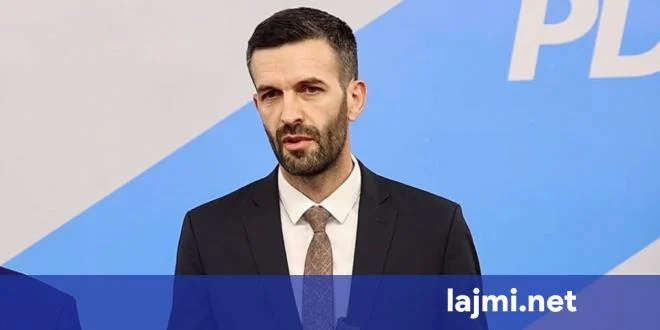
Pristina, Kosovo – A recent social media post by Eman Rrahmani, a Member of Parliament from the opposition Democratic Party of Kosovo (PDK), has ignited a fresh round of political and societal debate, employing sharp irony to criticize Prime Minister Albin Kurti and his government’s handling of the proposed Civil Code and associated draft laws. Rrahmani’s pointed remarks specifically target legislative initiatives pertaining to marriage, birth, and gender identity, framing them as a hurried attempt by the Kurti administration to introduce what he perceives as radical social reforms.
The controversy underscores a significant ideological divide within Kosovo’s political landscape, pitting traditional conservative values against a more progressive, internationally aligned legislative agenda. Rrahmani’s post, widely circulated, has not only drawn attention to specific legislative proposals but has also highlighted the often-charged rhetoric that characterizes political discourse in the young Balkan nation.
The Core of the Contention: Civil Code and Controversial Draft Laws
At the heart of MP Rrahmani’s satirical attack lies the long-awaited Civil Code and a series of accompanying draft laws. While a comprehensive Civil Code is a fundamental piece of legislation for any modern state, establishing the legal framework for personal status, property, and obligations, certain provisions, particularly those touching upon family law and individual rights, have historically proven contentious in Kosovo. Rrahmani’s recent comments specifically zeroed in on articles related to the definition of marriage, the legal recognition of diverse family structures, and provisions for gender identity changes.
His social media message, delivered with a tone of mock admiration for Prime Minister Kurti, suggested that these legislative changes are being fast-tracked to appease a specific, unnamed constituency, which he sarcastically referred to as "Albin’s beloved ones." This thinly veiled allusion is widely interpreted as a dismissive reference to LGBTQ+ communities and other progressive groups advocating for broader rights and recognition.
Rrahmani’s strategy is clear: to link the government’s legislative agenda to highly sensitive social issues, thereby mobilizing conservative segments of the population against the proposed laws and, by extension, against the Kurti government. The irony in his statements serves to amplify his message, transforming complex legal discussions into emotionally charged cultural battles.
Rrahmani’s Ironic Timeline
In his post, Rrahmani laid out a sarcastic timeline for the purported introduction of these contentious laws to the government, implying a rushed and politically motivated process:
- November 15: "For those of you who wish to marry men with men and women with women, he is bringing the Civil Code to the Government on November 15." This statement directly targets the potential inclusion of same-sex civil partnerships within the Civil Code, a provision that has previously stalled the code’s passage. Rrahmani’s framing deliberately simplifies and sensationalizes the issue, invoking traditional definitions of marriage to provoke a strong reaction from conservative elements.
- December 30: "For those of you waiting for women to give birth without men, he is bringing the law to the Government on December 30." This remark appears to be a sarcastic jab at laws or policies that might facilitate non-traditional family formations, such as single-parent adoption, surrogacy, or assisted reproductive technologies that do not necessarily involve a male partner in the traditional sense. It plays into anxieties about the erosion of conventional family structures.
- December 31 (New Year’s Eve): "And for those of you waiting to change your gender, he will honor you on New Year’s Eve! He is bringing the law to the Government on December 31." This final barb addresses potential legislation allowing for legal gender recognition based on self-determination, a policy advocated by human rights organizations but often met with resistance in more conservative societies. By associating it with New Year’s Eve, Rrahmani implies a celebratory, yet perhaps frivolous or even sinister, rush to implement such a "gift."
Rrahmani concluded his post with a final sarcastic flourish, "As someone else would say: ‘Thank God we have you, Albin!’" This closing line reinforces the cynical tone, suggesting that Kurti is either misguidedly or intentionally pursuing an agenda that Rrahmani and his political allies view as detrimental to Kosovan society.
Chronology of Legislative Efforts and Political Pushback
The debate surrounding Kosovo’s Civil Code is not new; it has been a protracted legislative saga spanning several years and multiple governments. The development of a comprehensive Civil Code is a crucial undertaking for Kosovo, essential for harmonizing its legal system with European standards and strengthening the rule of law. However, its passage has repeatedly been hampered by disagreements over specific articles, particularly those concerning family law and LGBTQ+ rights.
The draft Civil Code was initially submitted to the Assembly of Kosovo in 2020 by the previous government. Even then, it faced significant opposition. The most contentious aspect revolved around Article 1137, which in one iteration sought to recognize civil unions for same-sex couples. This article sparked a furious backlash from conservative politicians, religious leaders, and civil society groups, who argued it was an affront to traditional family values enshrined in the Kosovan Constitution. The Constitution of Kosovo defines marriage as a union between a man and a woman, a clause that many interpret as a direct prohibition of same-sex marriage. However, proponents of civil unions argue that this does not preclude the recognition of other forms of partnership that afford legal rights to same-sex couples without redefining marriage itself.
In April 2022, during the Kurti government’s tenure, the draft Civil Code was again brought before the Assembly. The government had attempted to address concerns by separating the controversial article on civil unions into a separate draft law, hoping to allow the main body of the Civil Code to pass. Despite this maneuver, the Code still failed to garner enough votes for adoption. Many MPs, particularly from opposition parties like PDK and AAK (Alliance for the Future of Kosovo), either voted against it or abstained, citing the underlying implications for family values, even if the explicit provision for same-sex unions was removed from the main text. The failure to pass the Civil Code was a significant setback for the Kurti government, highlighting the deeply entrenched social conservatism that permeates Kosovan politics.
The repeated stalling of the Civil Code illustrates the difficulty of balancing international human rights norms with deeply held national and religious traditions in Kosovo. The European Union and various international bodies have consistently urged Kosovo to align its legislation with European human rights standards, which include protections and rights for LGBTQ+ individuals. However, domestic political realities and strong societal resistance often create an impasse.
Supporting Data and Broader Societal Context
Kosovo is a predominantly Muslim-majority country, though constitutionally secular, where traditional and conservative values regarding family, marriage, and gender roles are deeply ingrained. Public opinion polls consistently show low levels of support for LGBTQ+ rights, particularly same-sex marriage. For instance, surveys by organizations like the National Democratic Institute (NDI) and local NGOs have indicated that a significant majority of Kosovars do not support same-sex marriage, reflecting a strong adherence to traditional norms.
The Constitution of Kosovo, adopted in 2008, states in Article 37, Paragraph 1: "Everyone has the right to marry and the right to create a family in accordance with the law." Paragraph 2 specifies: "Marriage is regulated by law. Marriage can be entered into between two persons of different sexes." This constitutional phrasing is a key point of contention. While it defines marriage as between "two persons of different sexes," it doesn’t explicitly prohibit other forms of civil partnerships or unions for same-sex couples. However, conservative interpretations often view it as a de facto ban on any form of legal recognition for same-sex relationships.
International human rights organizations, including the Council of Europe and various EU bodies, have repeatedly called on Kosovo to strengthen its legal framework to protect LGBTQ+ rights and ensure non-discrimination. The European Parliament, in its annual reports on Kosovo, often includes recommendations for progress in this area as part of the broader EU integration process. Kosovo’s aspiration to join the European Union means it must gradually align its legal system and societal norms with the acquis communautaire, which includes strong protections for human rights and equality, regardless of sexual orientation or gender identity.
The social and political climate in Kosovo is therefore a complex interplay of internal traditionalism and external pressure for progressive reforms. This dynamic often leads to heated debates, with politicians like Eman Rrahmani strategically leveraging public sentiment on conservative issues to gain political traction against the ruling party.
Official Responses and Political Divide
Following Rrahmani’s provocative post, direct official responses from Prime Minister Kurti or his government have been notably absent in the immediate aftermath, at least as reported by the initial news article. This lack of direct engagement is often a deliberate tactic by governments to avoid legitimizing or amplifying what they perceive as politically motivated attacks or sensationalist rhetoric. Engaging directly with Rrahmani’s sarcastic tone could be seen as falling into an opposition trap, diverting attention from the substantive aspects of the legislative process.
However, the ruling Vetëvendosje (Self-Determination) party, led by Kurti, generally adopts a more progressive stance on human rights and social issues compared to the PDK. While they may not openly champion same-sex marriage due to political expediency and constitutional constraints, they have historically shown more willingness to discuss and explore avenues for legal recognition of LGBTQ+ rights, often citing Kosovo’s international obligations and its path towards EU integration. The party’s legislative agenda, including the Civil Code, is often framed as modernizing Kosovo’s legal framework and bringing it closer to European standards.
The PDK, on the other hand, positioning itself as a defender of traditional values and national identity, frequently criticizes the Kurti government for what it perceives as an imposition of foreign or "un-Kosovan" agendas. Rrahmani’s remarks are a classic example of this strategy, aiming to paint the government as out of touch with the majority of the population and as prioritizing niche progressive issues over more pressing national concerns. This rhetorical approach allows the opposition to rally support among religiously conservative and traditionalist segments of the electorate.
Other political parties, such as the Democratic League of Kosovo (LDK) and the Alliance for the Future of Kosovo (AAK), often find themselves in a similar position to PDK, wary of supporting legislation that might be perceived as undermining traditional family values. Civil society organizations, however, are deeply divided. While LGBTQ+ advocacy groups and human rights defenders strongly condemn Rrahmani’s rhetoric as discriminatory and hateful, conservative civil society groups and religious organizations often echo his sentiments, expressing concern over the potential changes to family law.
Implications for Kosovo’s Political Landscape and European Aspirations
The ongoing debate, intensified by Rrahmani’s comments, carries significant implications for Kosovo’s political landscape and its international standing. Internally, it deepens the ideological chasm between the ruling Vetëvendosje party and the opposition, particularly the PDK. This polarization makes consensus-building on critical legislative reforms, such as the Civil Code, exceedingly difficult. The government faces the perennial challenge of navigating between its commitment to modernize the legal system and its need to maintain public support in a society that remains largely conservative on social issues.
The inability to pass a comprehensive Civil Code has broader ramifications. It leaves gaps in Kosovo’s legal framework, potentially hindering economic development and legal certainty. A modern Civil Code is crucial for property rights, commercial transactions, and personal status, all of which are foundational for a well-functioning state and economy.
From an international perspective, the debate impacts Kosovo’s aspirations for European integration. Persistent delays and controversies surrounding human rights legislation, particularly those related to LGBTQ+ equality, are viewed critically by the European Union. While Kosovo has made strides in many areas, its progress on human rights and rule of law is continuously monitored. The perceived reluctance to adopt legislation aligning with European human rights standards can impede its journey towards EU membership, affecting its credibility and the pace of its accession process.
Furthermore, the nature of the political discourse itself is significant. The use of ironic and potentially inflammatory language, as employed by Rrahmani, risks normalizing discriminatory rhetoric and fueling societal divisions. While freedom of speech is a fundamental right, political leaders bear a responsibility to engage in respectful and constructive debate, particularly on sensitive social issues that affect vulnerable communities.
Conclusion: A Battle of Ideologies
Eman Rrahmani’s satirical post is more than just a political jab; it is a calculated move in a larger ideological battle being waged in Kosovo. It brings to the forefront the deep-seated tensions between traditional values and modern progressive ideals, a conflict amplified by Kosovo’s unique historical context and its ambitions for European integration.
The Civil Code, intended to be a cornerstone of Kosovo’s legal system, has instead become a battleground for competing visions of the nation’s future. The government, under Prime Minister Kurti, is tasked with the delicate balancing act of pushing forward with reforms that align with international standards while navigating the strong currents of domestic conservatism. The opposition, epitomized by Rrahmani’s recent actions, seeks to capitalize on these divisions, leveraging social issues to undermine the government’s legitimacy.
As Kosovo continues its journey as a young democracy, the manner in which these debates are conducted, and ultimately resolved, will define not only its legislative framework but also its societal character and its standing on the international stage. The fate of the Civil Code and the associated draft laws remains uncertain, but one thing is clear: the conversation around marriage, birth, and gender identity will continue to be a potent and often divisive force in Kosovan politics for the foreseeable future.