The financial markets are currently locked in a delicate dance between robust labor data and the looming shadow of Federal Reserve policy. As of late October 2026, Coinbase (COIN) stock has been hovering near the $167 mark, serving as a bellwether for the broader digital asset sector. Investors are scrutinizing the latest U.S. employment figures to gauge whether the economy is overheating or settling into a sustainable "soft landing," all while preparing for the pivotal Federal Open Market Committee (FOMC) meeting scheduled for October 28.
Main Facts: The Labor Market’s Surprising Vitality
The latest report from the U.S. Labor Department has provided a significant talking point for market analysts. Initial jobless claims—a proxy for layoffs and corporate health—dropped to 194,000 for the most recent reporting period. This figure significantly outperformed market expectations, which had pegged claims at approximately 200,000.
The decline of 6,000 applications from the previous week’s revised data underscores a critical narrative: employers remain remarkably reluctant to trim their payrolls despite a high-interest-rate environment. This resilience in the labor market is a double-edged sword for investors. While it signals a healthy underlying economy that supports consumer spending and, by extension, corporate earnings, it also complicates the Federal Reserve’s mandate to cool inflation.

Chronology of Market Sentiment
The path to the current market position has been characterized by a transition from inflationary panic to a focus on structural stability.
- Early October: Markets began pricing in a "higher for longer" interest rate environment, causing volatility in tech-heavy stocks like Coinbase.
- Mid-October: As geopolitical tensions in the Middle East sparked fears of supply chain disruptions, Bitcoin and other major digital assets saw fluctuations. Bitcoin found a baseline around $81,100, while Ethereum and XRP maintained support levels near $2,376 and $1.31, respectively.
- The Current Week: The release of the 194,000 jobless claims figure acted as a catalyst. Markets reacted with cautious optimism, viewing the lack of layoffs as a sign that a recession is not imminent.
- Upcoming Milestone: All eyes are now turned toward October 28, the date of the next FOMC policy announcement.
Supporting Data: The Employment Dichotomy
While the initial jobless claims suggest a vibrant hiring market, the internal data reveals a more nuanced picture of the American workforce.
The four-week moving average, which serves to smooth out the inherent volatility of weekly data, currently sits at 197,750. This confirms that the labor market is historically tight. However, a deeper dive into the report reveals that continuing claims—the number of people who have been filing for benefits for more than one week—rose by 25,000 to reach 1.728 million.

This divergence is noteworthy. Economists interpret the increase in continuing claims as a signal of "re-employment friction." While companies are not firing people, they are also not hiring at the rate necessary to absorb those who have lost their jobs. This suggests that while the economy is not in a freefall, it is beginning to show the strain of persistent, elevated interest rates. For the crypto sector, this is a signal to remain cautious: the market wants low inflation, but it also needs a labor market healthy enough to support speculative investment.
The Federal Reserve and the FOMC Outlook
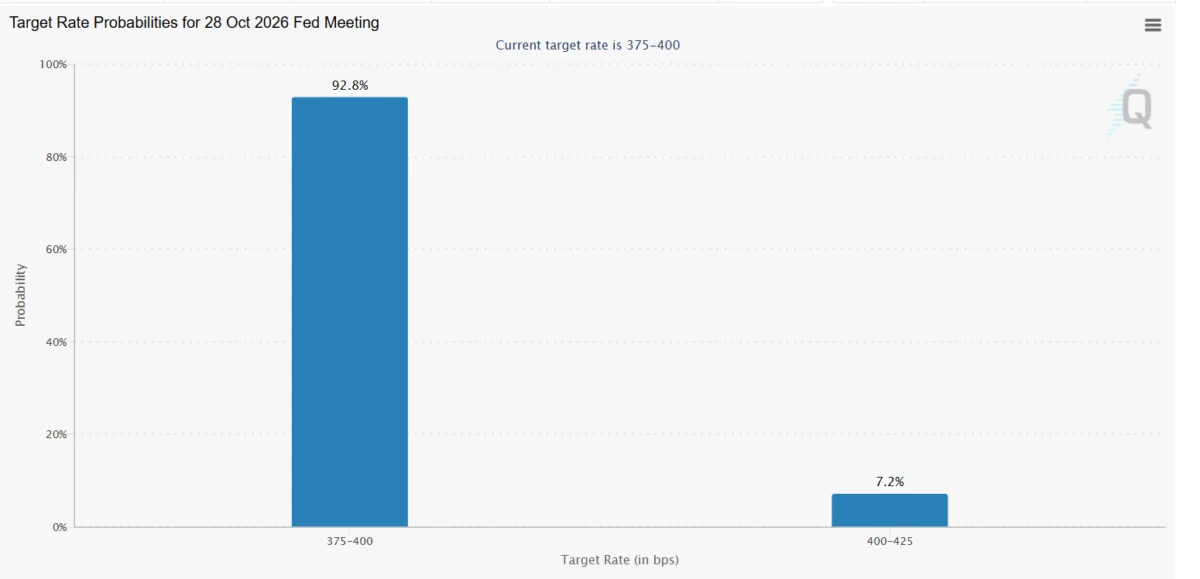
The Federal Open Market Committee is currently the primary arbiter of market direction. According to the latest CME FedWatch data, the probability of the Fed maintaining the current target range of 3.75% to 4.00% is an overwhelming 92.8%.
The market has essentially baked in a "no-action" scenario. There is only a 7.2% probability of a 25-basis-point hike to the 4.00%–4.25% range, and virtually zero probability of a rate cut. This consensus suggests that the Federal Reserve is comfortable with the current trajectory of the economy. Chair Jerome Powell and his colleagues are likely waiting for further evidence that inflation is sustainably tracking toward their 2% target before signaling any shift in policy.

The implication for investors is clear: the era of "easy money" is over, and the market is entering a phase of adaptation. Stocks that are highly sensitive to liquidity, such as COIN, will likely continue to trade based on the Fed’s verbal cues regarding the duration of this restrictive cycle.
COIN Stock Price Forecast: Technical Analysis
From a technical perspective, Coinbase (COIN) is currently navigating a period of bearish pressure. Having broken below its daily opening level, the stock is testing the integrity of the $167 support zone.
The Bearish Case
If the stock fails to hold the $166.82 support level, the technical outlook suggests a potential slide toward the $165 round-number support. Should that fail to provide a floor, the next major psychological level for traders to watch is $160. A breach of these levels would indicate that sellers are in firm control, potentially driven by a broader pullback in the crypto market if Bitcoin fails to maintain its $81,000 footing.

The Bullish Case
Conversely, a recovery hinges on the stock reclaiming the opening level and pushing past the $170.25 resistance barrier. Should the bulls regain momentum, the immediate target is $173.64. A clean break above this resistance, ideally accompanied by high trading volume, could signal a trend reversal.
The volatility in COIN is highly correlated with the broader crypto market. If Bitcoin continues to hold its position despite the geopolitical and macroeconomic headwinds, it provides a "safety net" for Coinbase, as increased trading volume in digital assets directly impacts the exchange’s revenue streams.
Implications for the Broader Crypto Ecosystem
The current economic environment presents a unique set of implications for the crypto industry:

- Macro-Correlation: We are witnessing an era where Bitcoin and other assets are moving in tandem with traditional equities. The days of "decoupling" appear to be on hold as institutional investors use crypto as a high-beta proxy for the broader tech sector.
- Institutional Sentiment: The resilience of the labor market is, paradoxically, both good and bad for crypto. A strong economy keeps the "risk-on" appetite alive, but it keeps the Fed hawkish. If the Fed stays hawkish for too long, the cost of capital remains high, potentially limiting the upside for speculative assets.
- The "Hold" Strategy: Given the 92.8% probability of a rate hold, the market is effectively waiting for a catalyst. For crypto to reach new highs, it will likely need either a shift in Fed rhetoric toward future cuts or a major breakthrough in institutional adoption that is independent of macro trends.
Conclusion: Preparing for the November Pivot
As the market approaches the end of October, the prevailing mood is one of watchful waiting. The 194,000 jobless claims figure has provided the necessary reassurance that the U.S. economy remains functional, preventing a panic-driven sell-off.
Investors holding COIN stock, as well as those invested in Bitcoin, Ethereum, and XRP, must remain cognizant of the fact that the next two weeks will be defined by the FOMC’s communication. While technical levels offer a roadmap for short-term trading, the fundamental direction of the market will be set in the conference room of the Federal Reserve.
Investors should monitor the volume levels on the next move above $170 for COIN; if it lacks conviction, the bearish pressure may persist. Regardless of the short-term noise, the underlying strength of the labor market remains the most significant indicator that the U.S. economy is currently navigating a soft landing, which—in the long term—is a constructive foundation for all asset classes, including digital assets.