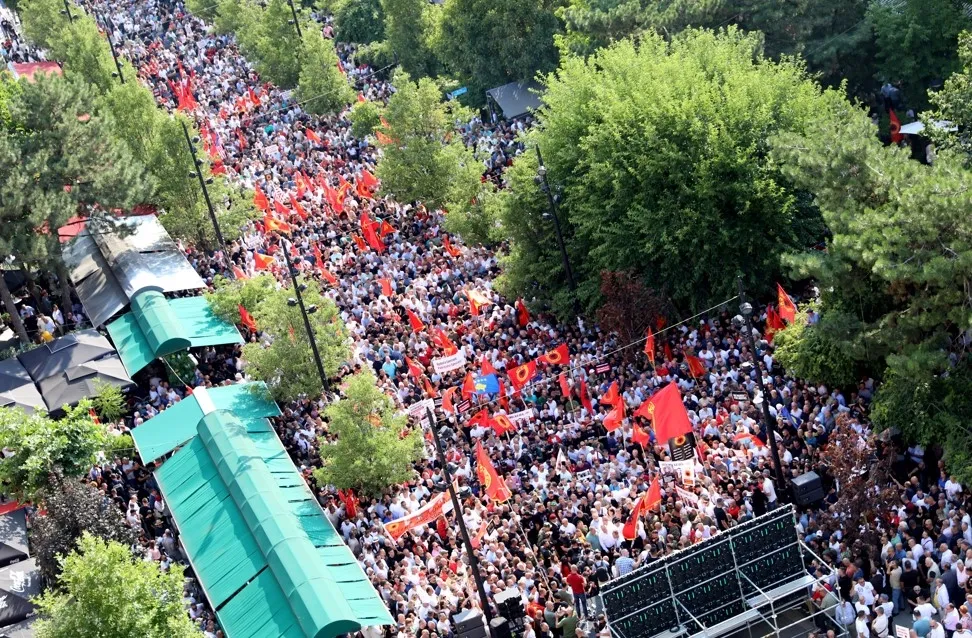
Pristina, Kosovo – October 1, 2026 – A wave of popular discontent crested in Pristina today as thousands gathered in a nationwide protest to vehemently oppose the recent verdict by the Kosovo Specialist Chambers (KSC), which found four prominent former leaders of the Kosovo Liberation Army (KLA) guilty of war crimes and crimes against humanity. The demonstration, called for 4:00 PM local time, is the latest and most significant expression of public outrage following the highly anticipated – and for many, deeply controversial – judgment.
Organized by the platform "Liria ka Emër" (Freedom Has a Name), the protest converged on the iconic Skanderbeg Square, transforming the heart of the capital into a sea of national flags and banners proclaiming support for the convicted KLA figures. The organizers, speaking at a press conference on Wednesday, had issued a fervent call for massive participation, underscoring the profound emotional and political resonance of the court’s decision across Kosovar society.
The KSC, an internationally staffed court operating under Kosovo law, had delivered a verdict that reverberated throughout the region. Former President Hashim Thaçi and former Speaker of Parliament Jakup Krasniqi were each sentenced to 25 years in prison, while former Speaker Kadri Veseli received an 18-year sentence, and former head of the KLA parliamentary group Rexhep Selimi was sentenced to 13 years. The charges centered on alleged war crimes and crimes against humanity, including persecution, imprisonment, arbitrary detention, cruel treatment, torture, murder, and enforced disappearances, committed between March 1998 and September 1999 during and immediately after the Kosovo War.
This demonstration marks the fifteenth consecutive day of protests in Kosovo, reflecting a deep-seated rejection of the Special Court’s legitimacy by a significant portion of the population. Beyond Kosovo’s borders, solidarity protests have been staged in Skopje, North Macedonia, several cities across the United States, Canada, Switzerland, Germany, and Austria. Further large-scale demonstrations are anticipated in Brussels on October 10, underscoring the global reach of the Kosovar diaspora’s concern and commitment to the KLA’s legacy.
The Genesis of Discontent: Main Facts of the Verdict and Public Reaction
The Special Court’s verdict against the "KLA Quartet" — Hashim Thaçi, Jakup Krasniqi, Kadri Veseli, and Rexhep Selimi — has ignited a potent blend of anger, grief, and defiance across Kosovo. For many Kosovar Albanians, the KLA is synonymous with their struggle for liberation from Serbian oppression, and its leaders are revered as national heroes. The court’s judgment, therefore, is not merely a legal pronouncement but is perceived as an affront to the collective identity and historical narrative of the nation.
The sentences handed down are among the longest ever issued by an international or hybrid tribunal for crimes committed during the Balkan conflicts. Hashim Thaçi, the most prominent of the accused, who served as the first post-war Prime Minister and later President of Kosovo, embodied the transition from guerrilla commander to statesman. His conviction, alongside key comrades, has been interpreted by many as an attempt to rewrite the history of the Kosovo War, equating the actions of the liberators with those of the aggressors.
The "Liria ka Emër" platform, comprised of veterans’ associations, civil society groups, and political activists, has become the focal point of this resistance. Their message is clear: the KLA’s struggle was just, and its leaders are innocent until proven guilty by a court perceived as fair and unbiased. They argue that the KSC, established under unique circumstances, disproportionately targets ethnic Albanians and fails to address the systematic atrocities committed by Serbian forces during the war.
The protests today in Pristina were expected to be massive, drawing participants from all walks of life, including families of KLA veterans, students, and political figures. The emotional stakes are extraordinarily high, as the future of these revered figures – and arguably, the national narrative itself – hangs in the balance.
A Troubled Timeline: Chronology of the Kosovo Specialist Chambers and the KLA Cases
The establishment of the Kosovo Specialist Chambers (KSC) and the Specialist Prosecutor’s Office (SPO) is a complex saga rooted in international pressure and the imperative for accountability. Its chronology reveals a gradual build-up to the current crisis:
- 2010: The Council of Europe publishes a report by Dick Marty, alleging organ trafficking and other crimes committed by elements of the KLA, particularly in the immediate aftermath of the war. This report served as a catalyst for international calls for an investigation.
- 2011: An EU Special Investigative Task Force (SITF) is launched to conduct a criminal investigation into the allegations raised by the Marty report.
- 2014: The SITF concludes its investigation, confirming that there was sufficient evidence to file indictments against certain individuals for war crimes and crimes against humanity. This led to calls for a special court.
- 2015: After significant debate and under immense international pressure, particularly from the United States and the European Union, Kosovo’s Parliament amends its constitution to allow for the establishment of the KSC. The court is formally created through a law passed by the Assembly of Kosovo, but it operates under Kosovo law with international judges, prosecutors, and staff, and is located in The Hague, Netherlands, to ensure independence and security for witnesses. Its mandate is specifically to investigate and prosecute individuals for crimes against humanity, war crimes, and other crimes under Kosovo law, committed between January 1, 1998, and December 31, 2000, focusing on the allegations from the SITF report.
- 2017: The KSC officially becomes operational, with the appointment of judges and the Specialist Prosecutor.
- 2019-2020: The SPO begins issuing summonses for questioning to numerous former KLA members. This period sees a growing sense of apprehension and public debate within Kosovo regarding the court’s activities.
- November 2020: Specialist Prosecutor Jack Smith confirms the indictment against Hashim Thaçi, Kadri Veseli, Rexhep Selimi, and Jakup Krasniqi, which had been filed confidentially in April 2020. The indictment alleges joint criminal enterprise involving crimes against humanity and war crimes. All four voluntarily resign from their respective political positions and are transferred to the KSC detention facility in The Hague.
- September 2021: The trial against the "KLA Quartet" formally begins, marked by opening statements from the prosecution and defense teams. The trial proceeds over more than two years, involving hundreds of witnesses and thousands of pages of evidence.
- September 2026: After extensive deliberations, the KSC delivers its verdict, finding all four defendants guilty on multiple counts and handing down significant prison sentences. The specific date of the verdict is not given in the original text, but it must have been shortly before October 1st, given the 15 days of protests.
- October 1, 2026: The nationwide protest in Pristina, marking a culmination of public anger and opposition to the verdict, takes place, followed by further scheduled demonstrations internationally.
This chronological overview highlights the protracted and often contentious journey that led to the current legal and political crisis in Kosovo, underscoring the deep divisions and unresolved historical wounds that continue to define the post-conflict landscape.
Delving Deeper: Supporting Data and Contextual Information
To fully grasp the magnitude of the current protests and the impact of the KSC verdict, it is essential to consider the broader historical, political, and social context.

The Kosovo Liberation Army (KLA) and National Identity:
For the vast majority of Kosovar Albanians, the KLA is not merely a military organization but the embodiment of their struggle for self-determination and freedom from decades of Serbian repression, culminating in the 1998-99 war. The KLA’s armed resistance, coupled with NATO’s intervention in 1999, led to Kosovo’s liberation and eventual declaration of independence in 2008. Consequently, its leaders, including those now convicted, are widely considered national heroes and architects of the independent state. Any attempt to tarnish their image or question their actions is often perceived as an attack on Kosovo’s very foundation and its legitimate right to exist.
The Mandate and Controversy of the KSC:
The KSC was established with a unique mandate. While operating under Kosovo law, its international composition and location in The Hague were designed to protect witnesses and ensure judicial independence from potential political interference within Kosovo. However, this structure has fueled a narrative among critics that the court is "ethno-specific," disproportionately targeting ethnic Albanians while crimes committed by Serbian forces during the same period are perceived to be largely unaddressed by international justice mechanisms focused on Kosovo. This perception of imbalance contributes significantly to the public’s distrust and outrage. The KSC’s jurisdiction covers alleged crimes against Serbs, Roma, and other minorities, as well as Kosovar Albanians perceived as collaborators, which adds another layer of complexity and sensitivity.
The "KLA Quartet" – From Commanders to Statesmen:
The four convicted individuals represent the highest echelons of the KLA command structure and subsequently dominated Kosovo’s political landscape for over two decades:
- Hashim Thaçi: "Snake" during the war, he was a key political representative of the KLA and later became Kosovo’s first Prime Minister, then President. His political trajectory mirrored Kosovo’s state-building efforts.
- Jakup Krasniqi: A KLA spokesman and political figure, he served as Speaker of Parliament, holding significant influence in post-war governments.
- Kadri Veseli: "Luli" was the head of the KLA’s intelligence service, SHIK, during the war, and later became Speaker of Parliament and leader of the Democratic Party of Kosovo (PDK), a major political force.
- Rexhep Selimi: A KLA commander, he became a prominent member of the Vetëvendosje Movement (Self-Determination), one of Kosovo’s most popular political parties.
Their prominence means that their convictions send a powerful message not only about individual accountability but also about the historical narrative of the war itself.
Public Opinion and Victimhood:
Polls conducted over the years have consistently shown a high level of support for the KLA among Kosovar Albanians and significant skepticism towards the KSC. Many view the court as an unjust imposition by the international community. This sentiment is often intertwined with a deep sense of victimhood from the 1998-99 war, during which over 13,000 people were killed, hundreds of thousands displaced, and widespread destruction inflicted by Serbian forces. For many, the focus on KLA crimes overshadows the greater suffering endured by Kosovar Albanians.
Transitional Justice in the Balkans:
The KSC is the latest in a series of international justice mechanisms deployed in the former Yugoslavia, following the International Criminal Tribunal for the former Yugoslavia (ICTY). While the ICTY prosecuted individuals from all ethnic groups involved in the conflicts, its legacy remains contentious in many parts of the region. The KSC, with its specific focus on KLA-related allegations, draws parallels and contrasts, often intensifying debates about selective justice and historical revisionism. The international community, however, views these courts as crucial for establishing individual accountability, promoting reconciliation, and upholding the rule of law in post-conflict societies.
The protests, therefore, are not merely a reaction to a legal verdict but a powerful statement about national pride, historical memory, and the ongoing struggle to define Kosovo’s past and future on its own terms.
Official Responses: A Kaleidoscope of Perspectives
The verdict and subsequent protests have elicited a range of responses from various stakeholders, reflecting the deep divisions and complex political landscape.
"Liria ka Emër" Platform and Protesters:
The platform’s representatives have been unequivocal in their condemnation of the verdict. During their press conference, they characterized the KSC as a "political court" designed to "demonize the KLA" and "equate the victim with the aggressor."
"This court does not serve justice; it serves a political agenda," stated a spokesperson for "Liria ka Emër" during the Wednesday press conference. "Our heroes fought for freedom, for the very existence of our nation. To condemn them for war crimes is to condemn our liberation struggle itself. We will not stand idly by while our history is rewritten and our liberators are imprisoned."
Protesters on Skanderbeg Square echoed these sentiments. "Thaçi is a hero! Veseli is a hero! They freed us!" shouted a middle-aged woman wrapped in a Kosovar flag. "This court is a shame. Where are the Serbs who killed our families?" Another young man held a banner proclaiming, "Freedom has a name: KLA!"
Kosovo Government and Political Leaders:
Official responses from Kosovo’s government have been nuanced, attempting to balance respect for the rule of law with solidarity for the KLA’s legacy. While refraining from directly criticizing the KSC’s independence, many leaders have expressed profound disappointment and sorrow over the verdict.
President Vjosa Osmani issued a statement acknowledging the pain and anger felt by many citizens. "The Kosovo Liberation Army’s war was a just war for liberation," she stated. "However, as a democratic state committed to justice and human rights, we must respect the judicial process. We believe in the innocence of our leaders until all legal avenues are exhausted, and we will support them through the appeal process."
Prime Minister Albin Kurti, whose Vetëvendosje party has historically been critical of the KSC’s mandate, emphasized the importance of upholding the KLA’s historical truth. "Our national memory of the KLA as a liberating force remains unshaken," Kurti remarked. "The verdicts are a painful moment for our nation. We expect justice for all victims of the war, including those of Serbian aggression, and believe that true reconciliation can only come through comprehensive justice."
Opposition parties, including those previously led by Thaçi and Veseli, have been more vocal in their condemnation, often joining the protests or expressing full solidarity with the convicted leaders.
International Community (EU, US, UN):
The international community, which played a pivotal role in the KSC’s establishment, has largely reiterated its support for the court’s independence, impartiality, and its crucial role in upholding the rule of law.
A spokesperson for the European Union External Action Service (EEAS) stated, "The European Union reaffirms its unwavering support for the Kosovo Specialist Chambers and Specialist Prosecutor’s Office. These institutions are vital for accountability for serious crimes and for strengthening the rule of law in Kosovo, a fundamental prerequisite for its European path. We call on all parties to respect the judicial process and to refrain from any actions that could undermine the court’s independence."
The U.S. Embassy in Pristina issued a similar statement, emphasizing the importance of judicial processes and accountability for war crimes, regardless of ethnicity or political affiliation. "The United States strongly supports the KSC’s mandate to deliver justice to victims," read the statement. "We urge all to remain calm and allow the legal process to proceed, including through appeals."
The United Nations Secretary-General’s office also underscored the importance of ensuring justice for victims and the principle of individual criminal responsibility, stressing that such processes are essential for lasting peace and reconciliation.
Serbia’s Reaction:
While the focus of the protests is internal to Kosovo, Serbia’s reaction has been predictable. Serbian officials have welcomed the verdicts as a long-awaited acknowledgment of crimes committed by the KLA, which they have consistently labeled a "terrorist organization." They have used the opportunity to reiterate calls for further investigations into alleged KLA atrocities and to highlight what they perceive as selective justice against Serbs in previous international tribunals. This divergence in narratives further complicates regional reconciliation efforts.

These diverse official responses highlight the deep ideological fault lines that continue to characterize the post-conflict Balkans, where historical memory, national identity, and the pursuit of justice often clash.
Far-Reaching Consequences: Implications of the Verdict and Protests
The KSC verdict and the ensuing public backlash carry significant implications for Kosovo’s political stability, regional relations, its international standing, and the long-term process of reconciliation.
1. Political Instability and Governance in Kosovo:
The conviction of figures who have been at the heart of Kosovo’s political establishment for decades creates a profound vacuum and a sense of national crisis. While the current government remains in power, the widespread public anger could fuel political instability, potentially leading to early elections or a crisis of confidence in state institutions that are perceived as having failed to protect national heroes. The deep emotional divide between those who accept the court’s legitimacy and those who vehemently reject it could exacerbate internal tensions, making consensus-building on crucial national issues even more challenging. The protests themselves, if they escalate or become prolonged, could disrupt daily life and economic activity.
2. Erosion of Trust in International Justice and Institutions:
For many Kosovars, the KSC is an imposition by the international community, and its verdicts reinforce a perception of bias and selective justice. This could lead to a further erosion of trust in international legal mechanisms and multilateral institutions, which have played a crucial role in Kosovo’s state-building. Such distrust could hinder future cooperation on critical issues, including security, rule of law reforms, and democratic development.
3. Impact on Kosovo’s Euro-Atlantic Integration Path:
Kosovo’s aspirations for full integration into Euro-Atlantic structures, particularly the European Union, are heavily reliant on its commitment to the rule of law, democratic principles, and accountability. While the international community views the KSC’s work as essential for these values, the internal resistance and the political fallout could complicate Kosovo’s progress. Brussels and Washington will be closely monitoring how Kosovo navigates this challenging period, balancing national sentiment with international obligations. Any perceived backsliding on judicial independence or rule of law could stall its membership prospects.
4. Regional Relations and Reconciliation:
The verdicts are likely to further strain already fragile relations between Kosovo and Serbia. While Serbia sees the convictions as vindication, Kosovo views them as an unfair targeting of its liberators. This divergence deepens the narrative chasm, making dialogue and normalization efforts between Pristina and Belgrade even more arduous. True reconciliation in the Western Balkans requires acknowledging suffering on all sides, but if one side perceives its narrative of victimhood and liberation to be under attack, the path to mutual understanding becomes fraught with obstacles.
5. The Legacy of the KLA and National Identity:
Perhaps the most profound implication is the challenge to the established narrative of the Kosovo War and the legacy of the KLA. For a young nation, whose identity is inextricably linked to its liberation struggle, the criminal conviction of its founding figures forces a painful re-evaluation of its past. This does not mean the KLA’s overall historical role as a liberating force will be erased, but it introduces a difficult truth about individual accountability for alleged abuses committed during a period of conflict. Navigating this complexity – celebrating liberation while acknowledging individual crimes – will be a defining challenge for Kosovo’s national self-perception for generations.
6. Justice for Victims and the Path to Healing:
While deeply controversial in Kosovo, the KSC’s verdicts are intended to provide justice for victims of alleged KLA crimes, regardless of their ethnicity. For these victims and their families, the convictions represent a measure of accountability and recognition of their suffering, which has long been overlooked or denied. However, the widespread protests highlight that the path to societal healing and reconciliation within Kosovo remains long and arduous, requiring difficult conversations and a willingness to confront uncomfortable truths on all sides. The challenge for Kosovo will be to find a way to honor the KLA’s overall contribution to liberation while simultaneously upholding the principles of justice and individual accountability for grave crimes.
The coming months will be critical for Kosovo as its political leadership, civil society, and general populace grapple with the aftermath of these landmark verdicts. The appeals process, which is expected to be lengthy, will undoubtedly continue to dominate headlines and public discourse, ensuring that the legacy of the KLA and the quest for justice remain at the forefront of the nation’s consciousness.