As the nation’s largest asset-based truckload (TL) carrier, Knight-Swift Transportation (NYSE: KNX) has long served as a vital bellwether for the health of the broader logistics economy. On Wednesday, following the market close, the company delivered a third-quarter performance that not only surpassed Wall Street expectations but also provided a clear narrative of a sector transitioning from a prolonged cyclical downturn toward a sustainable, structural recovery.
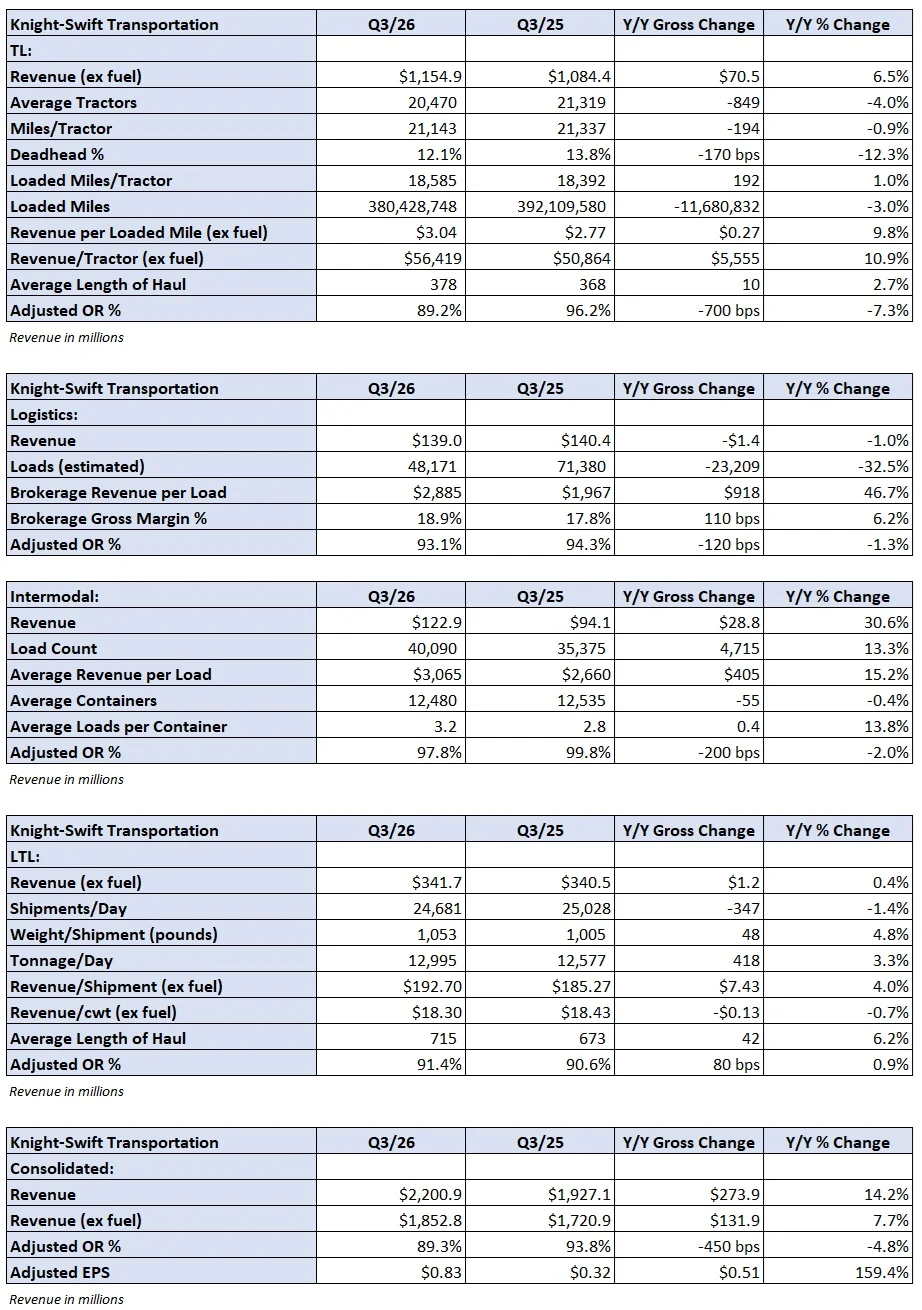
For investors and industry analysts alike, the results were a breath of fresh air. Knight-Swift reported adjusted earnings per share (EPS) of 83 cents—a significant leap of 51 cents over the year-ago quarter and a notable 7-cent beat against the consensus estimate. This performance stood in stark contrast to the firm’s own internal guidance range of 71 to 77 cents, signaling that the company is effectively navigating the volatile freight environment.
The Financial Landscape: A Breakdown of the Numbers
The headline figures for the third quarter underscore a company finding its footing in a complex market. Knight-Swift reported total revenue of $2.2 billion, representing a 14% year-over-year increase. When excluding the impact of volatile fuel surcharges, that growth still clocked in at a healthy 8%—comfortably exceeding analyst expectations of $2.17 billion.
This financial success was not merely a byproduct of volume, but a testament to improved operational efficiency. The company’s bottom line received a boost from several non-operational factors: a $22 million reduction in net interest expense, which added 10 cents per share; a more favorable tax rate, contributing 5 cents per share; and a marginal increase in gains from equipment sales. While these tailwinds were slightly dampened by a $3.5 million dip in "other income," the overall earnings picture remains robust.
Following the announcement, investors reacted with confidence, sending shares of KNX up 4.4% in after-hours trading, reflecting optimism that the worst of the freight recession is firmly in the rearview mirror.
Chronology of the Recovery: A Shift in Market Sentiment
To understand the significance of this quarter, one must look at the path Knight-Swift has traveled over the past 18 months. The industry had been grappling with a "freight recession" characterized by bloated capacity and depressed rates. However, the third quarter of 2026 marked a pivotal shift.
Management’s commentary highlighted that the momentum they observed in the previous quarter is continuing to build. CEO Adam Miller noted that as freight rates are reset across the industry and as the company continues to refine its cost-management and operational initiatives, the outlook is increasingly bullish. Perhaps most importantly, leadership identified a return of seasonal spot market activity and project-based opportunities that had been conspicuously absent for the past few years. This suggests that shippers are beginning to move beyond just-in-time inventory strategies and are engaging in broader, more complex logistics planning—a hallmark of a healthier economy.
Operational Performance: Deep Dive into Truckload and LTL
Knight-Swift’s core divisions offered distinct insights into how the company is leveraging its massive asset base to drive value.
The Truckload Unit: Leaner and More Profitable
The truckload (TL) segment saw a 6.5% year-over-year increase in revenue (excluding fuel). This was achieved despite a 4% decline in the average number of tractors in service—a strategic contraction that actually helped improve efficiency. Revenue per tractor increased by 11%, signaling that the fleet is being utilized far more effectively.
Key metrics for the TL unit showed remarkable consistency:
- Loaded Miles: This was the eighth consecutive quarter of growth, with loaded miles per tractor up 1% year-over-year.
- Deadhead Reduction: By reducing "deadhead" (empty miles) by 170 basis points to 12.1%, the company significantly improved its operating margin.
- Revenue per Loaded Mile: Excluding fuel, this metric climbed 10% year-over-year, with the over-the-road service category seeing mid-teen percentage gains.
The segment posted an 89.2% adjusted operating ratio (OR), which was 700 basis points better than the previous year. It is worth noting the performance of U.S. Xpress, the massive acquisition finalized in 2023. While Knight-Swift’s legacy brands operated at an impressive 88% OR, the U.S. Xpress unit operated in the low-90% range, indicating that the integration process is still yielding efficiency gains that will likely continue to improve in future quarters.

Less-Than-Truckload (LTL): Yield Management
The LTL division provided a more nuanced picture. Revenue (excluding fuel) grew by less than 1% year-over-year. While tonnage increased by 3%, revenue per hundredweight dipped by 1%. This was largely due to shifts in the composition of freight; a 5% increase in weight per shipment and a 6% increase in length of haul created a complex yield environment. Despite these fluctuations, revenue per shipment increased by 4%, and contractual renewals remained strong, posting mid-single-digit percentage gains. The LTL unit’s adjusted OR of 91.4% was 80 basis points weaker year-over-year, reflecting the ongoing investments required to scale the LTL network.
Official Responses and Forward Guidance
Management’s outlook remains disciplined. For the fourth quarter, Knight-Swift has issued adjusted EPS guidance in the range of 78 to 84 cents. This range effectively brackets the 82-cent consensus estimate held by Wall Street at the time of the release, signaling that while the company is optimistic, it remains grounded in the reality of a fluctuating macroeconomic landscape.
CEO Adam Miller’s tone in the earnings news release was one of measured confidence. By emphasizing the "reset" of rates and the maintenance of operational initiatives, Miller underscored that Knight-Swift is not relying on a sudden economic boom, but rather on its ability to control costs and optimize its network in a recovering market.
Strategic Implications: Why It Matters for the Industry
Knight-Swift’s third-quarter results provide more than just a snapshot of one company’s health—they act as a barometer for the North American supply chain. As the nation’s largest asset-based TL carrier, the firm’s ability to turn a profit during a period of rate instability is a strong signal that the "regulatory capacity cleanup"—a theme often cited in industry discourse—is finally taking hold.
For years, the market suffered from an oversupply of small carriers and a lack of regulatory enforcement regarding safety and insurance, which kept rates artificially depressed. As smaller, less efficient carriers exit the market, larger, technology-enabled carriers like Knight-Swift are absorbing the volume. This consolidation of capacity is, according to many experts, the engine driving the current recovery.
Furthermore, the focus on "seasonal spot and project opportunities" mentioned by management suggests that the industrial sector is beginning to restock or move goods with more frequency. This is a critical indicator of manufacturing and retail health.
Looking Ahead: The Future of Freight
As the industry looks toward the end of 2026, the focus for Knight-Swift will be on maintaining the momentum gained in the third quarter. Investors will be watching the integration of the U.S. Xpress unit closely, looking for further improvements in its operating ratio to match the company’s legacy brands. Additionally, the continued expansion of the LTL footprint will remain a key growth lever.
The company’s commitment to transparency, coupled with its consistent ability to beat expectations, has solidified its position as a favorite among logistics analysts. While external factors such as fuel prices, labor availability, and interest rates remain variables, Knight-Swift’s performance this quarter suggests that they are operating from a position of strength.
For the broader logistics and transportation sector, the takeaway is clear: the period of survival is transitioning into a period of growth. As Knight-Swift continues to optimize its fleet and lean into its LTL strategy, the company remains a cornerstone of the American logistics narrative, proving that in a complex global economy, operational excellence remains the ultimate competitive advantage.
Note: The company hosted a formal conference call at 5:30 p.m. EDT on Wednesday to discuss these results, providing further transparency to shareholders regarding their strategy for the final quarter of the year.