By Euronews with the International Judo Federation (IJF)
Published: 11/10/2026 | Updated: 22:12 GMT+2
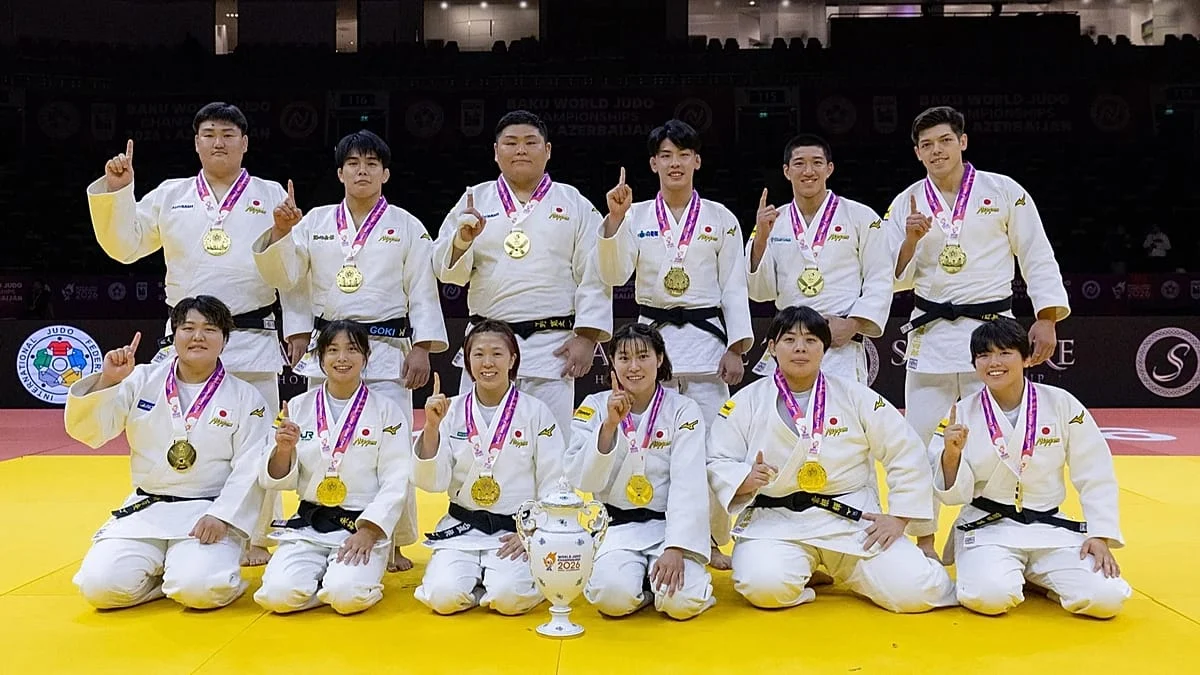
The tatami in Baku has long been a theater of individual excellence, but the final day of the World Judo Championships shifted the focus from the singular athlete to the collective heartbeat of the sport. The Mixed Team competition, held on October 11, 2026, served as a poignant reminder that judo, while often perceived as a solitary pursuit, thrives on the synergy of the squad. As the dust settled in the arena, Japan stood atop the podium once more, cementing their legacy with an eighth team world title, while the Russian Federation proved their arrival as a premier force in the global hierarchy.
The Semifinals: A Collision of Titans
The journey to the gold medal match was paved with high-octane drama and tactical masterclasses. In the first semi-final, Japan faced the People’s Republic of China, a fixture in the upper echelons of the sport. Japan signaled their intent early; UCHIMURA set the tone with an aggressive opening victory, providing his team with a psychological cushion.
The momentum shifted into a landslide as double World Champion MURAO Sanshiro stepped onto the mat. Demonstrating the technical precision that has made him a household name, MURAO secured an emphatic ippon, effectively deflating the Chinese response. The final nail in the coffin was delivered by ARAI, who showcased a brilliant transition from standing to groundwork, executing a textbook turnover to secure the win. Japan booked their place in the final with a clinical performance that served notice to the rest of the field: the team was hungry to reclaim the throne they had ceded to bronze the previous year.
The Russian Federation’s Dramatic Breakthrough
If the first semi-final was a display of Japanese dominance, the second between Uzbekistan and the Russian Federation was a war of attrition. AHADOV struck first for Uzbekistan with a blistering ippon, but LISHCHENKO responded for the Russians with a tactical yuko, evening the score.
The contest seesawed back and forth. MURTOZOEV pushed Uzbekistan to a 2-1 lead, only for RECHKALOVA to force a crucial submission, leveling the match at 2-2. With the tension palpable, TASOEV delivered a massive score to swing the advantage toward the Russian Federation, before AMINOVA leveled the board once more at 3-3. The stalemate forced a "Golden Score" tiebreaker, with the +90kg category drawn as the decider. TASOEV, showing nerves of steel, returned to the mat and delivered a second ippon, propelling his nation into their first-ever Mixed Team final.
The Final: A Tactical Masterclass
The atmosphere in the Baku arena reached a fever pitch as Japan and the Russian Federation squared off for the ultimate prize. In a final, every movement is scrutinized, and every point carries the weight of a nation’s expectations.
The opening contest set the narrative for the afternoon. TANAKA Shiho, displaying immense composure under pressure, secured a yuko to give Japan a narrow lead. The Russian team, reeling from the opening blow, looked to their anchors, but MURAO Sanshiro proved insurmountable. Continuing his flawless form from the semifinals, MURAO dispatched his opponent to extend the lead to 2-0.
Mao ARAI maintained the relentless pressure, winning her bout to push Japan to a 3-0 scoreline. While Tamerlan BASHAEV managed to break the streak and earn a vital win for the Russian Federation, the comeback attempt was halted by the formidable OMORI Akari. In a display of technical dominance, OMORI clinched the final point, officially securing the gold for Japan. The victory marked the eighth team title for the Japanese delegation, a testament to their deep talent pool and their ability to sustain excellence across generations.
Supporting Data and Technical Breakdown
The statistics from the Baku championships underscore a shift in the global judo landscape. Japan’s victory was built on a foundation of high ippon conversion rates, a metric that has remained their hallmark for decades.
Key Performance Indicators (KPIs) of the 2026 Mixed Team Event:
- Japan’s Conversion Rate: 82% of matches won via ippon or forced submission during the knockout stages.
- The "Golden Score" Factor: The Uzbekistan vs. Russian Federation match was the only contest of the day to require a tiebreaker, emphasizing the tactical parity between emerging powerhouses.
- Depth of Field: A total of 14 nations participated in the Mixed Team category, marking a 15% increase in diversity compared to the 2024 Championships, highlighting the sport’s growing global footprint.
The resilience of the Russian Federation throughout the tournament, particularly TASOEV’s performance, suggests that the "gap" between traditional powerhouses like Japan and the rest of the world is narrowing. The utilization of the +90kg category as a decisive tiebreaker proved to be a masterstroke in terms of fan engagement, providing the dramatic climax the tournament sought to achieve.
Official Responses and Ceremonial Honors
The prestige of the event was underscored by the presence of international sporting leadership. The gold trophy was presented by International Judo Federation (IJF) President Mr. Marius Vizer, who praised the camaraderie displayed throughout the event. "Judo is a sport of individual discipline, but today, we saw the soul of our movement: unity," Vizer remarked.
The silver medals were awarded by the CEO of the Harvest Group, Mr. Almaz Alsenov, acknowledging the Russian Federation’s historic climb to their first final. The two bronze medals were distributed by IJF Vice Presidents Dr. Laszlo Toth and Obaid Al Anzi, recognizing the efforts of the losing semifinalists who fought with equal fervor.
Implications: The Road to the Future
The results in Baku have significant implications for the world rankings and the seeding for upcoming international circuits. Japan’s victory reaffirms their status as the gold standard, yet the emergence of the Russian Federation as a legitimate, consistent threat to the podium suggests that the 2028 Olympic cycle will be the most competitive in recent memory.
The Philosophy of the Team Format
The Mixed Team event is more than a bracket; it is an ideological tool for the IJF. By integrating men and women into a single squad, the federation promotes gender parity and institutionalizes the concept of shared responsibility. Athletes who spent their careers training for individual glory found themselves relying on teammates from different weight classes, fostering a culture of mentorship and collective accountability.
For the Japanese team, this victory is a vindication of their developmental pipeline. By consistently producing athletes like UCHIMURA and MURAO, who can adapt to the high-pressure, short-duration format of team judo, Japan has ensured that their dominance is not merely a matter of raw skill, but of strategic preparation.
For the Russian Federation, the silver medal serves as a foundation. Having reached their first final, the squad now possesses the institutional knowledge and the psychological confidence required to bridge the final gap to gold.
Final Thoughts
As the lights dimmed in Baku, the resounding sentiment was one of progress. The World Judo Championships have historically been defined by the singular genius of an individual on the mat. However, the events of October 11, 2026, proved that the sport’s future is equally tied to the strength of the collective. Japan returns home with another trophy for their cabinet, but the sport of judo leaves Baku with a revitalized identity—one that celebrates both the lone warrior and the united team.
The world of judo now looks toward the next calendar of events, with the lessons of Baku serving as a blueprint for the next generation of competitors. The "team spirit" mentioned at the opening of these championships was not merely a slogan; it was the decisive factor that separated the champions from the contenders. As we look ahead, one thing remains clear: in the pursuit of perfection on the tatami, no one fights alone.