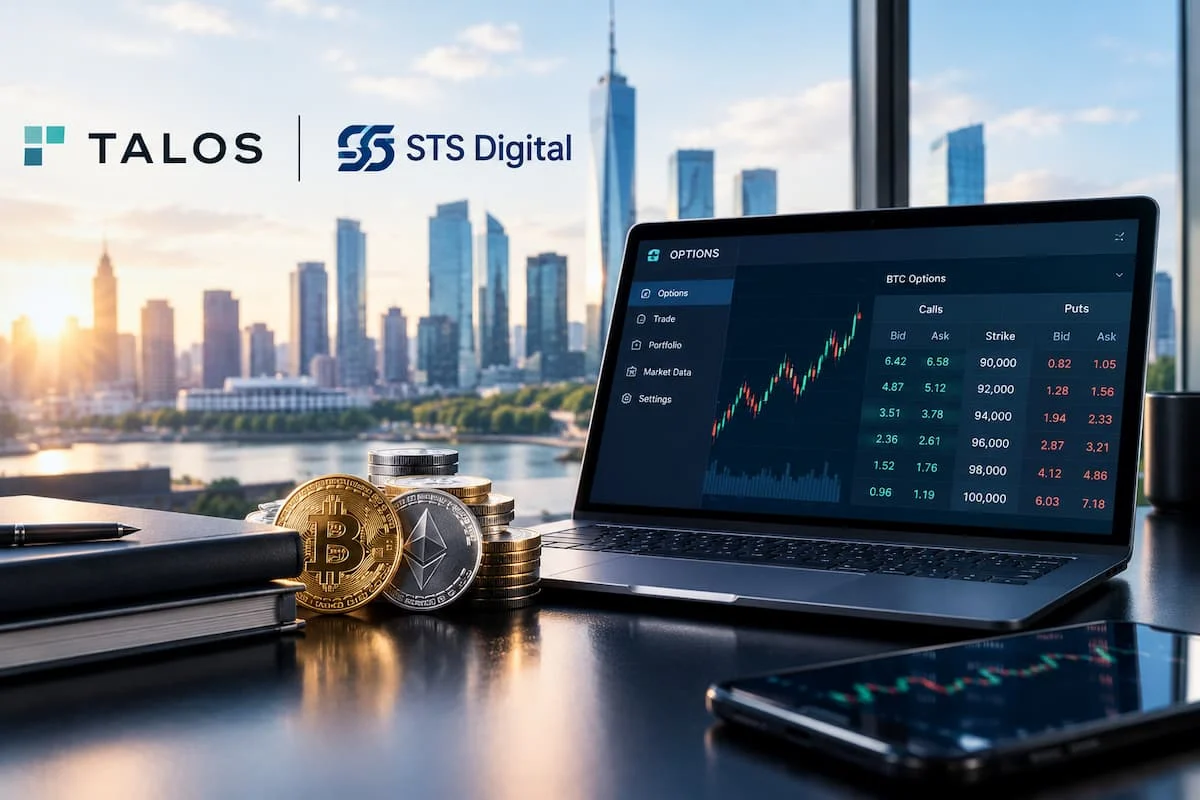
The institutional landscape for digital assets reached a new milestone on 5 August 2026, as Talos, the industry-leading institutional trading technology platform, announced the integration of STS Digital Ltd. into its prestigious Provider Network. This strategic move enables institutional clients to seamlessly access STS Digital’s deep liquidity in spot and derivatives markets directly within their existing Talos-enabled workflows.
As digital asset markets mature, the integration serves as a bellwether for the broader transition toward institutional-grade infrastructure. By bridging the gap between sophisticated, regulated principal trading and established institutional execution workflows, the partnership addresses a critical pain point in the market: the scarcity of regulated, broad-spectrum liquidity for complex altcoin derivatives.
Main Facts: The Intersection of Liquidity and Workflow
The core value proposition of this integration lies in the streamlining of over-the-counter (OTC) trading. Talos, known for its robust order management and execution capabilities, acts as a central nervous system for institutional desks. By adding STS Digital—a Bermuda-regulated powerhouse in digital asset derivatives—to its network, Talos is effectively decentralizing the access point for institutional capital.
Key features of the integration include:
- Broad Derivative Coverage: Clients gain access to both vanilla and exotic options across a selection of more than 400 tokens. This inclusion of "altcoin" options is a significant expansion of the current institutional menu, which is traditionally concentrated on Bitcoin and Ethereum.
- Integrated Execution: Trading is executed via Request-for-Quote (RFQ) and electronic workflows, allowing for high-speed, transparent execution without requiring clients to leave the Talos environment.
- Principal Liquidity: STS Digital acts as a principal trading firm, providing the necessary spot liquidity to support derivative hedging and complex portfolio rebalancing.
- Operational Continuity: The integration maintains existing custody and settlement arrangements, ensuring that institutions can leverage their current risk management frameworks while benefiting from STS Digital’s pricing.
Crucially, the relationship remains bilateral. Talos provides the technological conduit, but firms must negotiate their own terms, credit arrangements, and counterparty requirements directly with STS Digital, maintaining the bespoke nature of institutional OTC relationships.
Chronology of Development
The integration is the culmination of a rapid expansion phase for both entities, reflecting a broader trend of institutionalization within the crypto-native financial services sector.

- Early 2026: STS Digital executes a successful USD 30 million strategic funding round, attracting significant interest from industry heavyweights, including CMT Digital (lead investor), Payward (Kraken’s parent company), Arrington Capital, Strobe Ventures, F-Prime, and BitRock Capital. This capital infusion provided the runway for the firm to scale its regulatory and technological infrastructure.
- March 2026: STS Digital launches a high-performance structured products platform in partnership with Kraken, signaling its intent to capture the sophisticated end of the institutional market.
- 5 August 2026: Talos officially announces the inclusion of STS Digital in its Provider Network, signaling that the platform has met the rigorous institutional requirements set by the Talos vetting team.
- Present: The integration is now live, with institutional clients onboarding to the STS Digital liquidity stream, further cementing Bermuda as a preferred jurisdiction for regulated digital asset principal firms.
Supporting Data: The Bermuda Regulatory Advantage
The regulatory standing of STS Digital is perhaps its most significant competitive differentiator. The firm holds a full “F” License under the Bermuda Monetary Authority’s (BMA) Digital Asset Business Act 2018. This is the highest level of authorization available within the jurisdiction.
For institutional allocators, this provides a critical layer of comfort. The BMA’s reputation is bolstered by its active, high-level participation in global financial governance organizations, including the Financial Stability Board (FSB), the International Association of Insurance Supervisors (IAIS), and the Organization for Economic Cooperation and Development (OECD). Furthermore, the BMA’s status regarding Solvency II equivalence with the European Union provides a level of regulatory "read-across" that is invaluable to global firms navigating complex cross-border compliance.
In a market where many OTC desks operate with minimal oversight or in jurisdictions with nascent frameworks, the BMA “F” License signals a commitment to capital adequacy, operational risk management, and consumer protection—prerequisites for large-scale institutional participation.
Official Responses: The Strategic Rationale
The sentiment from leadership underscores a shared vision of creating a seamless, regulated digital asset ecosystem.
Daniel Packham, VP and head of Provider Network at Talos, emphasized that the addition of STS Digital fills a specific vacuum in the institutional product set. "Bringing STS Digital onto the Talos Provider Network gives our clients access to OTC derivatives liquidity in a regulated, principal context, executed through the workflows they already rely on for the rest of their digital asset trading," Packham noted. He further highlighted that the breadth of the altcoin options coverage was a key driver for the integration, addressing the demand for tools that allow for granular risk management beyond the two largest digital assets.
While STS Digital has not issued a singular public manifesto on the integration, their recent capital raise and product rollout strategy suggest a clear mission: to become the primary liquidity provider for institutional structured products. By plugging into the Talos network, they gain immediate, friction-less access to the most sophisticated institutional order flow in the market today.

Implications: The Shift Toward Institutional Infrastructure
The integration of STS Digital into the Talos ecosystem carries profound implications for the digital asset markets.
1. The Death of the "Siloed" Desk
Historically, institutional traders had to manage disparate relationships with various liquidity providers, often necessitating manual processes and fragmented execution. The Talos/STS Digital partnership reinforces the trend toward "multi-dealer connectivity." Institutional platforms are becoming the new distribution centers, where liquidity providers compete in a unified, transparent space. This reduces operational overhead and, by extension, increases the efficiency of the capital markets.
2. Regulatory Arbitrage vs. Regulatory Alignment
The market is increasingly bifurcated between regulated participants and those operating in the "gray zones." By choosing a Bermuda-regulated partner, Talos is signaling that institutional demand is tilting decisively toward firms that can pass rigorous compliance audits. While the European Union’s MiCA (Markets in Crypto-Assets) regulation and the UK’s FCA framework continue to evolve—often leaving derivatives in a complex regulatory limbo—the BMA model provides a clear, recognized framework that allows for sophisticated trading while maintaining high standards of oversight.
3. The Maturation of Altcoin Markets
The focus on "400+ tokens" for options coverage is a watershed moment for the altcoin market. Previously, deep-liquidity derivatives were largely confined to BTC and ETH. The expansion of these products into the broader token economy suggests that institutions are no longer just "dipping their toes" in Bitcoin; they are looking to build complex, hedged, and speculative portfolios across the entire crypto spectrum.
4. Risk and Counterparty Management
From a risk perspective, this move necessitates a shift in how institutional buyers assess counterparty risk. Trading with a principal firm like STS Digital is fundamentally different from trading on a central limit order book (CLOB) or via a prime broker. The principal model relies on the creditworthiness and capital strength of the counterparty. Consequently, the BMA license becomes the primary anchor for the institutional "due diligence" process. As the industry evolves, the ability of firms to prove their solvency and regulatory compliance will be the ultimate determinant of their longevity in the institutional Tier-1 space.
Conclusion
The integration of STS Digital into the Talos Provider Network is not merely a technological update; it is a manifestation of the institutionalization of digital assets. By providing a secure, regulated, and technologically integrated pathway for OTC derivatives, Talos and STS Digital have lowered the barrier to entry for the world’s most sophisticated capital. As the market looks toward the remainder of the decade, partnerships of this nature—characterized by high regulatory standards and deep technical integration—will likely become the standard, separating the professional-grade players from the remainder of the ecosystem.