OpenAI has pulled back the curtain on the architectural framework powering its rapidly expanding advertising ecosystem within ChatGPT. By detailing how the system interprets complex user dialogues, selects contextually relevant advertisements, and maintains a strict firewall between organic content generation and commercial placements, the company is attempting to provide transparency to a marketing community eager for a new performance channel.
With an annualized revenue run rate hitting $1 billion less than 200 days after launch and a roster exceeding 100,000 advertisers, ChatGPT has become one of the fastest-scaling ad products in history. However, as the technical complexity of this system grows, so do the questions regarding performance transparency and the actual return on investment (ROI) for those footing the bill.
Main Facts: The Architecture of an AI-Driven Marketplace
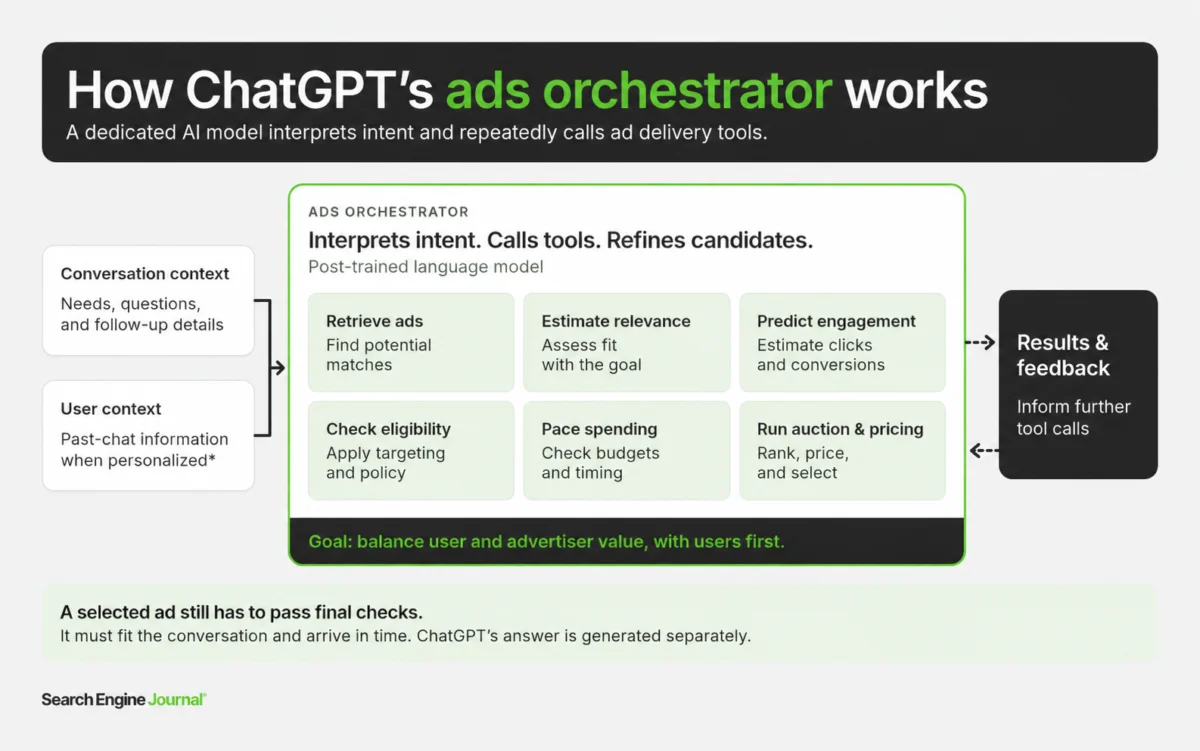
At the core of the ChatGPT ad system is a sophisticated "orchestrator" model. Unlike traditional keyword-based advertising, which relies on static intent markers, the ChatGPT orchestrator functions as a real-time analyst of human conversation.
The Decoupled System
OpenAI emphasizes a structural separation between its core generative model and the advertising engine. The system that crafts answers to user queries operates independently of the system that selects and displays ads. This "decoupling" is designed to ensure that the integrity of ChatGPT’s responses remains untainted by commercial interests.
As a user interacts with the chatbot, the conversation stream is processed by the advertising orchestrator in parallel. If a relevant advertisement is identified, it is presented beneath the response. Crucially, the ad selection process does not influence the generative model’s output, nor does the generative model wait for the ad system to complete its task before rendering an answer. If the advertising engine experiences latency, the response is delivered without ads, prioritizing user experience over ad delivery.
The Orchestrator’s Workflow
The orchestrator’s process is a multi-stage funnel:
- Semantic Understanding: It converts relevant parts of the conversation into search queries, which are then mapped as "embeddings"—mathematical representations of meaning—allowing the system to understand intent even when the user’s phrasing varies.
- Eligibility Filtering: Potential ads are vetted against a strict set of criteria, including geographic restrictions, budget pacing, and policy compliance.
- Auction Dynamics: Suitable candidates are submitted to an auction tool, which manages the final ranking and pricing based on historical performance data and the likelihood of user engagement.
Chronology of Rapid Expansion
The meteoric rise of OpenAI’s ad business is a case study in platform scaling. Since its inception, the rollout has been characterized by aggressive integration and rapid feature iteration:
- The Launch Phase: OpenAI introduced initial testing for sponsored content, focusing on subtle, non-intrusive placements that aligned with its core mission of providing helpful information.
- The "Stateful" Evolution: The system moved beyond simple keyword matching to "stateful" sessions. This allowed the AI to remember context throughout a long-form conversation, enabling it to serve ads based on needs established several prompts earlier.
- The Scaling Milestone: Within 200 days, the platform hit the $1 billion annualized revenue run rate. This rapid growth suggests that a diverse range of industries, from SaaS providers to e-commerce brands, have flocked to the platform to capture high-intent users.
- Current Status: The system now incorporates advanced signal processing, allowing it to distinguish between fleeting curiosity and genuine commercial intent, all while managing a daily influx of thousands of new advertisers.
Supporting Data: Understanding "Stateful" Context
The most compelling aspect of OpenAI’s technical breakdown is how it handles "stateful" sessions. In a typical search engine, every query is treated as a discrete event. In ChatGPT, the AI maintains a "memory" of the discussion, which fundamentally changes how ads are matched.
Consider a user researching project management software. In the first interaction, the user might express a need for "client approvals." Three prompts later, they ask about "pricing." A legacy search ad would only see the term "pricing." The ChatGPT orchestrator, however, carries the context of "small agency" and "needs client approvals" into the auction.
This allows an advertiser who specifically highlights "free guest accounts" to be matched with that user, despite the user not explicitly typing that requirement in their final prompt. This contextual intelligence is the "secret sauce" that OpenAI hopes will justify premium pricing and higher conversion rates for its advertisers.
Official Responses and Operational Safeguards
OpenAI’s technical documentation is clearly aimed at addressing industry skepticism. By documenting the "orchestrator," the company is responding to concerns about "ad creep" and the potential for corporate bias in AI responses.
The "No-Guarantee" Impression Policy
A critical takeaway from the documentation is that winning an auction does not guarantee an ad impression. OpenAI applies a secondary, post-auction "appropriateness" check. Even if an ad wins the bid, if the system deems it contextually jarring or inappropriate for the specific nuance of the current conversation, it will be suppressed.
For advertisers, this is a significant hurdle. It introduces a "black box" variable where an ad might be priced correctly and targeted perfectly, yet still fail to appear. OpenAI claims its internal logs track these failures, allowing the system to categorize why an ad was pulled (e.g., policy violation vs. timing latency). However, whether this granular data is accessible to the average advertiser remains unclear.
Implications: The Transparency Gap
While the engineering behind the platform is impressive, the implications for the advertising industry are mixed.
The ROI Question
The headline figure of $1 billion in revenue is an indicator of platform adoption, not necessarily advertiser success. The industry still lacks standardized benchmarks for Cost Per Acquisition (CPA) or Return on Ad Spend (ROAS) on the platform. Because the system is so unique—sitting somewhere between search, display, and consultative sales—advertisers are struggling to map it to traditional funnel metrics.
The Need for Better Reporting
The current state of reporting creates a "feedback loop deficit." Advertisers are forced to guess why their impressions are low. Is it a lack of relevance? Is it the auction bidding? Or is it a failure at the post-auction "appropriateness" check? Without clear, diagnostic-level reporting, advertisers are effectively flying blind, making it difficult to optimize campaigns in a way that generates consistent, profitable results.
The Long-Term Outlook
For OpenAI, the path forward involves balancing revenue growth with user trust. If the ads become too frequent or if the "orchestrator" begins to prioritize high-bidding advertisers over user intent, the quality of the ChatGPT experience will degrade.
Conversely, for advertisers, the platform represents a massive opportunity to capture users in a state of high-context research. The ability to intervene in a conversation exactly when a specific pain point is articulated is more powerful than any standard banner ad.
Conclusion: A New Frontier for Digital Marketing
OpenAI has successfully built a robust, technologically advanced advertising engine that respects the sanctity of the AI conversation while enabling commercial monetization. By leveraging stateful context and advanced embeddings, the platform offers a unique value proposition that differentiates it from traditional search advertising.
However, the transition from an experimental ad platform to a mature marketing channel requires more than just technical sophistication; it requires transparency. As the platform matures, the industry will demand clearer reporting, concrete performance benchmarks, and more insight into the "why" behind ad delivery failures. Until then, advertisers should approach ChatGPT Ads as a high-potential, experimental channel that requires a heavy investment in testing, monitoring, and patience.
The $1 billion milestone is a testament to the platform’s potential, but the real test—the sustainability and profitability of those 100,000 advertisers—is only just beginning.