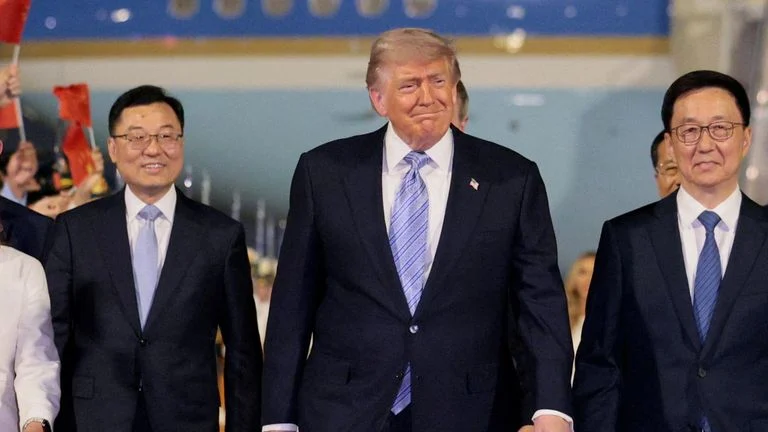
Beijing, China – In a pivotal moment for 21st-century geopolitics, then-American President Donald J. Trump embarked on a highly anticipated two-day state visit to China, a diplomatic engagement designed to address a burgeoning array of critical bilateral and global issues. The visit, framed by both Washington and Beijing as an opportunity to foster cooperation amidst growing competition, placed key areas such as trade imbalances, technological rivalry, the sensitive status of Taiwan, and the pressing challenge of Iran’s nuclear ambitions at the forefront of the agenda.
Upon his arrival in the Chinese capital, President Trump was met with a meticulously orchestrated spectacle of traditional ceremony and enthusiastic public greetings, a display designed to underscore the diplomatic significance of his presence. However, in a departure from standard protocol for such high-profile events, the American leader bypassed direct engagement with the waiting press contingent, proceeding directly to his accommodations. This initial lack of interaction immediately set a tone of guarded communication for a visit laden with immense expectations and potential for both collaboration and confrontation. Accompanying the President was a notable delegation, including members of his family, signifying the personal dimension of his presidency, alongside prominent American businessman Elon Musk, whose presence underscored the technological and economic undercurrents of the discussions.
A Grand Diplomatic Entrance: Chronology of Arrival and Initial Engagements
President Trump’s arrival in Beijing was characterized by the grandeur and precise choreography typical of Chinese state receptions for visiting heads of state. Stepping off Air Force One, the President and First Lady Melania Trump were greeted by senior Chinese officials, marking the formal commencement of their visit. The motorcade’s journey through the streets of Beijing was met with curated displays of welcome, featuring ceremonial guards, fluttering flags of both nations, and orchestrated public cheers, all designed to project an image of warmth and respect. Such elaborate receptions are a hallmark of Chinese diplomacy, meticulously planned to convey the host nation’s prestige and its regard for the guest.
However, despite the celebratory atmosphere and the inherent media interest surrounding a US presidential visit to China, President Trump opted not to engage with the journalists present at the arrival site. This decision, while not entirely unprecedented in the annals of presidential travel, nonetheless raised eyebrows among the international press corps, who were keen to glean immediate insights into the President’s initial impressions or any preliminary statements. Instead, after the formal greetings, the presidential motorcade proceeded swiftly to the hotel, signaling a desire to transition quickly from ceremonial pomp to the substantive, and undoubtedly arduous, discussions awaiting him.
This initial phase of the visit, though brief, served as a symbolic prelude to the complex negotiations ahead. The blend of traditional Chinese hospitality with the American president’s characteristic directness and media strategy hinted at the delicate balance both sides would seek to maintain throughout the two-day summit. The carefully managed optics of the arrival – showcasing China’s strength and hospitality while the US delegation quickly moved behind closed doors – underscored the high stakes and the controlled environment in which these crucial diplomatic exchanges would unfold. The absence of immediate press interaction by the President also suggested a strategy to reserve public statements for more formal settings, likely after initial discussions with Chinese leadership had commenced.
The High-Stakes Agenda: Navigating Complex Bilateral Issues
The itinerary for President Trump’s visit was packed with a dense agenda, reflecting the multifaceted and often contentious nature of US-China relations. Beyond the ceremonial aspects, the core objective was to tackle a series of issues that define the global strategic landscape, ranging from economic grievances to geopolitical flashpoints and shared international challenges.
Economic Tensions: Trade and Technology at the Forefront
At the apex of the discussion points lay the deeply entrenched economic tensions between the two largest economies in the world. The Trump administration had consistently vocalized its dissatisfaction with what it perceived as an unfair trade relationship, characterized by a substantial trade deficit in goods favoring China. American officials pointed to a range of alleged unfair trade practices, including intellectual property theft, forced technology transfers from American companies operating in China, extensive state subsidies for Chinese industries, and barriers to market access for US businesses.
The technology sector, in particular, was a burgeoning battleground. Concerns revolved around China’s ambition to dominate critical emerging technologies such as 5G telecommunications, artificial intelligence, and advanced semiconductors, often through state-backed initiatives like "Made in China 2025." The US saw these efforts not only as economic competition but also as a national security risk, fearing the implications of Chinese dominance in foundational technologies. Discussions during the visit were expected to delve into these grievances, with the US seeking concrete commitments from China to open its markets, protect intellectual property rights, and level the playing field for American companies. The presence of Elon Musk in the delegation subtly highlighted the private sector’s vested interest in these technological and economic dialogues, particularly regarding market access and regulatory frameworks for high-tech industries.
Geopolitical Flashpoints: Taiwan and Regional Stability
Another highly sensitive item on the agenda was the long-standing issue of Taiwan. Under the "One China" policy, the United States acknowledges, but does not endorse, Beijing’s claim over Taiwan, maintaining unofficial relations with the democratic self-governing island and providing it with defensive weaponry. China, however, views Taiwan as an inseparable part of its territory, to be reunified with the mainland, by force if necessary. Any perceived deviation from the "One China" policy by the US is met with strong condemnation from Beijing.
During his presidency, Trump had, at times, demonstrated a willingness to challenge established diplomatic norms regarding Taiwan, including an unprecedented phone call with Taiwan’s president-elect before taking office. This visit was an opportunity for both sides to clarify their positions and manage potential escalations. The discussions were critical for maintaining regional stability in the Indo-Pacific, where China’s growing military assertiveness, particularly in the South China Sea, already raised concerns among US allies. A nuanced diplomatic approach was required to prevent miscalculations that could destabilize an already tense region.
The Iranian Conundrum: A Shared but Divergent Challenge
The complexities of the Iranian nuclear program and its regional activities also featured prominently in the bilateral discussions. While both the US and China shared a common interest in preventing nuclear proliferation and maintaining stability in the Middle East, their approaches to Iran diverged significantly. At the time of the visit, the Trump administration was increasingly critical of the Joint Comprehensive Plan of Action (JCPOA), the international nuclear deal with Iran, signaling a potential withdrawal and a return to more stringent sanctions. China, a signatory to the JCPOA and a significant importer of Iranian oil, generally favored upholding the agreement, viewing it as a critical mechanism for controlling Iran’s nuclear ambitions.
The discussions likely centered on finding common ground to manage Iran’s behavior, particularly its ballistic missile program and its support for regional proxies, without necessarily agreeing on the fate of the JCPOA. The US would have sought China’s cooperation in pressuring Iran, leveraging Beijing’s economic ties and its permanent seat on the UN Security Council. Navigating these differences was crucial for demonstrating a unified international front on a critical global security issue.
North Korea: A Shadow Over the Summit
Although not explicitly mentioned in the brief initial report, the escalating nuclear and ballistic missile program of North Korea was an unavoidable and overarching concern that loomed over any high-level US-China summit during this period. China, as North Korea’s primary economic lifeline and geopolitical patron, held immense leverage over Pyongyang. The Trump administration had consistently pressed Beijing to exert greater pressure on North Korea to denuclearize, often linking China’s cooperation on this front to other aspects of the bilateral relationship.
Discussions on North Korea would have focused on the effectiveness of existing UN sanctions, the potential for new punitive measures, and the coordination of diplomatic strategies. The US sought China’s full commitment to enforcing sanctions and curtailing illicit trade that fueled Pyongyang’s weapons programs. The shared goal of a denuclearized Korean Peninsula provided a rare area for potential cooperation, even if the methods and timelines differed significantly between Washington and Beijing. The outcome of these discussions had profound implications for regional security and global non-proliferation efforts.
The Entourage: Family, Business, and Diplomacy
The composition of the American delegation offered insights into the multifaceted nature of President Trump’s approach to international relations. The presence of family members, notably First Lady Melania Trump, alongside the President, lent a personal dimension to the state visit. While First Ladies typically participate in cultural exchanges and soft diplomacy, their presence during the Trump administration often extended to being key figures in the broader diplomatic narrative. This familial aspect underscored the President’s unique blend of personal and professional engagement on the international stage.
More unusually, and certainly reflecting the economic and technological emphasis of the visit, was the inclusion of Elon Musk, the visionary CEO of Tesla and SpaceX. Musk’s participation was highly symbolic and practical. China represented a massive and strategically vital market for Tesla, with the company aggressively pursuing expansion and factory construction in the country. His presence signaled the administration’s focus on securing economic advantages and market access for leading American technology firms. It also indicated the broader theme of technological competition and cooperation, with Musk representing a pinnacle of American innovation seeking opportunities within China’s rapidly developing tech landscape. His direct access during a state visit could facilitate high-level discussions on regulatory issues, investment opportunities, and intellectual property protections for cutting-edge industries, effectively blending private sector interests with national diplomatic objectives.
Official Responses and Diplomatic Rhetoric
The initial lack of direct interaction between President Trump and the press corps upon arrival was indicative of a controlled communication strategy, where official statements and carefully crafted readouts would serve as the primary conduits for information. Both the American and Chinese sides meticulously managed their narratives, framing the visit in ways that aligned with their respective domestic and international objectives.
From the American perspective, the visit was presented as an opportunity to advance American interests, particularly in correcting trade imbalances and ensuring fair economic practices. The rhetoric from Washington emphasized the "America First" agenda, seeking to secure better deals for American workers and businesses. While acknowledging the importance of cooperation, the underlying tone often highlighted competition and the need for China to adhere to international norms. Subsequent official statements from the White House would likely detail the areas of agreement and disagreement, often through the lens of US gains or continued concerns.
Beijing, on the other hand, leveraged the visit to underscore its growing global stature and its commitment to fostering a "new type of great power relationship" with the United States. Chinese state media and official pronouncements emphasized the warm reception, the historical significance of the visit, and the potential for mutual benefit through cooperation. President Xi Jinping, in his interactions with Trump, was expected to project an image of strength, stability, and pragmatic leadership, advocating for dialogue and mutual respect as the foundation for resolving differences. The absence of immediate presidential press remarks upon arrival might have been interpreted by Beijing as a sign of the serious, business-like nature of the discussions, rather than a dismissal of media scrutiny. Later in the visit, joint press conferences or official statements from both leaders were anticipated to provide a more structured summary of the outcomes, carefully worded to present a positive spin on the progress made, even amidst persistent disagreements.
Broader Implications: A Shifting Global Landscape
The two-day state visit carried significant weight, with potential ramifications extending far beyond the immediate bilateral relationship. Its outcomes, or lack thereof, were poised to influence global economics, geopolitical alliances, and the domestic political landscapes of both nations.
Economic Ramifications
On the economic front, any breakthroughs or stalemates in trade and technology discussions would have immediate and lasting effects. Significant agreements on market access, intellectual property protection, or tariff reductions could inject confidence into global markets, benefiting multinational corporations and impacting supply chains worldwide. Conversely, a failure to address core grievances could foreshadow an escalation of trade tensions, potentially leading to increased tariffs, trade wars, and a fragmentation of the global economy. The discussions around technology, in particular, could dictate the future trajectory of innovation, setting standards for intellectual property rights and influencing the global competitiveness of industries like telecommunications, artificial intelligence, and advanced manufacturing. The presence of business leaders like Elon Musk underscored the direct economic stakes for private industry.
Geopolitical Realignments
The visit’s geopolitical implications were equally profound. The nature of US-China engagement directly impacts the balance of power in Asia and globally. Allies and rivals alike keenly observed the interactions, seeking clues about the future direction of US foreign policy and China’s strategic ambitions. A strong, cooperative US-China relationship could facilitate solutions to global challenges like climate change, pandemics, and nuclear proliferation. Conversely, a relationship dominated by rivalry and distrust could embolden adversaries, destabilize regions like the South China Sea, and force other nations to choose sides, potentially leading to a fragmentation of international order. The discussions on North Korea and Iran, in particular, were litmus tests for the ability of the two great powers to find common ground on critical security issues.
Domestic Political Stakes
For both President Trump and President Xi Jinping, the visit held considerable domestic political significance. For Trump, demonstrating a tough stance on trade while securing favorable deals for American businesses resonated with his "America First" base and could bolster his domestic approval. His ability to negotiate directly with China’s top leader was also a testament to his perceived deal-making prowess. For Xi Jinping, hosting a US President for a state visit reinforced his image as a powerful and respected global leader, particularly important in the context of consolidating his leadership within the Chinese Communist Party. A successful visit, marked by mutual respect and dialogue, would bolster his narrative of China’s peaceful rise and its indispensable role in global governance.
The Future of US-China Relations
Ultimately, the visit was a critical juncture in defining the future trajectory of US-China relations. It provided a platform for direct, high-level communication, which, despite underlying tensions, is essential for managing a complex and vital relationship. The outcomes would help determine whether the relationship would lean more towards cooperation or competition, whether areas of convergence could be expanded, and whether areas of divergence could be managed without escalating into conflict. The visit was not expected to resolve all outstanding issues, but rather to establish frameworks for ongoing dialogue, set expectations, and potentially lay the groundwork for future agreements.
Conclusion: A Precarious Path Forward
President Donald Trump’s two-day state visit to China was a masterclass in high-stakes diplomacy, a convergence of ceremony and intense negotiation against a backdrop of global uncertainty. From the meticulously planned reception in Beijing to the closed-door discussions on trade, technology, Taiwan, and Iran, every aspect of the visit underscored the immense significance of the US-China relationship. While immediate answers to the myriad challenges were unlikely, the engagement itself was a critical exercise in communication, seeking to navigate a path between cooperation and competition.
The absence of immediate public pronouncements from President Trump upon arrival hinted at the gravity and complexity of the issues at hand, suggesting a focus on substantive discussions rather than fleeting soundbites. The diverse accompanying delegation, including family members and the prominent entrepreneur Elon Musk, further illuminated the multifaceted nature of American interests – blending traditional diplomatic protocol with a strong emphasis on economic and technological leverage. As the world watched, the outcomes of these two days were poised to cast a long shadow over global economic stability, geopolitical alignments, and the delicate balance of power that defines the 21st century. The path forward for US-China relations remained precarious, but the state visit served as an undeniable testament to its unparalleled importance on the international stage.