In a significant evolution of its generative AI search strategy, Google has announced a series of five foundational updates aimed at refining how AI Overviews and AI Mode present information to users. These changes, detailed by Hema Budaraju, Vice President of Product Management, represent a concerted effort to balance the efficiency of AI-generated summaries with the necessity of linking to original, authoritative sources. As Google continues to integrate large language models (LLMs) into the fabric of its core search product, these adjustments reflect a growing sensitivity toward publisher visibility and user trust.
Main Facts: The Five Pillars of the Update
The latest announcement from Google focuses on improving the "connective tissue" between AI-generated responses and the web ecosystem. The five primary changes include:
- Increased Frequency of Inline Links: Google is strategically placing inline citations higher within AI-generated responses to ensure users can verify claims immediately.
- Official Source Prioritization: For task-based queries where authoritative data is limited (e.g., government portals or official refund policies), Google is testing a dedicated "Official Site" section at the top of responses.
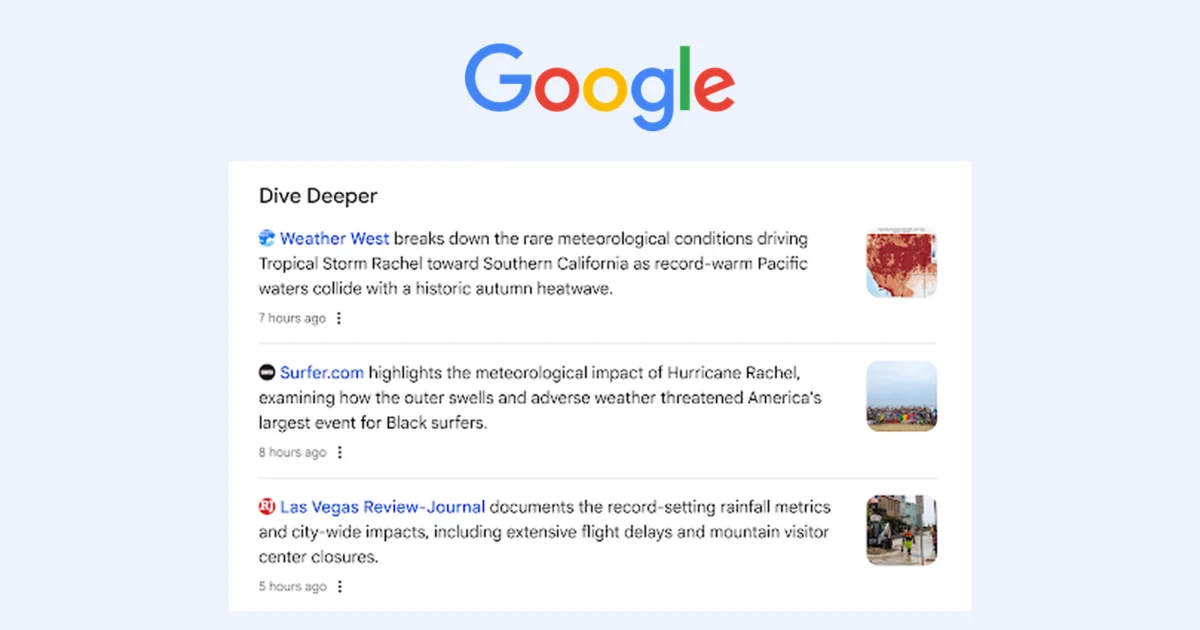
- Enhanced Visuals for Related Links: The "Dive Deeper" sections at the bottom of AI responses are receiving a facelift, incorporating image thumbnails and more visually distinct, clickable designs.
- Expansion of Timely Content Carousels: The carousel feature, which highlights news and articles on developing topics, is expanding to additional languages and global markets.
- Integration of Search Profiles: Google is beginning to test the inclusion of creator and publisher profiles directly within AI Mode video results, allowing users to verify the source of content with a single click.
Chronology of Google’s AI Search Evolution
To understand the trajectory of these changes, it is essential to view them as part of a broader, ongoing rollout that began in earnest earlier this year.
- May 2024: Google first signaled a shift toward deeper link integration, announcing that users would see more inline links placed directly adjacent to relevant text. During this same period, the company introduced the concept of "Preferred Sources," allowing users to curate their own search results, and launched the initial version of timely content carousels.
- June 2024: The company officially launched "Search Profiles," a feature designed to consolidate a creator’s digital footprint—including articles, videos, and social media activity—into a unified, verifiable landing page.
- October 2024: Google confirmed the expansion of these features. While some elements, such as the timely article carousels, are currently rolling out, others—such as the official site section and AI Mode profile links—remain in the testing phase.
Supporting Data and User Behavior
While Google has been somewhat opaque regarding specific performance metrics, the data provided points to a clear trend of increasing user adoption of personalization features.

The Rise of Preferred Sources
Google reports that the utilization of its "Preferred Sources" feature has grown by more than seven times since the beginning of the year. This feature allows users to signal to Google which publishers they trust, effectively "voting" for those sources to appear more prominently in their future AI-generated summaries.
The "Search Profile" Threshold
The infrastructure supporting these changes is rooted in strict eligibility criteria. As of mid-October, Search Profiles are available in the United States, Canada, and India. To qualify for a profile, creators must have at least 10,000 followers on platforms like YouTube, Instagram, X (formerly Twitter), or TikTok, and must be at least 18 years old. These requirements ensure that the "Search Profile" link—now appearing in AI Mode—is restricted to verified, established entities, thereby mitigating the risk of misinformation.
Official Stance and Strategic Direction
In her blog post, Hema Budaraju emphasized that Google’s goal is to provide a "balanced" experience. By providing context on why a link is a good resource—particularly in the new "Official Site" section—Google is attempting to address common criticisms that AI-generated responses are "black boxes" that obfuscate the origin of information.
The decision to place inline links higher up in the response is a direct response to publisher feedback. Many in the digital media space have expressed concerns that AI Overviews act as "walled gardens," keeping users on the Google Search page rather than directing traffic to external websites. By moving citations higher, Google is effectively conceding that the "link-out" is a critical component of the user journey, not just an afterthought.

Implications for SEO and Content Strategy
For publishers and SEO professionals, these updates necessitate a recalibration of content strategy.
The Role of Search Console
Google has clarified that its Search Console remains the source of truth for visibility. If a site is not explicitly included in the Search generative AI features via Search Console, it cannot be selected as a "Preferred Source." Publishers are encouraged to use the dedicated tools and deep links provided in Search Console to invite their audience to opt into these features.
Understanding "Positioning"
A critical takeaway for the SEO community is that the "position" of a link within an AI Overview is distinct from traditional blue-link ranking. Currently, Search Console assigns all links within an AI Overview the same collective position. Therefore, moving a link to the top of an AI response does not inherently change the analytical data reported in Search Console, though it is expected to have a tangible impact on click-through rates (CTR).
The Value of Authority
The introduction of "Official Site" sections and creator profiles underscores the growing value of E-E-A-T (Experience, Expertise, Authoritativeness, and Trustworthiness). As Google leans further into surfacing the "official" source for specific tasks, sites that lack official status or clear, verified authorship may find themselves sidelined in favor of recognized entities.

Looking Ahead: What to Expect
The landscape of search is shifting from a list of links to a conversational, multi-modal experience. The expansion of timely article carousels suggests that Google is attempting to solve the "freshness" problem inherent in LLMs, which are often trained on static datasets. By injecting real-time, high-authority content into these carousels, Google is effectively creating a hybrid model—blending the synthesis of AI with the real-time reporting of traditional journalism.
As the industry waits for the full rollout of the "Official Site" section and the integration of creator profiles into broader AI Mode, publishers should remain vigilant. Monitoring AI Search results in the specific regions and languages they serve will be essential in the coming months.
Ultimately, Google’s latest updates serve as a reminder that the "search experience" is no longer a static product. It is a dynamic, iterative platform. For creators, the message is clear: if you are not actively leveraging the tools Google provides—such as Search Profiles and Preferred Source prompts—you are losing the ability to influence how your brand is represented in the era of artificial intelligence. As these features evolve, the relationship between the AI engine and the human creator will continue to be defined by transparency, attribution, and the strategic placement of the humble hyperlink.