In the rapidly evolving landscape of artificial intelligence, a fundamental shift is occurring: the transition from static, conversational chatbots to dynamic, action-oriented AI agents. While Large Language Models (LLMs) have historically functioned as "black boxes" that take a prompt and generate a response, the modern developer ecosystem is pivoting toward agents that can reason, plan, and execute tasks across disparate environments.
With the recent introduction of the OpenAI Agents SDK, this transition has become significantly more accessible. Developers are no longer required to engineer complex, brittle tool-calling loops from scratch. Instead, they can leverage high-level abstractions to create agents that interact with the web, perform calculations, and maintain stateful, persistent memories. This article explores how to harness these capabilities to build robust, production-ready AI agents.
Understanding the AI Agent Paradigm
To appreciate the significance of the OpenAI Agents SDK, one must first distinguish between a standard LLM application and an AI agent.
The Traditional Flow
A standard LLM application typically follows a linear, unidirectional path: Prompt → Model → Response. In this model, the intelligence is confined to the predictive capabilities of the model. Once the text is generated, the interaction concludes. There is no capacity for the system to verify its own facts, perform external calculations, or maintain context beyond the immediate window provided by the user.
The Agentic Loop
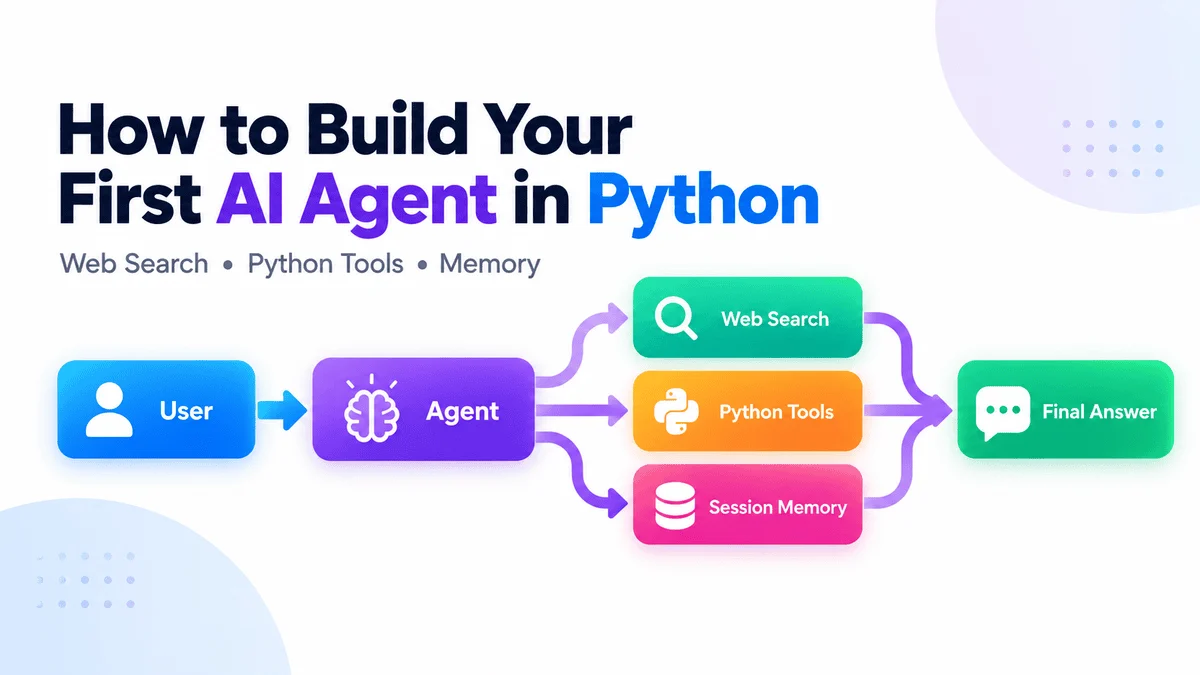
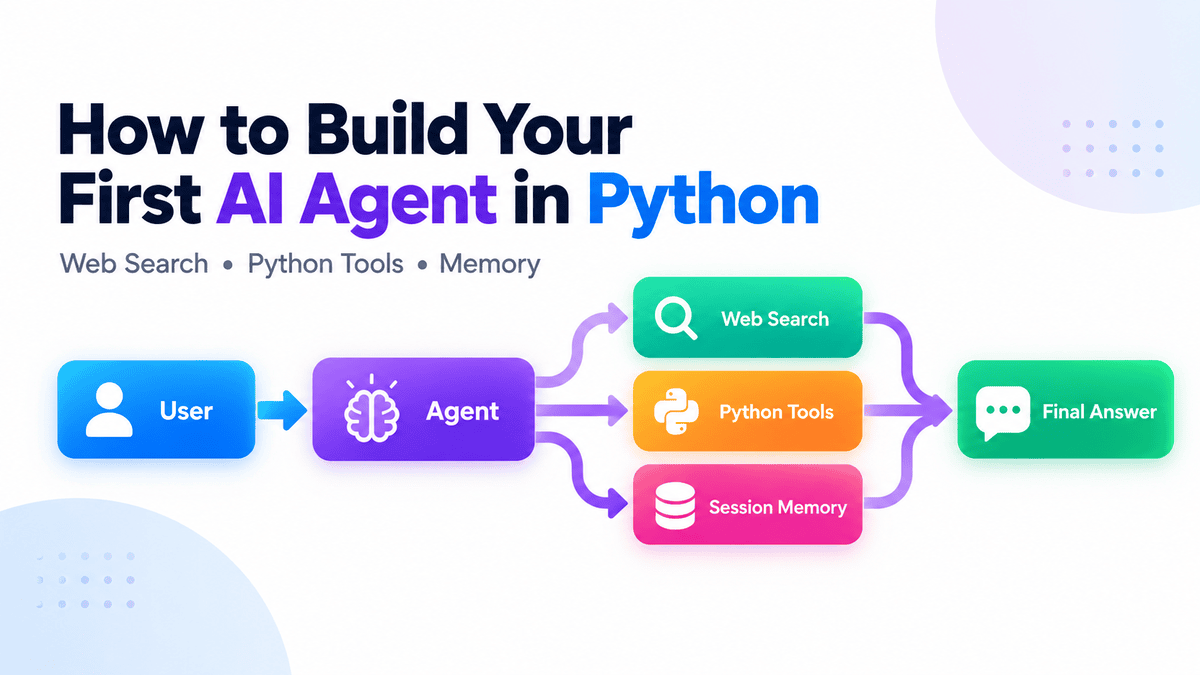
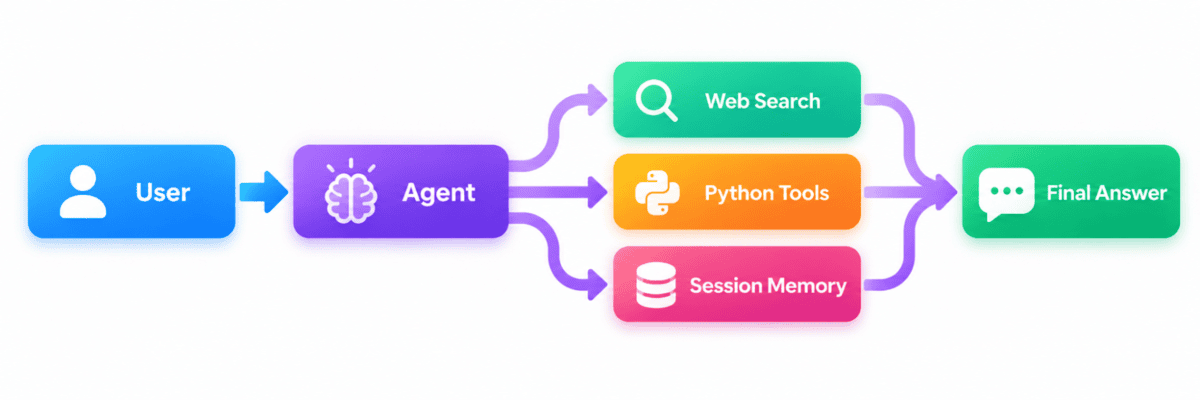
An AI agent introduces a critical architectural component: the Execution Loop. The workflow evolves into: User → Agent → Tool (if needed) → Agent → Final Response.
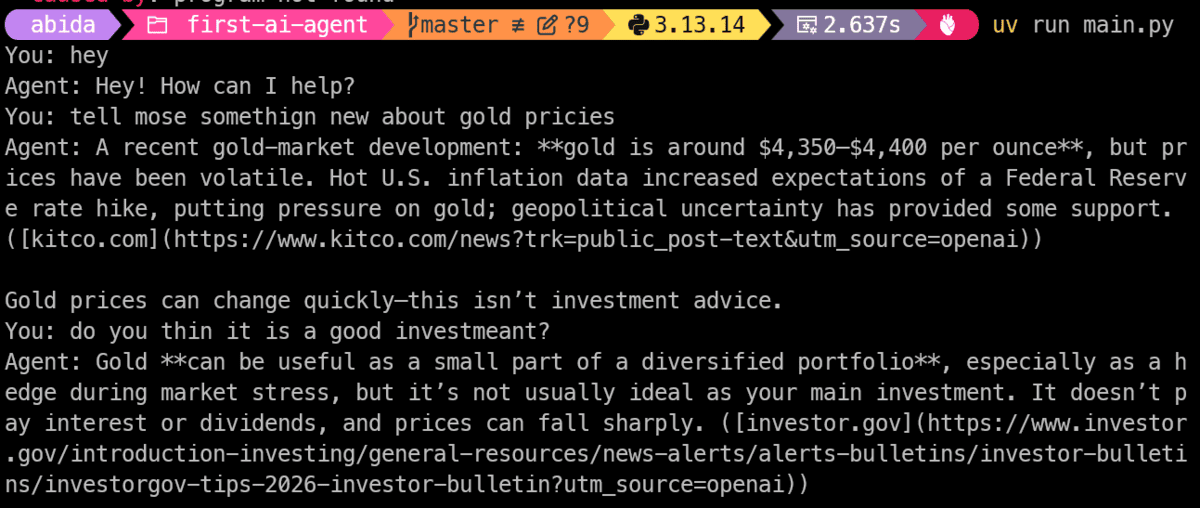
In this scenario, the agent acts as a reasoning engine. When faced with a query, it assesses whether it possesses sufficient information to answer. If it requires external data—such as real-time stock prices, web search results, or specialized mathematical computations—it pauses its text generation, selects the appropriate tool, and executes it. The output of that tool is then fed back into the agent, which evaluates the new information before providing a final, synthesized answer. This ability to operate across multiple steps is what defines "agentic" behavior.
Chronology of Development: Building Your First Agent
The process of building an agent has moved from low-level API manipulation to declarative configuration. Here is the chronological path to implementing your first research-oriented assistant.
Phase 1: Environment Configuration
Before code is written, a stable environment is paramount. Utilizing modern dependency managers like uv ensures that your Python environment remains isolated and performant.
- Project Initialization: Create a dedicated directory and initialize your environment.
mkdir first-ai-agent && cd first-ai-agent uv init uv add openai-agents - Authentication: Securely store your API credentials as an environment variable to ensure your application can authenticate with OpenAI’s backend services.
Phase 2: Defining the Core Agent
The Agent object acts as the persona and the logic controller. By defining instructions, you set the boundaries for the agent’s behavior. By passing a list of tools, you equip it with specific capabilities.
from agents import Agent, Runner, WebSearchTool

agent = Agent(
    name="Research Assistant",
    instructions="You are a concise research assistant. Use web search for current data.",
    tools=[WebSearchTool()],
)
Phase 3: The Execution Engine
The Runner is the unsung hero of the SDK. It manages the state of the conversation, handles the underlying API calls, and automatically parses the output of tools. When you call Runner.run_sync(), the SDK performs the heavy lifting, orchestrating the back-and-forth between the model and the external tools until the task is complete.
Supporting Data and Custom Implementation
The power of an agent is directly proportional to its toolset. While the WebSearchTool is excellent for general knowledge, the real utility emerges when agents are integrated into custom business logic.
Integrating Custom Python Tools
The OpenAI Agents SDK utilizes Python decorators to bridge the gap between human-readable code and machine-executable schemas. By using the @tool decorator, developers can turn any standard function into an agent capability.
from agents.decorators import tool

@tool
def calculate_total(price: float, quantity: int) -> float:
    """Calculate the total cost of an order."""
    return price * quantity
The SDK automatically extracts the function name, arguments, and type hints to create a JSON schema that the LLM understands. This eliminates the need for manual prompt engineering to define tool-use protocols. When the agent receives a prompt like, "Calculate the cost of 14 units at $2.49," it identifies that calculate_total is the appropriate function, extracts the arguments, and returns the result without the user ever seeing the underlying code execution.
Persistent Memory via Sessions
One of the primary challenges in AI development is context retention. Stateless models require the developer to manually manage the history of the conversation. The Agents SDK simplifies this with the Session object. By utilizing SQLiteSession, developers can store the entire history of a conversation in a local database file, allowing the agent to remember context across multiple user sessions and system restarts.
Implications for Future Development
The transition to agentic workflows has profound implications for software architecture and technical debt.
1. Shift from Hardcoding to Reasoning
Traditionally, if a user wanted to fetch data and perform a calculation, the developer would write an if-else chain or a sequence of function calls. Agents replace this rigid flow with probabilistic decision-making. The developer provides the tools, and the agent decides if and when they are needed. This significantly reduces the complexity of the application’s control flow.
2. Enhanced Debugging via Tracing
A common critique of LLMs is their opacity. The OpenAI Agents SDK addresses this by enabling tracing by default. Traces provide a granular, step-by-step breakdown of the agent’s internal thought process. If an agent fails to arrive at the correct conclusion, developers can inspect the trace to see exactly which tool was called, what arguments were passed, and how the model interpreted the tool’s output. This level of observability is essential for moving from experimental prototypes to production-grade applications.
3. Scalability and Extensibility
The modular nature of the SDK allows for seamless growth. An agent that starts with a simple web search can be scaled to support:
- Database Interactions: Connecting agents to SQL or NoSQL databases to retrieve real-time customer data.
- API Integrations: Using agents to interact with SaaS platforms like Jira, Slack, or GitHub via REST APIs.
- Multi-Agent Handoffs: Designing systems where specialized agents (e.g., a "Research Agent" and a "Code Execution Agent") pass tasks between each other to solve complex, multi-layered problems.
Conclusion: The Path Forward
Building your first AI agent is less about mastering a new, complex language and more about adopting a new mindset. It is about shifting from "coding the process" to "providing the capabilities."
By equipping your models with the right tools, defined through simple Python decorators, and providing them with persistent memory, you enable them to operate with a level of autonomy that was previously reserved for highly specialized systems. As the ecosystem matures, we can expect to see an influx of tools—such as Model Context Protocol (MCP) servers and standardized guardrails—that will further harden these agents for enterprise use.
For the modern developer, the message is clear: start small. Create a single, functional workflow that solves one specific problem. Once that foundation is established, the modular architecture of the OpenAI Agents SDK ensures that you can expand your agent’s capabilities as your application’s requirements evolve. The future of software is not just in writing code that executes instructions, but in creating intelligent systems that understand the world well enough to act within it.