By Editorial Staff
France is currently gripped by a wave of public frustration not seen in years. As hundreds of thousands of citizens descend upon the streets of Paris, Marseille, Lyon, and beyond, the message from the public is clear: the current economic trajectory of the French Republic is failing its people. Driven by a volatile combination of a burgeoning national debt crisis, crumbling educational infrastructure, and a palpable sense of stagnation, the French populace has reached a boiling point.
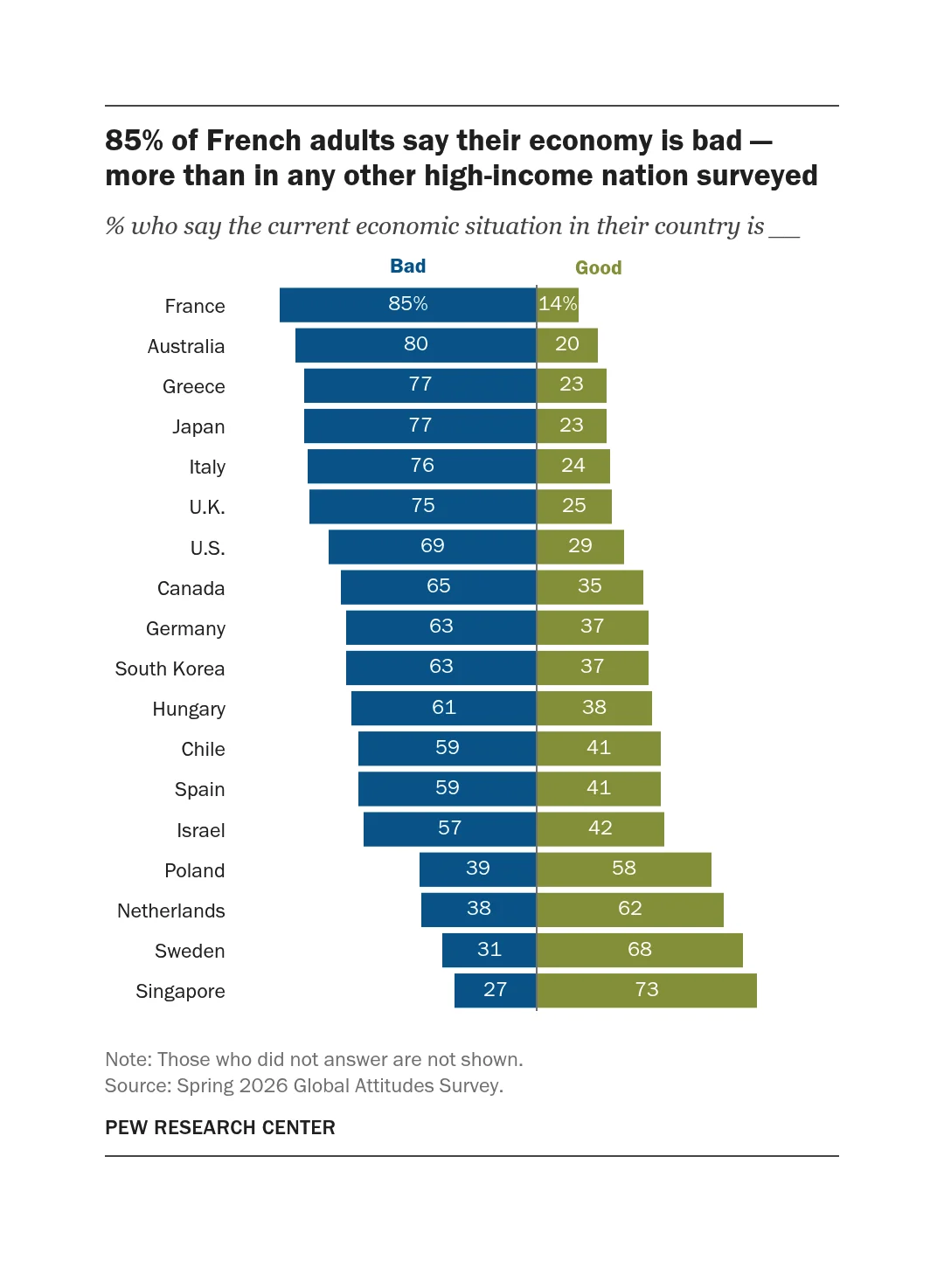
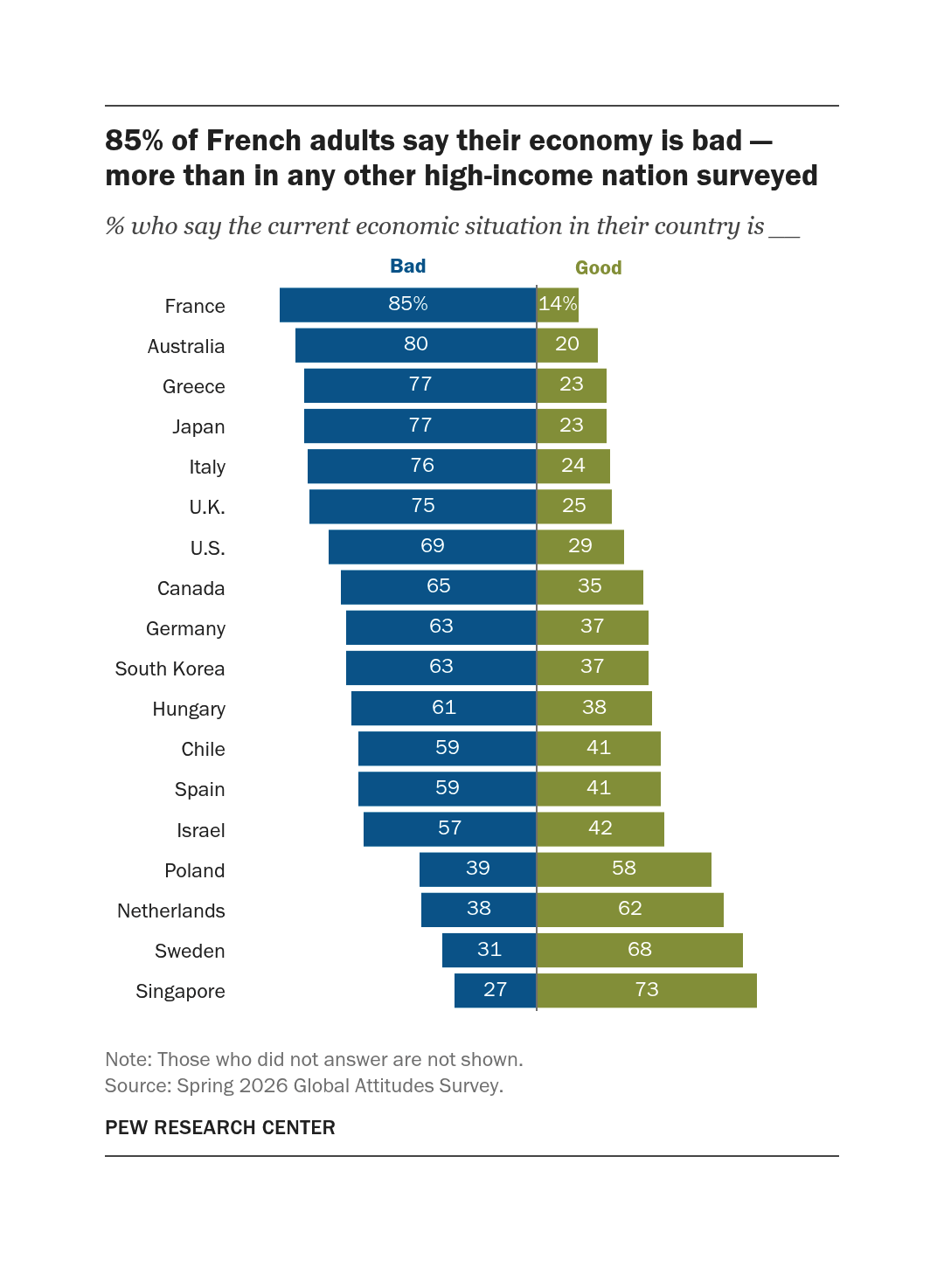
New data from the Pew Research Center confirms that this unrest is not merely a fringe movement but a reflection of a deeply ingrained, widespread malaise. With 85% of French adults describing their country’s economic situation as "bad," France stands as the most pessimistic nation among 18 high-income countries surveyed this year. This article examines the roots of this discontent, the progression of the crisis, and the potential long-term implications for the nation’s social and political fabric.
The Anatomy of the Economic Crisis
The current crisis is not a singular event but an accumulation of systemic failures. While the government has struggled to manage the post-pandemic recovery, the reality for the average French citizen has been one of tightening belts and diminishing expectations.
A Debt-Ridden Horizon
The French government is grappling with a debt-to-GDP ratio that has drawn sharp criticism from European Union officials and domestic fiscal hawks alike. The "growing debt crisis," as identified by economic analysts, has limited the state’s capacity to invest in essential public services. When the government attempts to implement austerity measures or cut spending, the backlash is swift and severe.

The Educational Tipping Point
The most visible spark for the recent street protests has been the state of the public school system. Parents, teachers, and students have united in a call for reform, citing chronic underfunding, decaying infrastructure, and overcrowding. For many, the schools serve as the canary in the coal mine—if the state cannot provide a quality environment for the next generation, the perceived "social contract" is effectively broken.
A Chronology of Declining Sentiment (2018–2026)
The decline in public optimism did not happen overnight. The Pew Research Center’s longitudinal data reveals a steady, downward trend in economic confidence that has been accelerated by both global shocks and domestic policy decisions.
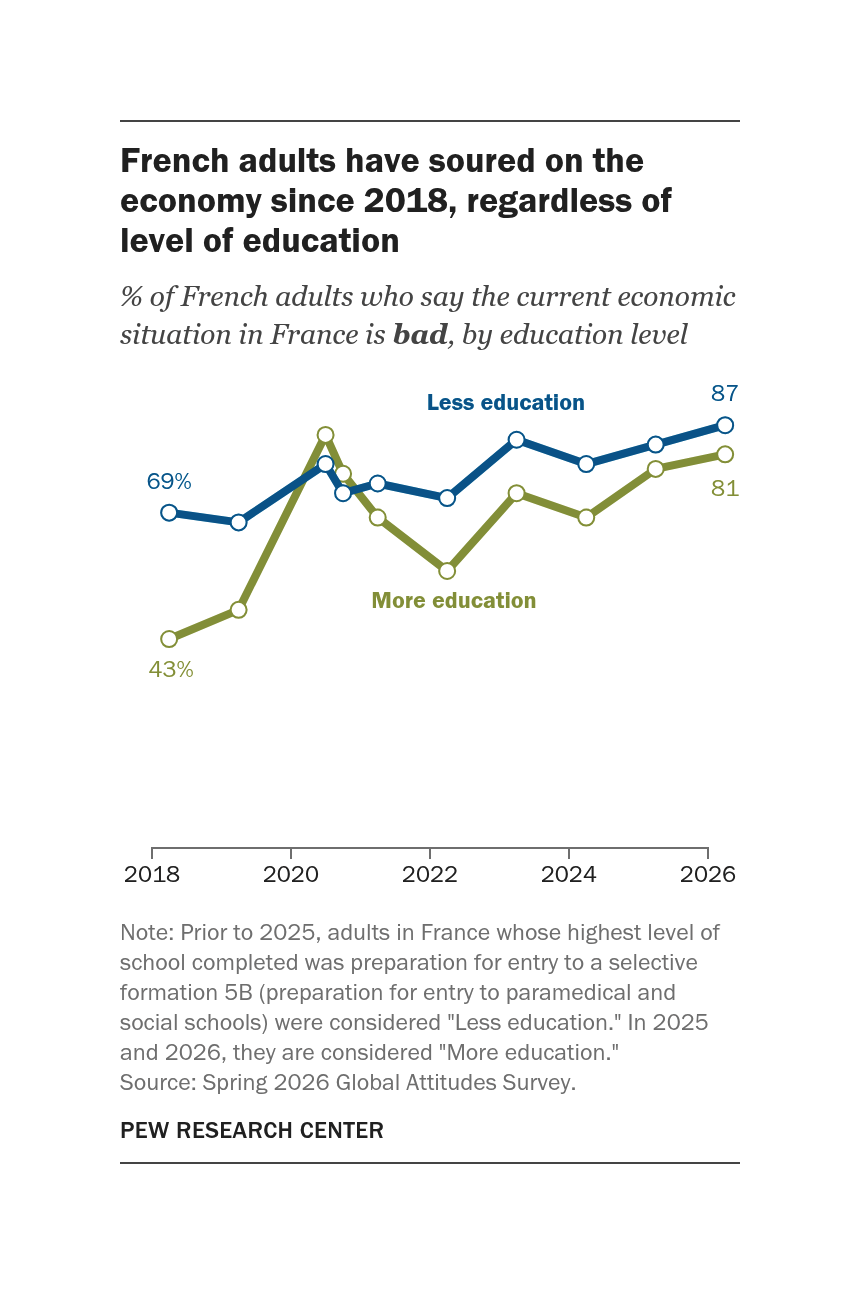
- 2018–2019: The Pre-Crisis Baseline. In 2018, only 43% of those with "more education" and 69% of those with "less education" viewed the economy as bad. The national mood was cautious but not yet despairing.
- 2020: The Pandemic Shock. The onset of COVID-19 caused a seismic shift. By the summer of 2020, economic pessimism spiked, with 85% of "more educated" adults—and 79% of "less educated" adults—labeling the economy as "bad."
- 2022: The Brief Recovery and Subsequent Slide. While there was a slight stabilization in 2022, the subsequent years saw a return to pessimism. The gap between educational demographics began to compress as inflation and energy costs hit all tiers of society.
- 2026: The Current Nadir. Today, the pessimism has reached a near-unanimous level. The 85% of the total population who view the economy negatively marks the highest level of dissatisfaction in the developed world, surpassing even nations like Australia, Greece, and Japan.
Supporting Data: Why France Stands Out
The 2026 Global Attitudes Survey provides a stark comparison between France and its peers. While economic anxiety is a global phenomenon, the intensity of the French sentiment is unique.
Comparative Pessimism
When asked to characterize the national economy, 85% of French respondents chose "bad." To put this in perspective, only 69% of U.S. respondents and 63% of German respondents expressed similar views. In contrast, countries like Singapore and Sweden maintain much higher levels of confidence, with 73% and 68% of their populations, respectively, viewing their economies in a positive light.
The Education Gap
Interestingly, the divide between educational levels has narrowed significantly. In 2018, there was a 26-point gap between those with more education and those with less regarding their negative views of the economy. By 2026, that gap has shrunk to just 6 points (81% vs 87%). This suggests that the current economic pain is no longer confined to specific socioeconomic cohorts; it is a shared experience across the French workforce.
The Ideological Dimension
The data also highlights the role of political polarization. Among those who identify with the ideological right, the disapproval rate reaches 91%. Perhaps most notably, supporters of the National Rally—the right-wing populist party led by Marine Le Pen—are among the most critical, with 92% expressing dissatisfaction. This convergence suggests that economic frustration has become a primary driver of the populist surge currently reshaping French politics.
Official Responses and the Governance Challenge
On September 15, 2026, a high-stakes press conference featuring France’s Minister of the Economy, Finance, and Industrial, Energy and Digital Sovereignty, Roland Lescure, alongside Bank of France Governor Emmanuel Moulin, attempted to address the growing unrest.
The official government stance remains focused on structural reform. Minister Lescure emphasized that "the path to recovery requires difficult decisions, but those decisions are necessary to ensure the long-term sovereignty of the French economy." Governor Moulin echoed these sentiments, stressing the need for fiscal discipline to stabilize the national debt.
However, these messages have largely fallen on deaf ears. For the thousands of protesters currently occupying major thoroughfares, the "sovereignty" mentioned by the Minister feels disconnected from their daily struggle to afford basic necessities and secure adequate public services. The government’s challenge is not merely economic; it is a challenge of communication and trust. They are facing a population that no longer believes in the promised outcomes of current reforms.
Implications: The Road Ahead
As France navigates this period of instability, the implications for the nation and the broader European Union are profound.
Social Fragmentation
The breadth of the protests suggests that the feeling of being "left behind" is not limited to rural areas or specific industries but is a national sentiment. This fragmentation makes it increasingly difficult for the government to implement coherent, long-term policy without triggering a new wave of civil unrest.
Political Realignment
The fact that 92% of National Rally supporters view the economy as "bad" highlights a significant political risk for the current administration. If the government fails to address these concerns, the next election cycle may see a dramatic shift toward political extremes. The economic anxiety measured by Pew is a direct fuel for populism; as long as the perception of a "bad" economy persists, traditional centrist parties will likely continue to lose their grip on the electorate.
The EU Connection
France is a cornerstone of the European project. A weakened, unstable France creates a ripple effect across the Eurozone. If the French government is forced to abandon fiscal discipline due to domestic pressure, it could trigger a wider crisis of confidence in the Euro, potentially testing the limits of European solidarity.
The Path Forward
To regain public confidence, the French administration will need to move beyond technical economic jargon and address the visceral, daily anxieties of its citizens. Whether through targeted investments in education, more transparent fiscal management, or a broader social dialogue, the government must find a way to reconcile its budgetary constraints with the public’s demand for a more stable and equitable future.
The coming months will be critical. If the current trajectory continues, France risks entering a prolonged period of legislative paralysis, where the government’s ability to govern is hampered by its inability to find common ground with an increasingly disillusioned populace. The "Pessimism Index" of 2026 is a warning sign that cannot be ignored.

Methodology Note: The data presented here is based on a representative survey of 1,006 French adults conducted by the Pew Research Center between Feb. 9 and April 17, 2026. For full details on the survey methodology and specific questions, please refer to the official Pew Research Center archives.