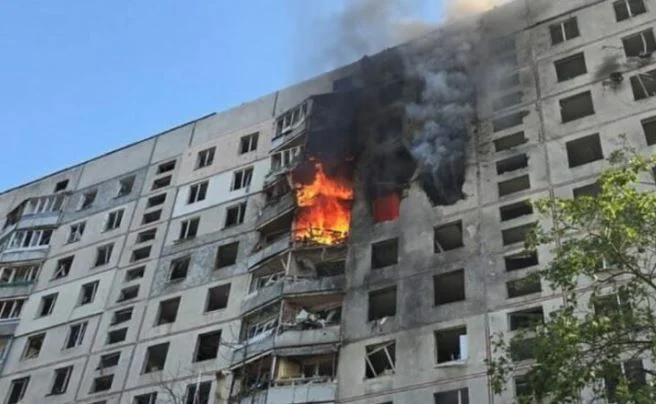
ZAPORIZHZHIA, UKRAINE – [Date of article, e.g., October 26, 2026] – A brutal Russian missile strike targeting the southeastern Ukrainian city of Zaporizhzhia in the early hours of this morning has tragically claimed the lives of at least seven civilians, including three young children. The devastating assault, which struck a five-story residential building, has also left at least ten individuals wounded, with one child among the injured and two adults reported to be in critical condition. Search and rescue operations are intensely underway amidst the rubble, as authorities fear more victims may still be trapped beneath the collapsed structures.
The attack, described by Ukrainian officials as an act of terror, underscores the relentless human cost of the ongoing full-scale invasion, particularly for non-combatants in cities near the active frontlines. Zaporizhzhia, a strategically vital city, has been a frequent target of Russian aggression, enduring repeated shelling and missile attacks that often indiscriminately hit civilian infrastructure.
Mykhailo Semikin, the Acting Head of the Zaporizhzhia Military Administration, conveyed the grim update via Telegram, confirming the rising death toll and the severity of the injuries. His office continues to coordinate the emergency response, mobilizing rescue workers, paramedics, and volunteers to sift through the debris and provide urgent medical assistance to the survivors. The incident has sent shockwaves across Ukraine and drawn renewed international condemnation, highlighting the urgent need for enhanced air defense systems and accountability for war crimes.
Main Facts of the Attack
The pre-dawn hours of [Date] brought terror to Zaporizhzhia as Russian forces unleashed a barrage of guided bombs on the city, with one particular strike proving catastrophic. The target, a residential building housing numerous families, was reduced to a mangled ruin, trapping its unsuspecting occupants.
The Deadly Toll
Initial reports indicated at least two fatalities, but as rescue teams meticulously worked through the wreckage, the grim reality of the attack began to unfold. Mykhailo Semikin confirmed that the death toll had tragically climbed to seven, a figure that includes three innocent children. The presence of children among the deceased and injured amplifies the profound grief and outrage, serving as a stark reminder of the indiscriminate nature of modern warfare and its devastating impact on the most vulnerable. Families are left shattered, and communities are grappling with an unimaginable loss, facing the stark reality of sudden, violent death brought to their doorsteps. The emotional and psychological scars left by such an event will undoubtedly linger for years, if not generations.
Target and Methodology
The strike specifically targeted a five-story residential apartment block, a clear civilian structure with no apparent military significance. Ukrainian officials reported that the attack was carried out using "guided bombs," a type of munition designed for greater precision than unguided artillery. The use of such weaponry against a residential area raises serious questions about intent and adherence to international humanitarian law. While guided bombs are theoretically capable of precise targeting, their deployment in densely populated urban environments invariably carries a high risk of civilian casualties, often constituting a disregard for the principle of distinction between military objectives and civilian objects. The choice of weapon and target suggests either a deliberate targeting of civilians or a reckless indifference to civilian lives, both of which are grave violations of international law.
Immediate Response and Ongoing Efforts
In the immediate aftermath of the strike, emergency services, including the State Emergency Service of Ukraine (SESU), rapidly deployed to the scene. Firefighters battled blazes, while search and rescue teams, aided by sniffer dogs and heavy machinery, began the arduous task of sifting through tons of concrete and twisted metal. Medical personnel established triage points to provide immediate care to the wounded before transporting them to local hospitals. The sheer scale of the destruction has made the rescue operation incredibly challenging, with fears that the number of casualties could still rise as more debris is cleared. Volunteers from the local community have also rallied, providing support, food, and comfort to those affected, demonstrating the resilient spirit of the Ukrainian people in the face of adversity. The ongoing efforts are a race against time, with every minute crucial for those potentially trapped beneath the ruins.
Chronology of the Assault
The attack on Zaporizhzhia was not an isolated incident but part of a broader pattern of Russian aggression against Ukrainian cities. However, the events of this particular morning unfolded with a swift and deadly precision that left little time for residents to react.
Pre-Dawn Strikes and Initial Reports
The tranquility of the pre-dawn hours was shattered by the deafening roar of incoming munitions. Around [Specific Time, e.g., 4:30 AM] local time, multiple explosions rocked Zaporizhzhia. Residents, awakened by the blasts, immediately sought shelter, a routine response to the constant threat of aerial attacks. Within minutes, emergency services received distress calls reporting a direct hit on a residential building in one of the city’s districts. Initial assessments from local authorities confirmed a significant strike, with pictures and videos quickly emerging online showing extensive damage, smoke billowing from the site, and the beginnings of rescue efforts. The first reports from the ground were harrowing, describing widespread destruction and the immediate discovery of casualties.
Escalation of Casualties
As daylight broke, the full extent of the tragedy began to emerge. Initially, officials confirmed two fatalities and several injuries, but these figures were rapidly updated as rescue teams accessed more areas of the collapsed building. The discovery of more bodies, particularly those of children, sent a wave of shock and sorrow throughout the nation. Mykhailo Semikin’s updates chronicled the grim escalation, from initial reports of two dead to the confirmation of seven, with the critically injured fighting for their lives in hospitals. This progressive increase in the casualty count underscored the complexity and danger of the rescue operation, as well as the overwhelming force of the explosion that leveled parts of the structure. Each updated figure represented a life lost, a family devastated, and another layer of grief for a country already reeling from years of conflict.
The Aftermath: Search and Rescue
The immediate aftermath saw a coordinated and desperate search and rescue operation. Hundreds of personnel, including firefighters, paramedics, police, and military engineers, converged on the scene. They were joined by a large contingent of civilian volunteers, eager to lend a hand in any way possible. Heavy lifting equipment, including cranes and excavators, was brought in to carefully remove slabs of concrete and debris, while sniffer dogs were deployed to detect signs of life beneath the rubble. The work is painstaking and fraught with danger, as the remaining parts of the building are unstable, posing a constant threat to the rescuers. Psychologists are also on site, providing support to survivors, witnesses, and the rescue teams themselves, who are often exposed to traumatic scenes. The operations are expected to continue for several days, until all possible victims are accounted for, even as hope dwindles for those still missing.
Supporting Data and Context
The attack on Zaporizhzhia cannot be viewed in isolation. It is part of a larger, systemic pattern of aggression that has defined the conflict in Ukraine, with profound implications for the civilian population.
Zaporizhzhia: A City Under Siege
Zaporizhzhia holds immense strategic importance in the ongoing conflict. Located in southeastern Ukraine, it serves as a critical industrial hub and a gateway to central Ukraine. Crucially, it is also home to the Zaporizhzhia Nuclear Power Plant (ZNPP), Europe’s largest nuclear facility, which has been under Russian occupation since March 2022. The city itself sits perilously close to the active frontlines, making it a constant target for Russian artillery and missile attacks. Its strategic location means that control over Zaporizhzhia is vital for both sides, leading to relentless pressure and frequent attacks on its infrastructure, often with devastating consequences for its residents. The presence of the nuclear plant adds another layer of global concern, as any damage to the facility could lead to a catastrophic environmental and humanitarian disaster far beyond Ukraine’s borders.
Civilian Targets and International Law
The targeting of a residential building, resulting in multiple civilian deaths including children, constitutes a grave violation of international humanitarian law (IHL), also known as the laws of armed conflict. IHL strictly prohibits direct attacks on civilians and civilian objects, such as homes, schools, and hospitals. The principle of distinction mandates that parties to a conflict must always distinguish between combatants and civilians, and between military objectives and civilian objects. Furthermore, the principle of proportionality prohibits attacks that are expected to cause incidental loss of civilian life, injury to civilians, or damage to civilian objects, which would be excessive in relation to the concrete and direct military advantage anticipated. Attacks that deliberately target civilians or civilian infrastructure, or are carried out with reckless disregard for civilian life, can be classified as war crimes under the Rome Statute of the International Criminal Court (ICC). Human rights organizations and international bodies have repeatedly documented such violations by Russian forces throughout the conflict.

Previous Attacks on Zaporizhzhia
This morning’s strike is far from an isolated incident. Zaporizhzhia has endured a relentless barrage of Russian attacks since the full-scale invasion began. The city has been subjected to indiscriminate shelling, drone attacks, and missile strikes, often targeting residential areas, energy infrastructure, and public facilities. Notable previous attacks include a missile strike in October 2022 that hit a convoy of civilians attempting to evacuate, killing dozens, and numerous other strikes on apartment blocks and critical infrastructure throughout 2022 and 2023. These repeated assaults have instilled a constant state of fear and anxiety among the population, forcing many to spend significant portions of their lives in bomb shelters. The pattern of attacks on civilian targets suggests a deliberate strategy to terrorize the population and undermine their morale.
The Broader Humanitarian Impact
The cumulative effect of these attacks has created a profound humanitarian crisis in Zaporizhzhia and across Ukraine. Beyond the immediate casualties, hundreds of thousands have been displaced from their homes, forced to seek refuge in safer regions or abroad. Those who remain face immense psychological trauma, including PTSD, anxiety, and depression, particularly children exposed to the horrors of war. Critical infrastructure, including heating, water, and electricity networks, is frequently damaged, especially during the colder months, making daily life incredibly challenging. Access to healthcare is often disrupted, and the economy has been severely impacted. Humanitarian organizations are struggling to meet the vast needs for shelter, food, medical supplies, and psychological support, as the scale of destruction continues to grow. The attack in Zaporizhzhia is a stark reminder of the ongoing humanitarian catastrophe unfolding in Ukraine, demanding sustained international attention and aid.
Official Responses and Condemnations
The attack on Zaporizhzhia immediately triggered a wave of condemnation from both Ukrainian and international officials, highlighting the ongoing global concern over Russia’s conduct in the war.
Local Ukrainian Authorities
Mykhailo Semikin, the Acting Head of the Zaporizhzhia Military Administration, was at the forefront of the local response. His statements, delivered via Telegram, provided critical updates on the casualty figures and the ongoing rescue efforts. Semikin vehemently condemned the attack, calling it a "barbaric act of terrorism" against the civilian population. He emphasized the determination of local authorities and emergency services to continue their work tirelessly, ensuring every possible survivor is reached and every victim accounted for. He also appealed for continued international support, particularly for air defense systems, which he stressed are vital for protecting Ukrainian cities from such devastating strikes. Local municipal leaders echoed Semikin’s sentiments, expressing profound grief for the victims and pledging full support to the affected families, including housing and financial assistance for those who lost their homes.
National Ukrainian Government
The national government in Kyiv swiftly reacted, with President Volodymyr Zelenskyy issuing a powerful condemnation of the attack. In a statement, Zelenskyy described the strike as another "inhuman act" by Russia, underscoring Moscow’s consistent targeting of civilians. He reiterated Ukraine’s unwavering resolve to defend its people and territory, vowing that Russia would be held accountable for every life lost and every building destroyed. The President also renewed his calls for increased military aid from international partners, specifically emphasizing the urgent need for more advanced air defense systems to protect Ukrainian skies. Ukraine’s Ministry of Foreign Affairs issued a formal protest, denouncing the attack as a war crime and urging the international community to strengthen sanctions against Russia and support efforts to establish a special tribunal for Russian aggression.
International Reactions and Calls for Accountability
The international community was quick to respond with widespread condemnation. The United Nations Secretary-General issued a statement expressing deep concern over the civilian casualties and reiterated calls for all parties to respect international humanitarian law. The European Union’s High Representative for Foreign Affairs and Security Policy denounced the "senseless violence" and reaffirmed the EU’s unwavering support for Ukraine’s sovereignty and territorial integrity. Several EU member states, including Germany, France, and Poland, individually condemned the attack, with their respective foreign ministers calling for thorough investigations into potential war crimes.
The United States also condemned the attack, with the State Department spokesperson reiterating calls for Russia to cease its aggression and withdraw its forces from Ukraine. NATO Secretary-General highlighted the continued brutality of Russia’s war and pledged ongoing support for Ukraine’s self-defense. Human rights organizations like Amnesty International and Human Rights Watch issued reports detailing the violations of international law, demanding accountability for those responsible. Calls for the International Criminal Court (ICC) to investigate these incidents as potential war crimes intensified, underscoring a growing international consensus that such acts cannot go unpunished.
Russia’s Stance
As is characteristic of its response to previous incidents involving civilian casualties, Russia has yet to acknowledge responsibility for the strike or has offered its standard denial. Typically, the Kremlin dismisses accusations of targeting civilians, often claiming that its forces only strike military targets or that Ukrainian air defense systems are responsible for collateral damage. In other instances, Russian state media propagates disinformation, fabricating narratives that blame Ukraine itself for attacks on its own civilian infrastructure. This consistent pattern of denial and deflection further complicates efforts for accountability and justice, demonstrating Russia’s continued disregard for international norms and factual reporting.
Implications of the Attack
The latest attack on Zaporizhzhia carries significant implications, reverberating across various facets of the ongoing conflict and its humanitarian, social, and geopolitical dimensions.
Escalation of Violence and Civilian Vulnerability
The strike on Zaporizhzhia, particularly with its high civilian death toll including children, signifies a disturbing escalation in the intensity and indiscriminate nature of Russian attacks. It underscores the profound vulnerability of civilians in frontline cities, who are often caught in the crossfire or deliberately targeted. This pattern of attacking residential areas suggests a calculated strategy to sow fear, destabilize communities, and potentially pressure the Ukrainian government. The use of guided bombs, while ostensibly precise, in urban settings ensures widespread devastation and civilian casualties, indicating a deliberate disregard for human life. This escalation threatens to further entrench the conflict, making any prospect of a diplomatic resolution more distant as trust and goodwill erode with each civilian casualty.
Impact on Civilian Morale and Resilience
Such brutal attacks undoubtedly take a heavy toll on civilian morale. Living under constant threat, with the knowledge that one’s home could be destroyed at any moment, creates immense psychological strain. However, paradoxically, these attacks often also serve to harden the resolve of the Ukrainian people. Instead of breaking their spirit, acts of terror frequently galvanize communities, fostering a stronger sense of national unity and a deeper commitment to resistance. The outpouring of local volunteers to aid in rescue efforts in Zaporizhzhia is a testament to this resilience. Yet, the cumulative trauma can lead to long-term societal challenges, including widespread mental health issues and a generation of children growing up with the scars of war. The human spirit’s capacity for endurance is immense, but it is not infinite.
Humanitarian Aid Challenges
The continuous targeting of urban centers exacerbates the already dire humanitarian situation in Ukraine. Each strike creates new displaced persons, new medical emergencies, and new requirements for shelter, food, and basic necessities. Humanitarian organizations face immense challenges in delivering aid, operating in dangerous conditions, and accessing affected areas, especially those close to the frontlines. The destruction of civilian infrastructure, including transportation networks and utilities, further complicates aid distribution. The international community’s capacity to provide sustained humanitarian assistance is constantly tested by the scale and frequency of these attacks, highlighting the need for robust, long-term funding and coordinated efforts to mitigate the suffering.
Geopolitical Ramifications and Future of the Conflict
The attack on Zaporizhzhia will undoubtedly have geopolitical ramifications. It will likely strengthen the resolve of Ukraine’s Western allies to continue providing military and financial support, reaffirming their commitment to helping Ukraine defend itself. Calls for more stringent sanctions against Russia and for the establishment of accountability mechanisms, such as a special tribunal, will intensify. The incident further diminishes any realistic prospects for immediate peace negotiations, as such acts of aggression make it incredibly difficult for Ukraine to consider any cessation of hostilities without a clear pathway to justice and security. It reinforces the narrative that Russia is unwilling to adhere to international norms and is committed to a strategy of attrition, with civilians bearing the brunt of its aggression. The future trajectory of the conflict will continue to be shaped by such tragic events, solidifying positions and making compromise increasingly difficult.
In conclusion, the brutal Russian missile strike on Zaporizhzhia serves as a grim reminder of the war’s relentless toll on innocent lives. The deaths of seven civilians, including three children, underscore the urgent need for robust international action, enhanced air defense capabilities for Ukraine, and unwavering commitment to holding perpetrators of war crimes accountable. As search and rescue operations continue and the city mourns its dead, the resilience of the Ukrainian people remains a beacon of hope in the face of unimaginable tragedy, yet their calls for justice and protection grow ever louder.