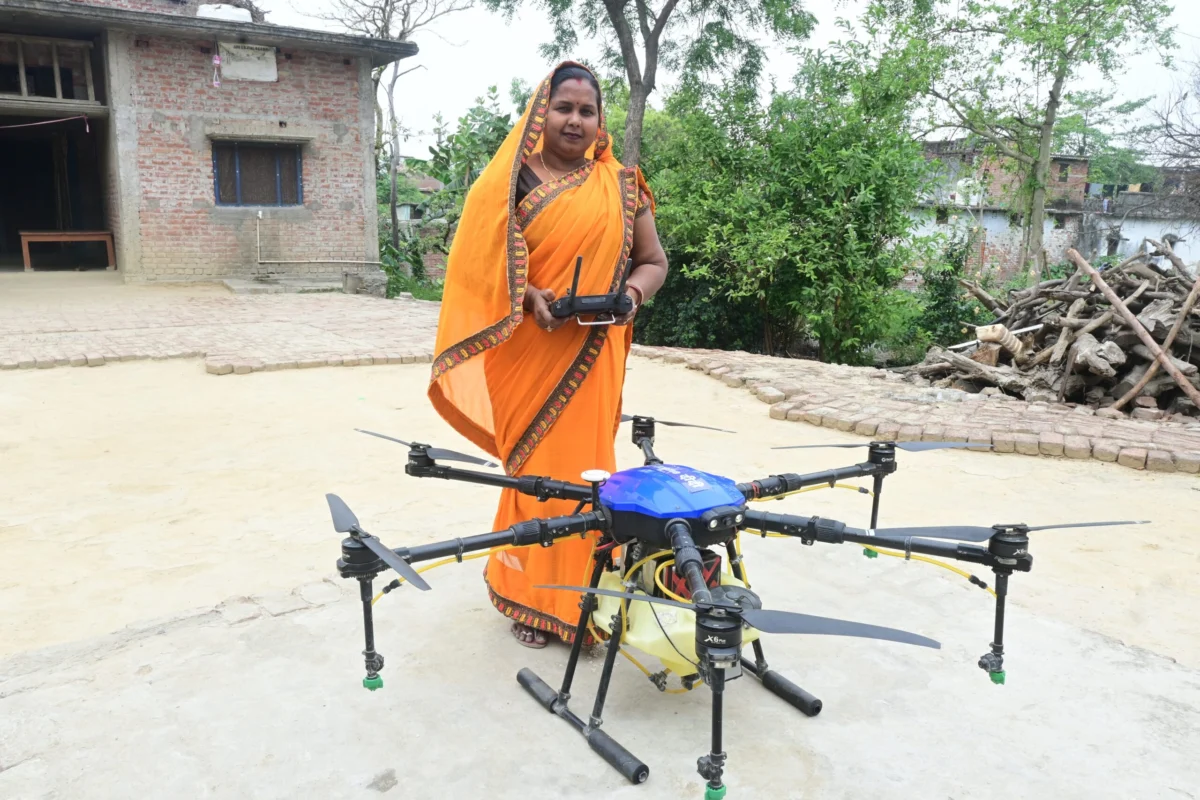
In the heart of Purvanchal, a region in the eastern reaches of Uttar Pradesh, India, a quiet revolution is taking flight. Literally. In the village of Deoria, Seema Gupta—affectionately known by her community as "Drone Didi"—has become a symbol of a burgeoning technological transformation. Farmers across the district now rely on her not for traditional manual labor, but for precision agricultural services. Armed with an agricultural drone, she navigates the skies above their fields, applying fertilizers and pesticides with surgical accuracy, optimizing crop yields, and drastically improving farm efficiency.
Seema’s journey from a rural homemaker to a tech-enabled entrepreneur is not an isolated success story; it is the flagship result of Tech Shakti Sri, a transformative initiative spearheaded by the nonprofit organization Jagriti, with the strategic support and funding of Cisco’s India Cash Grant program. This partnership is fundamentally altering the socio-economic landscape of Purvanchal by bridging the gap between untapped human potential and the digital tools required to harness it.
The Genesis of a Digital Movement
The Purvanchal region, while rich in history and culture, has long faced systemic challenges regarding economic mobility and access to modern infrastructure. For generations, the potential of its workforce—particularly its women—remained largely latent due to a lack of formal training and the absence of a digital ecosystem.
Recognizing that "talent is everywhere, even when opportunity is not," Cisco aligned its global corporate purpose—to power an inclusive future for all—with Jagriti’s deep grassroots reach. The objective was clear: to move beyond mere digital literacy and foster a structured path toward sustainable entrepreneurship. The result was the Tech Shakti Sri program, a multi-phased intervention designed to dismantle the barriers that keep rural women on the periphery of the digital economy.
A Chronology of Empowerment: The Three-Tiered Funnel
The success of Tech Shakti Sri lies in its highly structured, intentional design. Rather than adopting a "one-size-fits-all" approach, the program utilized a funnel methodology that allowed for wide-scale mobilization followed by intensive, high-impact incubation.
Phase 1: Mobilization and Awareness
The program kicked off with awareness camps across the districts of Deoria, Kushinagar, and Gorakhpur. The primary goal of this phase was to demystify technology. By engaging with local women, organizers sought to shift the perception of smartphones and digital tools from mere recreational devices to powerful instruments of economic mobility. This phase successfully mobilized 1,110 women, creating a foundational community of interest and aspiration.
Phase 2: Structured Skill Acquisition
From the initial group, 618 participants transitioned into formal, structured training. This phase focused on the "nuts and bolts" of the digital world:
- Computer and Internet Literacy: Moving from basic navigation to functional use.
- Digital Business Integration: Leveraging smartphones for banking, digital payments, and e-commerce.
- Digital Marketing: Using social media platforms to expand the reach of local businesses.
- Financial Literacy: Managing business capital, understanding profit margins, and navigating formal credit systems.
Phase 3: The Incubation Crucible
The most rigorous stage of the program involved selecting 42 high-potential candidates for an intensive incubation period. This was where the investment per participant deepened significantly. These women were provided with:
- Essential Hardware: Laptops, printers, and lamination machines to jumpstart their operations.
- One-on-One Mentorship: Guidance from Jagriti enterprise coaches on business strategy, client acquisition, and service diversification.
- Institutional Linkages: Connections to government e-service networks, local suppliers, and innovation hubs, ensuring these new entrepreneurs were integrated into the broader regional economy.
Supporting Data: From Potential to Prosperity
The results of this strategic investment are not merely anecdotal; they are reflected in the measurable economic success of the participants. Among the 42 women who completed the incubation phase, the transformation in income and self-sufficiency has been stark.
Consider the case of Kashish Verma from Gorakhpur. Entering the program with no prior experience in design, Kashish leveraged the training and hardware provided to build a thriving business in graphic design and video editing. Today, she manages a portfolio of four clients and earns approximately ₹40,000 per month—a significant income level for the region. Her success has not plateaued; she is currently upskilling in AI-driven design tools to stay ahead of market trends.
Similarly, Manisha Sharma, a resident of Deoria, successfully established a T-shirt printing business. Despite facing initial social resistance—a recurring theme in regions where traditional gender roles remain deeply entrenched—Manisha persevered. Her business is not only self-sustaining but has also created local employment, proving the program’s goal of creating a "multiplier effect" within the community.
Official Perspectives and Corporate Vision
The partnership between Cisco and Jagriti is viewed by leadership as a blueprint for future CSR (Corporate Social Responsibility) initiatives in developing economies.
Shreya Arora, a member of Cisco’s India Cash Grant team who supports the rollout and governance of these programs, emphasizes the importance of a holistic view. "Drawing on seven years of experience in program development," Arora notes, "my goal has always been to translate local needs into real-world solutions. Collaborating with Jagriti has allowed us to see how technology can be a catalyst for inclusive, community-driven change."
Ashutosh Kumar, CEO of Jagriti, highlights the cultural shift the program has facilitated. "In Purvanchal, there is a local saying: ‘jo dikhta hai, wahi bikta hai’—what is visible, sells. For generations, the extraordinary capabilities of women here remained hidden. Tech Shakti Sri was designed to make those capabilities visible by providing the pathway from potential to enterprise."
Harish Krishnan, Managing Director and Chief Policy Officer for Cisco India, South and South East Asia, reinforces the company’s long-term commitment. "Our commitment is to ensure that access to technology and opportunity reach those who need it the most. We are incredibly proud of what these women have achieved, and they serve as an inspiration for us to continue building pathways that enable more people to realize their full potential."
Implications: The Ripple Effect of Digital Inclusion
The broader implications of the Tech Shakti Sri program extend far beyond the balance sheets of individual businesses. By fostering a cohort of digitally fluent women, the program has created "last-mile" connectivity for rural communities. These women are now the go-to resources for their neighbors, assisting them in accessing government schemes, educational resources, and financial services that were previously out of reach.
The businesses that have emerged are diverse, ranging from drone services and IT education to gaming zones and digital photography studios. Each of these enterprises serves as a community hub, a physical space where digital access is democratized. This is the essence of Digital India—a grassroots reality where technology is not a luxury, but a utility.
Furthermore, the social impact is profound. By shattering the "glass ceiling" in traditional rural sectors, these women are actively redefining the status of women in their families and communities. They are proving that when provided with the right tools and a supportive network, women are not just beneficiaries of development—they are its primary drivers.
Conclusion: A Model for the Future
The success of the collaboration in Purvanchal serves as a compelling proof-of-concept for similar regions across India. The model—characterized by wide-scale mobilization, structured capacity building, and deep-dive incubation—addresses the fundamental friction between the "digital divide" and the "entrepreneurial spirit."
As Seema Gupta continues to fly her drone over the fields of Deoria, and as women like Kashish and Manisha scale their operations, they do more than build livelihoods; they build a legacy of inclusion. The work of Cisco and Jagriti has demonstrated that the future of India is not just in the high-tech corridors of its major metros, but in the hands of women in its villages who are learning to harness the power of the digital age to change their world. With plans to expand this approach to more communities, the trajectory for digital inclusion in India looks increasingly bright, paved by the ambition and resilience of its rural entrepreneurs.