Modern AI coding agents—such as Anthropic’s Claude Code, Cursor, GitHub Copilot, and OpenCode—have reached a level of proficiency that was unimaginable just a few years ago. They can generate boilerplate code, debug complex syntax errors, and refactor functions with high accuracy. However, seasoned software engineers know that writing code is only a small fraction of the product development lifecycle.
True software engineering encompasses requirement gathering, architectural planning, rigorous testing, security auditing, code review, and the strategic decision-making required to ship stable, production-ready applications. When AI agents lack a defined process, they often fall into the trap of "vibe coding"—writing code that looks correct but fails to adhere to the broader constraints of a professional codebase.
The solution is emerging in the form of AI Agent Skills: modular, reusable instructions and workflows that codify expert engineering methodologies. By integrating these skills, developers can transform their AI agents from simple code generators into disciplined, systematic software engineers.
1. The Core Philosophy: Why Skills Matter
The fundamental limitation of standard AI coding assistants is their tendency to work in isolation. Without external guidance, an agent may attempt to solve a problem by blindly modifying files until the error disappears. This "random walk" approach is antithetical to professional software development.
Agent skills act as a "meta-layer" of instructions. They provide the agent with a playbook: how to interpret a ticket, how to write a test before a line of implementation code is touched, and how to verify that a feature satisfies security requirements before it is committed. By adopting these repositories, developers are not just installing plugins; they are embedding best practices directly into their IDEs and CLI environments.
2. Top 5 Repositories Transforming AI Development
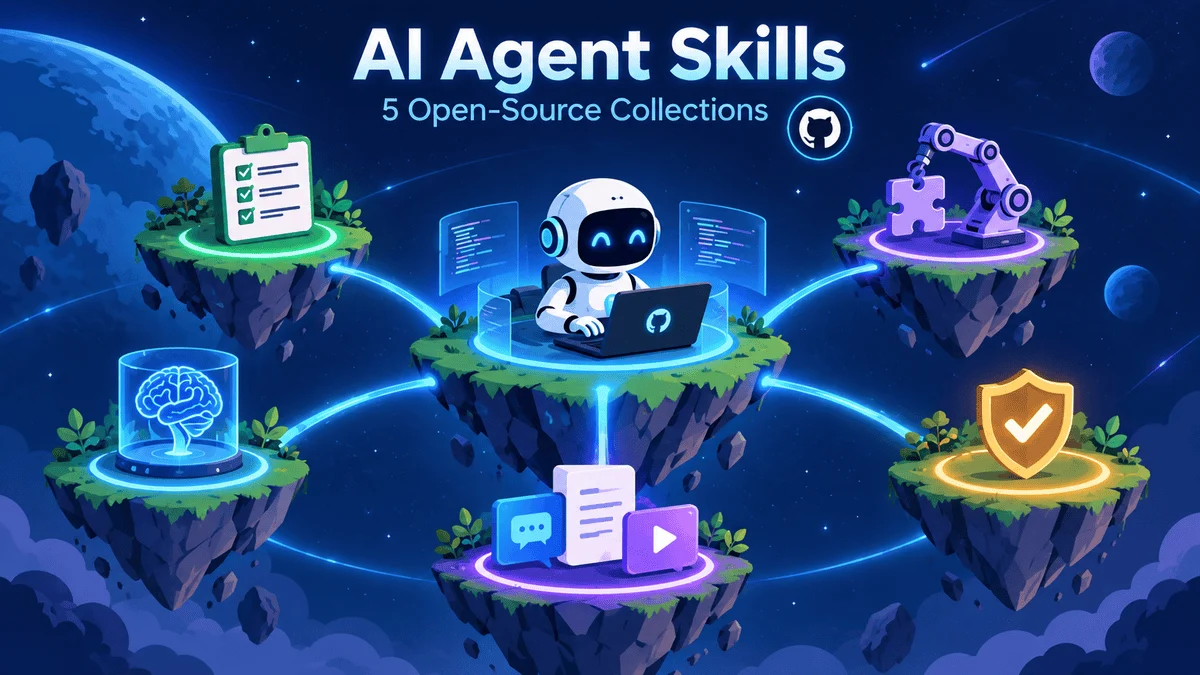
The current landscape of open-source agent skills is diverse, ranging from structured methodologies to highly composable toolkits. Here are the five most influential repositories currently shaping the field.
Superpowers by Jesse Vincent
Created by Jesse Vincent and the team at Prime Radiant, Superpowers is arguably the most rigorous implementation of an engineering methodology for AI.
- The Methodology: Superpowers moves beyond simple task execution. It enforces a strict workflow: brainstorming to define requirements, architectural design, plan approval, test-driven development (TDD), and final verification.
- Key Advantage: It solves the "hallucination of competence" by forcing the agent to demonstrate intent before it takes action. If you ask for a feature, it doesn’t just code; it maps out the sub-tasks, ensures they are logically sound, and checks the code against existing test suites.
- Best For: Teams and individuals who want a standardized, "by-the-book" development process that reduces technical debt.
Skills for Real Engineers by Matt Pocock
Matt Pocock’s Skills for Real Engineers is built on the premise that development should be pragmatic and modular.
- The Approach: Unlike a rigid framework, this collection is designed to be "Lego-like." It favors small, composable scripts that integrate into a larger pipeline.
- Key Feature: The
grill-with-docsskill is a standout. It forces the agent to interview the developer to clarify the "why" behind a task, effectively updating internal project documentation (likeCONTEXT.mdor ADRs) as it works. - Best For: Engineers who want to maintain full control over their workflow while automating the tedious, repetitive aspects of documentation and bug diagnostics.
ECC by Affaan Mustafa
ECC is, by volume and capability, the most comprehensive "platform" in this list. It is designed to turn an AI agent into an autonomous, self-improving unit.
- Capabilities: ECC provides a complete ecosystem including specialized agents, memory management, continuous learning, and security tools.
- Security Integration: The inclusion of "AgentShield"—a security layer that scans configurations for risky permissions and leaked secrets—is a critical addition for enterprise-grade development.
- Best For: Developers who want their AI agent to act as a full-stack teammate that remembers previous project context and grows in efficiency over time.
Awesome LLM Apps by Shubham Saboo
While others focus on specific coding workflows, Awesome LLM Apps acts as a massive laboratory for AI-driven development.
- The Scope: With over 100+ agents and skills, this repository allows developers to see how different models (GPT-4, Claude, Llama, DeepSeek) behave when subjected to various prompt-engineering techniques.
- Unique Utility: The "Project Graveyard" skill is a unique tool that analyzes abandoned local repositories, interprets their history, and makes recommendations on whether to revive them.
- Best For: Researchers, AI hobbyists, and developers looking to experiment with how different agents handle complex tasks outside of standard web development.
Agent Skills by Addy Osmani
Addy Osmani, a veteran in the web performance and engineering space, has created a repository focused squarely on the Product Lifecycle.
- The Workflow: His collection is structured around six distinct stages: DEFINE, PLAN, BUILD, VERIFY, REVIEW, and SHIP.
- Quality Gates: The standout feature here is "Constraint-Driven Development." Osmani’s collection allows developers to set performance and security budgets early, ensuring the agent doesn’t write "lazy" code that requires massive refactoring later.
- Best For: Frontend and full-stack developers who need to ensure that their AI-generated code meets strict performance and production standards.
3. Supporting Data and Technical Implementation
The adoption of these tools is supported by the CLI-based nature of modern AI agents. Most of these repositories utilize standardized installation methods like npx or /plugin install, ensuring they work across various environments including VS Code (Cursor/Cline), the terminal (Claude Code), and GitHub Copilot CLI.
| Repository | Focus Area | Installation |
|---|---|---|
| Superpowers | Methodology/Discipline | /plugin install superpowers |
| Skills for Real Engineers | Composability/Pragmatism | npx skills@latest add |
| ECC | Platform/Security | npx [email protected] setup |
| Awesome LLM Apps | Experimentation | npx skills add [url] |
| Agent Skills (Osmani) | Production/Lifecycle | npx skills add addyosmani/agent-skills |
4. Industry Implications: The Shift Toward "Agentic Engineering"
The rise of these skill repositories signals a fundamental shift in the software industry. We are moving away from the era where "coding assistants" are simple autocomplete tools.
Standardization of Workflow: By codifying how code is written, reviewed, and shipped, teams can enforce consistency. If every agent in an organization uses the same "Code Review" skill, the quality of pull requests becomes standardized regardless of which developer is using the AI.
Security and Governance: With tools like AgentShield, companies can finally trust AI agents with access to their codebase. By restricting what an agent can do through pre-defined, audited skills, organizations mitigate the risks of AI-induced security vulnerabilities.
The "Human-in-the-Loop" Evolution: The most successful engineers are not the ones who let the AI run wild; they are the ones who act as "Architects of the Workflow." By choosing which skills to enable and which prompts to prioritize, the human engineer remains the driver, while the AI becomes a hyper-efficient engine.
5. Conclusion: Choosing Your Toolkit
The abundance of these resources offers a significant advantage to the modern developer. However, the goal is not to install every available skill. Overloading an agent with too many instructions can lead to "prompt drift," where the model loses focus due to excessive system instructions.
The recommended approach is to start with a core methodology—such as Addy Osmani’s lifecycle workflows—and augment it with specialized skills from Matt Pocock’s collection for specific tasks like documentation or bug fixing. As you refine your process, you will find that you aren’t just using a tool; you are teaching a digital entity how you, specifically, prefer to build software.
In the future of AI-assisted engineering, the most valuable skill will not be the ability to code, but the ability to define the processes that govern the code. These repositories are the first step toward that reality.
About the Author:
Abid Ali Awan is a certified data scientist and technical author with a focus on machine learning and AI-driven development. With a background in telecommunications engineering and technology management, Abid is dedicated to bridging the gap between complex AI research and practical, real-world application.