For many aspiring data scientists and AI engineers, the introductory chapters of a Python textbook feel like a bureaucratic hurdle—a "waiting room" one must endure before reaching the "prime time" libraries like PyTorch, TensorFlow, or Pandas. There is a prevailing myth in the tech industry that real work begins only when one starts importing heavy-duty frameworks.
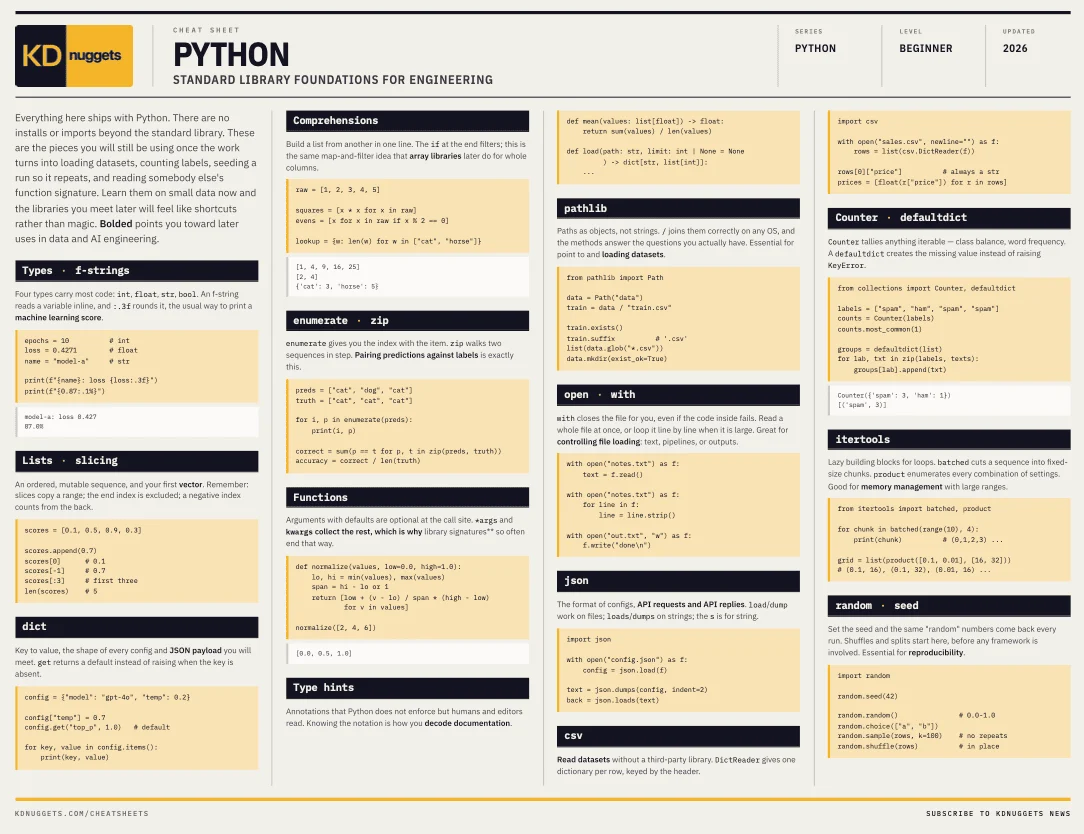
However, this mindset often produces a fragile class of practitioner: one capable of replicating a tutorial line-by-line, but utterly stranded the moment the data structure deviates from the provided example. To address this persistent gap in technical literacy, KDnuggets has released a new, comprehensive Python Foundations for Engineering Cheat Sheet. It serves as a stark reminder that the most sophisticated AI systems are built on the same simple, immutable pillars of logic that every beginner encounters on day one.
The Core Philosophy: Why Fundamentals Never Go Out of Style
The evolution of the Python ecosystem is defined by a shift toward more powerful abstractions. We move from raw lists to NumPy arrays; from basic file I/O to high-performance data lakes. Yet, the underlying mechanical logic remains identical.
A transformation applied to a Python list via a list comprehension is conceptually identical to the vectorized operations performed by an array library on a dataset of ten million rows. When developers treat basic Python as a temporary necessity rather than a permanent tool, they lose the ability to bridge that gap. The KDnuggets cheat sheet focuses on the "material that does not get left behind." It strips away the complexity of third-party dependencies to highlight the logic that remains consistent regardless of scale or hardware.
Debugging: The Ultimate Test of Understanding
The distinction between a "tutorial coder" and a true engineer becomes painfully clear when code breaks. Debugging is not merely about fixing syntax; it is about tracing data flow through a logical pipeline. If a practitioner has only memorized syntax through copying and pasting, they are effectively flying blind. By grounding one’s skill set in core engineering principles, developers gain the ability to perform root-cause analysis rather than relying on trial-and-error, which is, at its core, a "fool’s game" in a professional production environment.
Chronology: From Syntax to Software Engineering
The journey of a Python developer often follows a predictable, yet often flawed, trajectory. Understanding this progression is key to identifying where many engineers go wrong.
- Phase One: The Syntax Phase. The learner focuses on basic data types, loops, and conditional logic. This is where the foundation is poured, but it is rarely reinforced.
- Phase Two: The Library Leap. The developer rushes toward external frameworks. They learn the "how" (e.g., how to call
model.fit()) but often ignore the "why." - Phase Three: The Reality Check. The developer encounters a production environment where documentation is sparse, APIs are inconsistent, and data is "dirty." This is where the lack of foundational knowledge becomes a bottleneck.
- Phase Four: The Engineering Maturity. The professional realizes that the most efficient code is often the most readable, leveraging Python’s built-in capabilities to minimize technical debt.
The new cheat sheet is designed to truncate this cycle by ensuring that Phase One is not just a passing memory, but a robust toolkit that remains relevant through Phase Four.
Supporting Data: The Anatomy of Modern Engineering
A significant portion of real-world software engineering is not spent training models or designing neural network architectures. It is spent on the "unsexy" work: file manipulation, data cleaning, format conversion, and environment management.
The Pillars of Production-Ready Code
- Safe File Handling: Understanding context managers (
withstatements) and path handling. - Data Integrity: Moving between disparate formats (JSON, CSV, YAML) that characterize real-world API traffic.
- Verification: Counting, validating, and sanity-checking datasets before they reach the model pipeline.
- Reproducibility: Setting random seeds and managing environment states to ensure that results are not just impressive, but repeatable.
These tasks are not "preliminaries." They constitute the vast majority of an engineer’s daily labor. When developers ignore these foundational aspects, they accumulate technical debt that manifests as "black box" behavior—where the engineer knows the output but cannot explain the path taken to achieve it.
Official Perspectives: The Language of Documentation
One of the most overlooked aspects of Python mastery is the ability to interpret documentation. Every major library—be it Scikit-Learn, Hugging Face, or Pandas—describes itself using the grammar of the Python language itself.
The Literacy Gap
If a developer is not conversant in function signatures, optional arguments, type annotations, or argument packing/unpacking, the official documentation remains a closed book. When these concepts are foreign, the developer is forced to rely on secondary sources: Stack Overflow, peers, or generative AI. While these are useful tools, they are not substitutes for the ability to read a function signature and understand exactly what data a library expects.
By mastering the syntax of documentation, developers unlock the ability to learn any new tool independently. They cease to be consumers of tutorials and become practitioners of the language.
Implications for the AI/Data Industry
The implications of this "foundational shift" are profound for the current job market. As the barrier to entry for AI work lowers, the market is becoming flooded with individuals who can build models using high-level frameworks but who lack the depth to debug those models when they deviate from expected behavior.
Why "Zero-Dependency" Skills Matter
The KDnuggets cheat sheet emphasizes concepts that require no installation, no version pinning, and no dependency management. In an era where "dependency hell" is a common cause of project failure, the value of standard library proficiency cannot be overstated.
- Reduced Technical Debt: Code written using fundamental Python constructs is inherently more portable and easier to maintain.
- Enhanced Troubleshooting: When a model fails, the solution is rarely in the model’s hyperparameters; it is usually in the data preparation logic—a task handled by core Python.
- Independence: Engineers who understand the fundamentals do not need to wait for a tutorial update to understand how a new library feature works. They can read the source code or the docstrings and understand the implementation immediately.
Conclusion: The Long-Term Play
The rapid pace of AI innovation tempts developers to prioritize the "new" and the "shiny." However, the most successful engineers are those who view Python not just as a tool for today’s project, but as a language to be mastered over a career.
By revisiting the foundations—file I/O, type annotations, vectorized logic, and reproducible environments—developers can inoculate themselves against the volatility of the tech landscape. The KDnuggets Python Foundations for Engineering Cheat Sheet is more than just a reference guide; it is a manifesto for a more rigorous, sustainable approach to data science and software engineering.
In a world where the tools change every six months, the foundations are the only thing that will keep you relevant. Stop treating the basics as a waiting room and start treating them as the cornerstone of your professional expertise. Whether you are debugging a complex neural network or simply cleaning a CSV, the logic remains the same. Master the foundation, and you master the field.