
For the modern entrepreneur, the email dashboard is often a source of quiet anxiety. You log in, scan a sea of percentages—open rates, click rates, bounce rates—and, feeling either momentarily validated or vaguely concerned, you close the tab to return to the actual work of running a business.
However, the reality of digital marketing is that most of these metrics are vanity indicators. In an era of aggressive privacy filters and automated bot activity, the data you’ve been relying on might be lying to you. To turn your email marketing from a guessing game into a predictable revenue engine, you must stop "monitoring" and start "deciphering."
The Evolution of Email Analytics: A Brief Chronology
To understand why your current dashboard is misleading, we must look at the timeline of email tracking.
- The Pre-2021 Era: For nearly two decades, the "Open Rate" was the North Star of email marketing. It was a reliable proxy for subject line effectiveness and list health.
- The 2021 Inflection Point: Apple’s release of Mail Privacy Protection (MPP) fundamentally broke the open rate. By pre-loading emails on proxy servers, Apple ensured that even unopened emails registered as "opened."
- The Post-MPP Landscape: Overnight, the industry saw inflated metrics across the board. Marketers who continued to treat open rates as a precise measurement were essentially flying a plane with a broken speedometer.
- The Current Shift: Today, sophisticated brands are moving away from surface-level engagement metrics toward "hard" conversion data, such as Revenue Per Email (RPE) and verified click-through rates.
The Broken Speedometer: Why Open Rates No Longer Tell the Truth
Let’s address the elephant in the room: The open rate is effectively a vanity metric. Because Apple Mail—which accounts for a massive portion of mobile email traffic—automatically pings tracking pixels, you can no longer distinguish between a human reader and a machine.
Should you abandon it entirely? Not quite. While the absolute number is now unreliable, the trend remains a useful diagnostic tool. If your open rate is consistently trending downward over a fiscal quarter, it is not a statistical fluke; it is a signal of a cooling list, poor sender reputation, or a failure in your subject line strategy. Use the open rate as a compass for direction, not a ruler for precision.
Click-Through Rate: The Gold Standard of Honesty
If the open rate is a broken speedometer, the Click-Through Rate (CTR) is your engine’s internal diagnostic system. Unlike opens, clicks cannot be triggered by automated privacy features. When a subscriber clicks a link, it is a deliberate act of engagement.
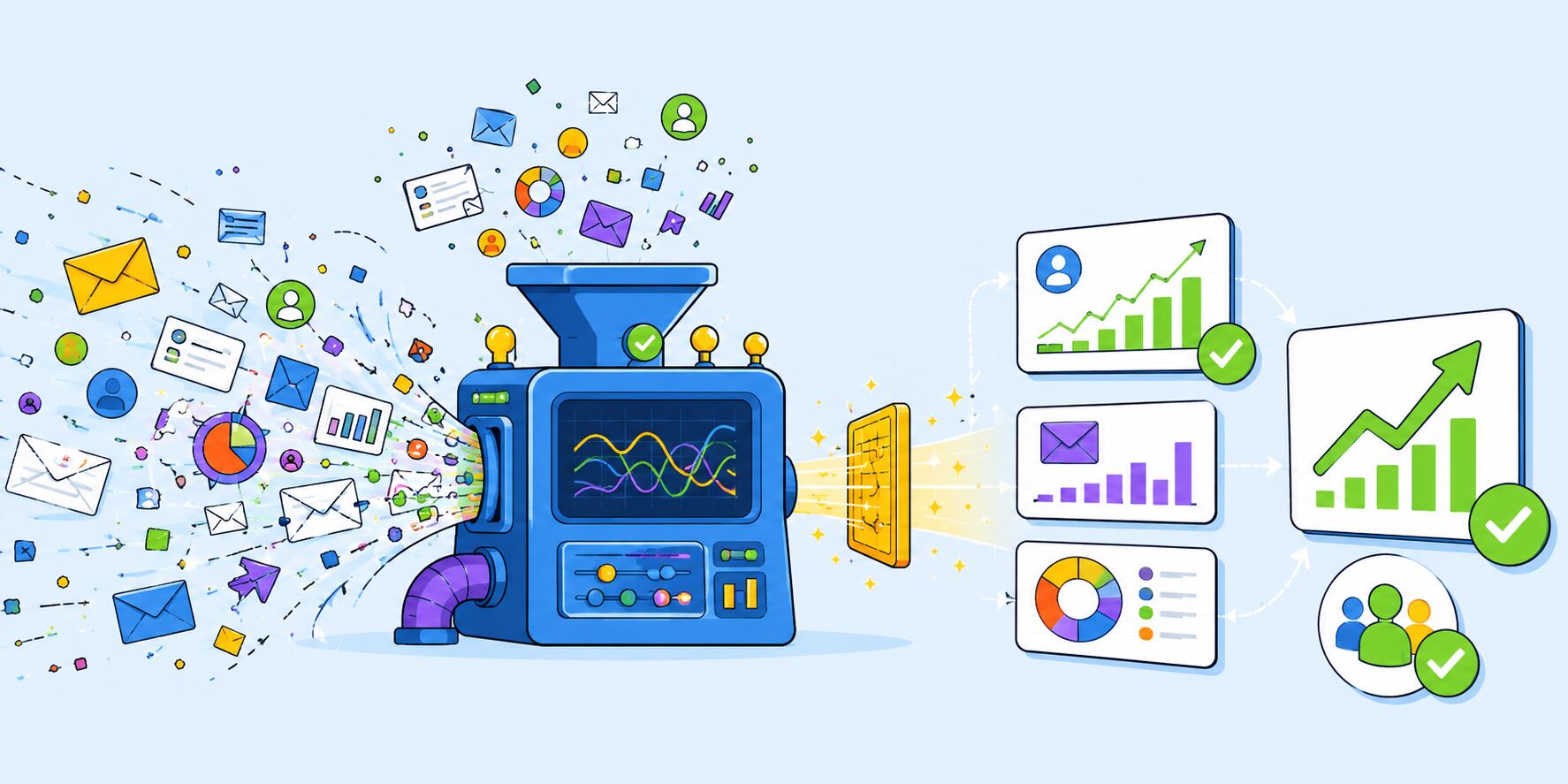
The Diagnostic Power of Dual Metrics
To truly understand your performance, you must compare two distinct metrics:
- Click Rate (CR): Clicks divided by total emails delivered. This measures the overall campaign reach.
- Click-to-Open Rate (CTOR): Clicks divided by actual opens. This measures the effectiveness of your content.
The Strategy: When you read these together, the narrative becomes clear. A low CR but a high CTOR suggests your subject lines are failing to grab attention, but your email body is compelling. Conversely, a high CR but a low CTOR indicates you are writing "click-bait" subject lines—you’re getting people in the door, but the content isn’t delivering on the promise.
Revenue Per Email: The "Grown-Up" Metric
Engagement is a means to an end, but in business, the end is revenue. Revenue Per Email (RPE) is the most critical metric for any founder because it strips away the ego of "creative" campaigns and shows you exactly which emails are building your bottom line.
Why RPE Changes Everything
- Comparability: RPE allows you to compare the performance of a high-effort newsletter against a simple automated product drop on an equal footing.
- The 20/30 Rule: For a healthy e-commerce brand, email should contribute 20% to 30% of total store revenue. If you are significantly below this, your email strategy is likely an underutilized asset.
- Automation vs. Campaigns: One of the most common pitfalls is over-investing in manual newsletters while ignoring automated flows. Automated sequences—such as "Abandoned Cart" or "Post-Purchase" flows—should yield significantly higher RPE because they reach the customer at a moment of high intent. If your automation revenue is a "sliver" of your total, you are leaving significant capital on the table.
The Smoke Detectors: Metrics You Should Ignore (Until You Can’t)
Most of the time, you should ignore the "maintenance" metrics. However, when these numbers spike, they act as smoke detectors for your business.
- Bounce Rate: A hard bounce indicates an invalid email address. If your bounce rate exceeds 1%, your list hygiene is failing. This signals to inbox providers (like Gmail or Outlook) that you are a spammer, which can tank your deliverability for your entire list.
- Unsubscribe Rate: A healthy unsubscribe rate (between 0.2% and 0.5%) is actually good for your business. It prunes your list of disengaged subscribers who were never going to purchase. However, a 0% unsubscribe rate is a red flag—it often means your unsubscribe link is too difficult to find, which leads users to report your email as "Spam" instead of simply opting out.
- Spam Complaints: This is the most dangerous metric. A complaint rate above 0.1% can lead to domain blacklisting. If this number spikes, it is almost always a result of poor frequency management or irrelevant content.
The Fifteen-Minute Monthly Ritual
The greatest mistake in analytics is the belief that "monitoring" leads to growth. It does not. Only deciding does.
To optimize your email program without getting lost in "spreadsheet archaeology," implement this monthly ritual:

- Analyze Revenue: Which three campaigns generated the highest RPE? What did they have in common?
- Analyze Engagement: Which automations are coasting, and which are high-performing?
- Analyze Trends: Are opens, clicks, and unsubscribes moving in a positive direction over the last 90 days?
- The "One Change" Rule: Do not try to fix everything at once. Choose one lever to pull. Maybe you rewrite the welcome series, or perhaps you adopt the subject-line style of your highest-performing campaign for the next month.
Leveraging Technology for Clarity
Modern platforms like Omnisend are designed to move beyond raw data by providing real-time revenue attribution. By placing your campaigns and automations side-by-side, you can stop guessing and start steering. For founders looking to scale, the ability to see performance segmented by audience behavior is the difference between a "blast" and a targeted conversation.
Final Implications: From "Sending" to "Steering"
Your email dashboard is not a scorecard to be watched; it is an argument to be engaged with. If your data doesn’t tell you what to change next, it is not analytics—it is just noise.
By focusing on the metrics that reflect true intent—clicks and revenue—and treating your bounce and complaint rates as early-warning systems, you shift your mindset from a sender to a strategist. You aren’t just sending emails; you are building an asset that compounds over time.
For founders ready to professionalize their email marketing, Omnisend offers a streamlined approach to attribution and automation. Use code FOUNDR50 for 50% off your first three months to turn your email program into a high-performance engine.