
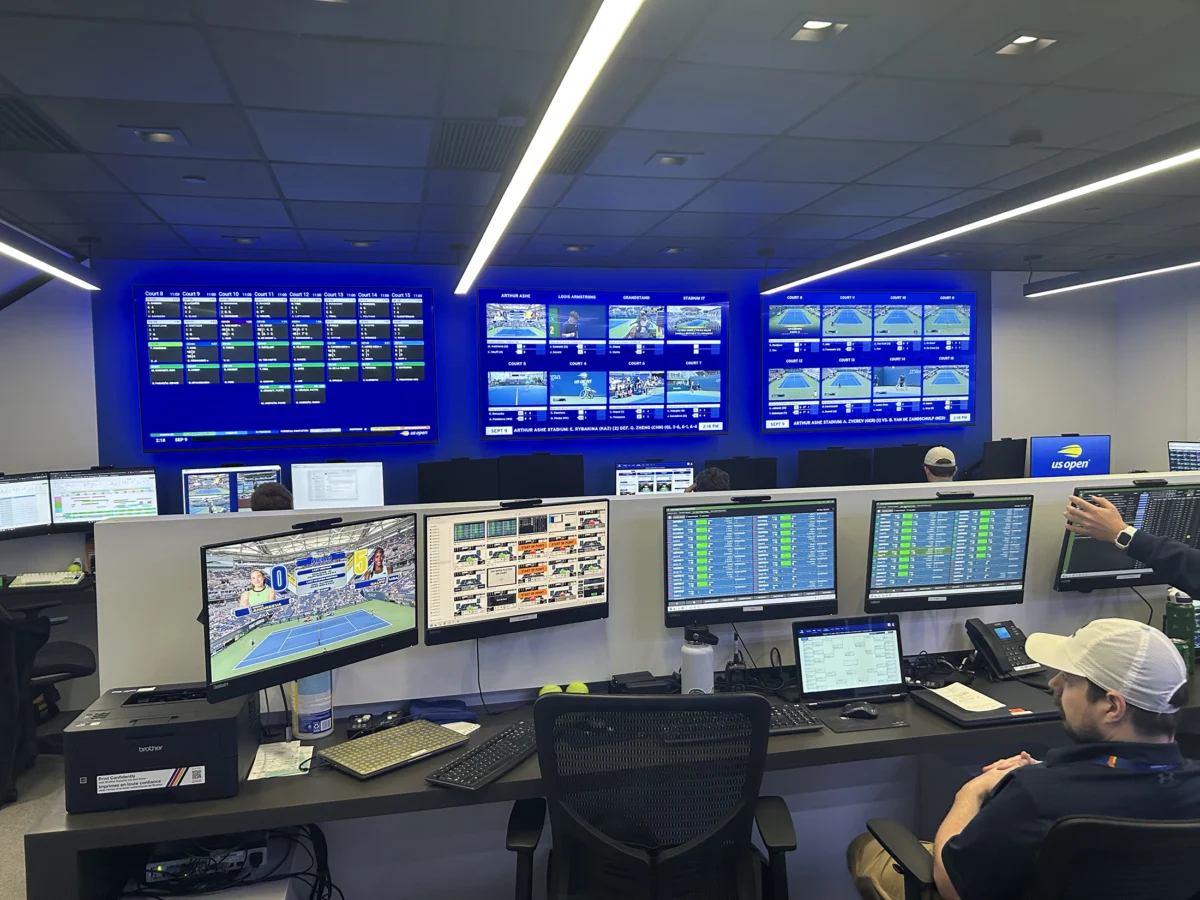
While corporate giants often treat the U.S. Open as little more than a high-end hospitality suite for entertaining clients or a canvas for garish, temporary signage, IBM has chosen a different path. For the century-old technology titan, the U.S. Open is not merely a tennis tournament; it is a live-fire laboratory for the future of artificial intelligence. Behind the curtain of pristine courts and celebrity-packed stands, IBM serves as the "invisible hand" of the USTA, orchestrating the digital infrastructure that engages over 14 million fans worldwide. In doing so, Big Blue is proving that high-stakes sports may be the most effective, high-velocity testing ground for AI integration in the global market.
The Architecture of a Match: Servers Behind the Serves
To the average fan, the U.S. Open digital experience feels effortless. A quick tap on a smartphone reveals real-time scores, crystal-clear highlight reels, and deep-dive analytics. However, the veneer of simplicity masks a gargantuan engineering challenge. IBM and the USTA must synthesize a mountain of raw data in real time, utilizing a hybrid approach of AI-driven processing and human oversight to maintain the delicate balance between rapid deployment and clinical accuracy.
The complexity of this operation is best exemplified by the tournament’s new “Serve Quality” metric. This feature does not merely track speed; it functions as a digital biomechanical analysis. By monitoring 21 distinct data points across a player’s body and racquet—sampled 50 times per second—the system generates roughly 4.6 million data points per single match. Over the course of the tournament, this results in more than 1.2 billion data points, all of which are processed, contextualized, and delivered to fans in milliseconds.
Beyond the metrics, IBM has deployed sophisticated generative AI, such as the tournament’s "match chat" bot. This interface allows fans to engage in natural, conversational inquiries, moving beyond static search boxes to ask complex questions like, "Who holds the record for the most break points saved in a final?" This responsiveness is clearly resonating with the public. In 2025, over 14 million unique devices engaged with U.S. Open digital platforms, resulting in 47 million visits—a staggering 19% year-over-year increase.
The Operational Anatomy of the U.S. Open
Why does the USTA, an organization with a modest core staff, require a tech behemoth like IBM to manage a sporting event? The answer lies in the nature of the tournament itself. The U.S. Open is not just a competition; it is a massive, high-pressure business operation with a three-week shelf life.
The USTA is essentially a small-to-mid-sized organization expected to scale its operations to a global, enterprise-level scale for twenty-one days each year. Without IBM’s technological backbone, the logistical burden would be insurmountable. IBM’s AI-powered tools act as a force multiplier, allowing the USTA to streamline infrastructure management, optimize overhead costs, and maintain operational resilience under extreme load.
One of the most practical applications of this partnership is in content production. The USTA’s editorial team is relatively lean, yet the demand for content is insatiable. By using bespoke AI tools to generate initial match summaries—which are then reviewed and refined by human editors—the USTA has increased its content production capacity by 300%. This allows the organization to punch well above its weight, delivering professional-grade storytelling at a scale previously reserved for multi-billion-dollar media conglomerates.
Security at the Edge: Protecting the Digital Courts
The sheer scale of the U.S. Open makes it a prime target for digital adversaries. An operation of this magnitude involves massive amounts of proprietary data, financial transactions, and high-traffic digital assets, creating an enormous attack surface.
According to IBM representatives, the company’s security infrastructure protects the tournament against nearly 500 million suspicious requests during the event. To combat these threats, IBM employs AI agents that monitor traffic patterns, identify anomalies, and categorize potential risks in real time. By prioritizing these threats, the security team can respond with surgical precision, ensuring that the digital experience remains seamless while the underlying infrastructure is shielded from malicious actors.

Chronology of Innovation: A Strategic Evolution
The evolution of the U.S. Open’s digital transformation can be viewed as a multi-year roadmap of iterative development:
- Phase 1: Foundation (Historical Context): IBM began by ensuring basic connectivity and reliable data delivery, focusing on the stability of the USTA’s legacy infrastructure.
- Phase 2: Data Enrichment (2020-2023): The focus shifted to data visualization, introducing advanced statistics that provided deeper insights into player performance.
- Phase 3: The AI Era (2024-2025): The introduction of Generative AI, including the "match chat" and automated content generation, marked the shift toward personalized, conversational interactions.
- Phase 4: Scaling the Future (2026-Present): The current focus is on democratizing innovation, as seen in the launch of the USTA Connect Innovation Challenge and the IBM Sports Tech Startup Challenge, which aim to foster an ecosystem of external developers.
The Human Factor: Why Fans Are Buying In
Public sentiment toward AI has been notoriously volatile, marked by concerns over job displacement and data privacy. However, IBM’s 2026 Sports Survey paints a different picture. The data suggests that sports fans are, in fact, highly receptive to AI integration.
Approximately 80% of surveyed fans identified clear value in AI-powered experiences, specifically citing real-time statistics, personalized highlights, and instant translation as key benefits. Notably, among tennis fans, 64% expressed explicit trust in AI-generated sports content, suggesting that as long as the AI provides utility—rather than just gimmickry—the public is willing to adopt it.
Furthermore, the data underscores the necessity of a robust digital presence. With 91% of fans using sports apps while attending live events, the "second-screen" experience is no longer a luxury; it is the primary way spectators consume the game. By tethering live attendance to digital engagement, the U.S. Open has transformed from a static event into a comprehensive digital ecosystem.
Implications: Beyond the Baseline
IBM’s sports strategy is not restricted to the tennis courts of Flushing Meadows. The company has applied similar methodologies to The Masters, the UFC, and Wimbledon, proving that its AI-first approach is highly portable across different sports and cultural landscapes.
However, the true long-term play for IBM is the cultivation of a grassroots ecosystem. By launching the IBM Sports Tech Startup Challenge, the company is positioning itself as the central node in a network of innovators. By providing startups with access to massive, high-quality data sets, IBM is encouraging founders to solve the next generation of sports-tech problems. The winners of these challenges aren’t just gaining exposure; they are integrating their solutions into one of the most high-traffic environments in the world.
Conclusion: The Professional Mandate
The success of the U.S. Open’s digital transformation carries a broader lesson for entrepreneurs and business leaders: technology is not a bolt-on solution; it is a fundamental architectural requirement. Whether it is using AI to bolster cybersecurity or leveraging generative models to increase editorial output, the integration of technology at the U.S. Open illustrates that even the most "traditional" industries must pivot to digital-first models to remain relevant.
As IBM continues to quietly shape the fan experience behind the scenes, it sends a clear signal to the business world: sports are the perfect proving ground for the future of enterprise technology. For those paying attention, the message is clear—the next great leap in AI won’t just happen in a Silicon Valley boardroom; it’s being built, one serve at a time, on the center court.