The traditional pillars of Search Engine Optimization—tracking rankings, measuring click-through rates (CTR), and attributing conversions to specific organic traffic—are currently facing an existential crisis. As AI-powered search engines, generative AI summaries, and "zero-click" interfaces become the standard for information retrieval, the old metrics are increasingly insufficient.
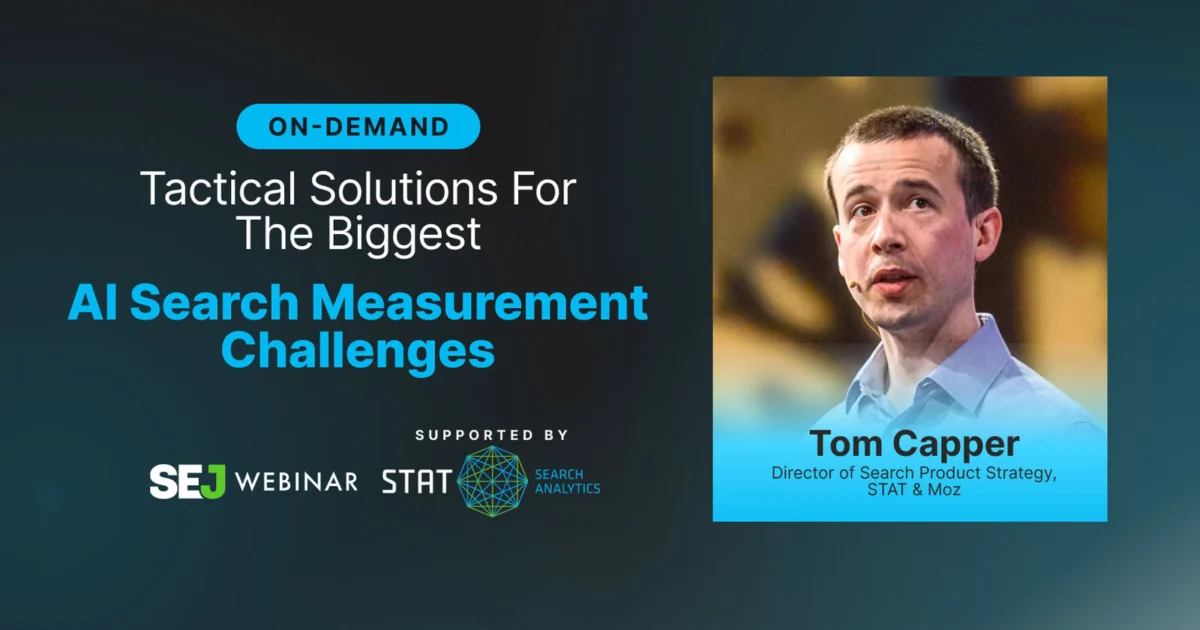
A brand might be recommended as the premier solution in an AI-generated response, yet the analytics dashboard will show nothing—no click, no referral, no direct traffic. Does this mean the marketing effort was wasted? Far from it. As Tom Capper, Director of Search Product Strategy at STAT, recently argued, the failure lies not in the AI, but in our outdated measurement frameworks.
In a recent industry webinar, Capper dismantled the myth that clicks are the only currency of the digital age, proposing a new, more nuanced approach to measuring visibility and business impact in an era defined by generative AI.
The Measurement Crisis: Why Traditional Analytics Fail
For decades, the customer journey was linear: search, click, browse, convert. Modern AI search, however, has introduced "the attribution black hole." When an AI model generates an answer for a user, it often provides the information needed to satisfy the query directly within the response. A user may read an AI recommendation for a specific product, decide to purchase it, and later visit the brand’s website via a direct search or even go to a physical retail location.
Because there is no "click" on a link, traditional web analytics tools categorize this as "Direct" traffic, or fail to capture it entirely. This creates a dangerous disconnect: a marketing team might conclude that their brand is losing relevance because organic traffic metrics are stagnant, even while the brand is actually being recommended by AI thousands of times a day.
Capper frames this not as a traffic problem, but as a fundamental "measurement problem." The solution is to shift the focus from tracking URLs to tracking entities, and from measuring clicks to measuring visibility alongside tangible business outcomes.
Distinguishing Brand Mentions from Source Citations
A critical component of Capper’s framework is the distinction between a citation and a mention. In the current SEO landscape, many practitioners are obsessed with backlink counts—monitoring whether their domain is included in the "Learn More" or "Sources" section of an AI answer.
Capper argues that this is a tactical distraction. He points to a hypothetical scenario: an AI model recommends "Audi" as a top-tier vehicle, but the cited links point to third-party car review websites rather than Audi’s own domain. If an SEO team is only tracking their own domain’s citation count, they would conclude that they were not "present" in that AI answer. In reality, they won the most important battle—they were the recommended entity.
The Shift to Entity-Based Tracking
To stay relevant, brands must shift their focus to tracking entities. This involves:
- Defining Brand Entities: Clearly mapping the brand, its sub-brands, and its key products.
- Monitoring Competitor Entities: Tracking how often competitors are recommended as solutions in the same context.
- Decoupling URLs from KPI Success: Treating citations as useful "tactical data" for understanding how AI sources information, but refusing to use them as the primary indicator of success.
As Capper succinctly noted during the webinar, "Citations have URLs. That’s still valuable tactical data, but I don’t think it should be your KPI. Mentions have entities."
Building a Representative Prompt Sample
One of the most common rebuttals to measuring AI visibility is that AI results are unpredictable and highly variable. If the same query can return different answers for different users, how can a business track its performance?
Capper compares this to the early days of localized search, where results varied by city and device. The solution is not to try to capture every single iteration of a conversation, but to treat AI variability as a "sampling problem."
Best Practices for Prompt Sampling:
- Avoid Keyword-Only Lists: Don’t simply plug your existing SEO keyword list into an AI prompt tracker. These lists are often designed for search intent that doesn’t match the conversational nature of AI.
- Use "People Also Ask" (PAA) Data: Start your sampling process by looking at PAA data to understand the actual questions users are asking.
- Contextualize the Persona: Incorporate variables like user location, budget constraints, and specific needs into the prompts.
- Use the Right Environment: Capper emphasizes that brands should test using the web interface of models (like ChatGPT or Google’s SGE), rather than relying exclusively on API responses, as the UI/UX layer often presents information differently than the raw data might suggest.
By sampling a broad range of relevant scenarios, brands can identify patterns in how they are positioned, even if they cannot predict the exact phrasing of every AI response.
The Role of Citations as Investigative Tools
While Capper warns against making citations a primary KPI, he does not suggest ignoring them entirely. Instead, he proposes using them as a diagnostic tool.
If a competitor is being consistently recommended, looking at the citations in that answer reveals which sources the AI model trusts. If the model is pulling information from a specific industry publication or review site, that source becomes a high-priority target for PR, content marketing, or partnership efforts.
The investigative process should look like this:
- Identify the Source: Which third-party site is cited alongside the competitor?
- Analyze the Content: What information on that site is the AI prioritizing?
- Action: Can the brand improve its presence on that specific third-party source?
- Monitor: Did the change in third-party source quality lead to a change in the brand’s own AI recommendation frequency?
Integrating Visibility Metrics with Business Outcomes
To gain a holistic view of performance, Capper recommends a broader set of "leading indicators" that work in tandem with traditional metrics. These include:
- Visibility Share: The frequency with which your brand entity appears in relevant, sampled AI responses.
- Relative Position: AI answers often display multiple results. Being the "first" recommendation is significantly more valuable than being buried at the bottom of a scrollable list.
- Qualitative Sentiment: Moving beyond simple "positive/negative" scores. Understanding why a brand is being recommended (e.g., for its durability, its price, or its luxury status) is far more actionable than a volatile summary chart.
The Attribution Gap: The Power of Post-Purchase Surveys
During the Q&A session, the conversation turned to the "attribution gap"—how to prove to stakeholders that an AI recommendation led to a sale when the analytics don’t show it.
Capper’s recommendation is to combine data streams. If a brand sees an uptick in AI visibility (tracked via a prompt-sampling tool) and a simultaneous increase in direct traffic, that is a strong correlation. However, the "smoking gun" is the post-purchase survey. By asking customers, "How did you first hear about us?" and including options like "AI/Search Summary," teams can bridge the gap between AI exposure and actual revenue.
Integrating this survey data into existing CRM or analytics platforms allows marketing teams to treat "AI-driven discovery" as a measurable dimension.
Implications for the Future of Search Strategy
The shift toward AI-integrated search is not a temporary trend; it is a fundamental architectural change in how information is consumed. Organizations that continue to demand "click-to-conversion" reporting will inevitably find themselves reporting on a shrinking slice of the total opportunity.
The implications for SEO professionals and digital marketers are clear:
- Stop Chasing the Click: Focus on brand presence and entity authority. If you are not the entity being recommended, the click doesn’t matter because you weren’t part of the consideration set.
- Diversify the Reporting Stack: Add "visibility metrics" to your monthly reports. Make them as important as traditional rankings.
- Invest in Entity SEO: Ensure that your brand’s digital footprint—including your presence on review sites, social platforms, and industry publications—is robust. AI models rely on these signals to form their "knowledge" of your brand.
- Embrace Qualitative Data: Start using customer surveys as a formal part of your attribution model.
As Tom Capper concluded, the goal of modern measurement is not to reconstruct every single person’s path—that is a futile effort in a complex, multi-channel world. Instead, the goal is to create a fuller account of influence. By measuring the brand’s visibility in the AI-driven ecosystem, businesses can finally begin to see the invisible hand that is guiding the modern customer journey.