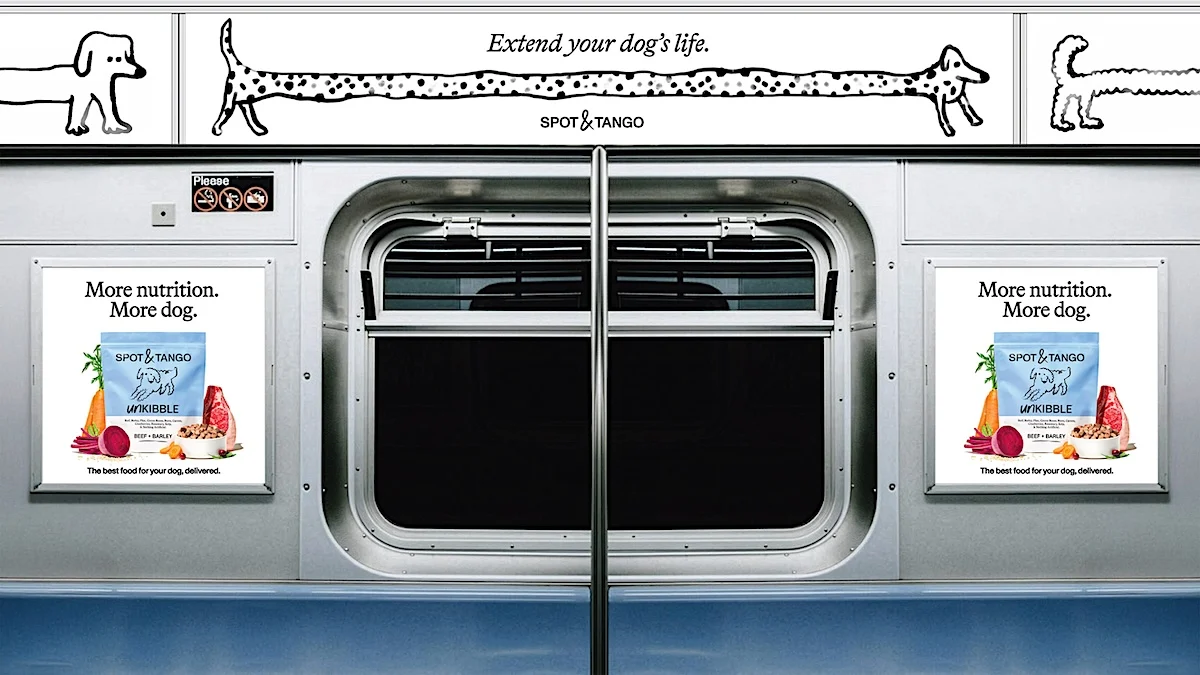
New Yorkers commuting through the city’s labyrinthine subway system this month are encountering an unusual sight: cartoonishly elongated dogs plastered across the walls of over 570 train cars. The playful imagery, which features the tagline "More nutrition. More dog," is the latest creative push from Spot & Tango, a digitally native pet food brand that is currently rewriting its playbook for growth.
While the campaign is visually whimsical, it represents a calculated, multi-million dollar pivot in strategy. After years of relying almost exclusively on the precision-targeted world of performance marketing, Spot & Tango is aggressively moving into the "top-of-funnel"—the broad-reach branding efforts designed to turn a niche subscription service into a household name.
The Strategic Pivot: From Performance to Awareness
For much of its history since launching in 2018, Spot & Tango functioned with what co-founder Dylan Munro describes as "performance marketing DNA." In the direct-to-consumer (DTC) space, this is a familiar profile: a heavy reliance on Meta, Google, and TikTok advertisements where every dollar spent is tracked against a specific conversion.
"With performance marketing, you know exactly where the dollars are going," Munro says. "You know exactly what revenue it’s driving. It’s amazing, but there comes a point in your business where you need to be educating more broadly within the consumer base. Performance marketing can only take you so far."
That "limit" has led the company to allocate $3.5 million this year to top-of-funnel marketing—a stark contrast to the near-zero budget allocated to these channels in previous years. The shift is designed to build brand equity as the company prepares for its 10th anniversary in 2028, aiming to court a wider audience beyond the early adopters of premium, fresh pet food.
A Chronology of Growth and Diversification
Spot & Tango’s trajectory reflects the broader evolution of the modern pet industry, which has seen a massive surge in human-grade, subscription-based nutrition.
- 2018: Spot & Tango launches, focusing on fresh, subscription-based meals for dogs and establishing a strong foothold in the DTC market.
- The Scaling Years: The company establishes its own manufacturing facility in Pennsylvania, moving away from third-party reliance to ensure quality control and operational stability.
- 2023: The company introduces "PupGum," an in-house dental chew brand, signaling a move toward a multi-category portfolio. The product hits $10 million in annual recurring revenue within seven months.
- 2024: Spot & Tango officially pivots to a balanced marketing strategy, funneling millions into Out-of-Home (OOH) subway ads, billboards, and Connected TV (CTV) spots.
- 2025 and Beyond: The company plans to increase its top-of-funnel budget to between $5 million and $7 million, with a clear eye on expansion and brand dominance ahead of its 2028 milestone.
Supporting Data: Why the Shift Matters
The decision to diversify marketing spend is backed by impressive fiscal performance. Spot & Tango currently boasts a $200 million annualized revenue run rate and has achieved profitability—a rare and significant achievement in the crowded DTC space.
According to co-founder Russell Breuer, the brand’s expansion is necessary because the pet food market remains dominated by massive legacy players like Purina and Blue Buffalo. "A lot of folks have heard of us, but not everyone," Breuer notes. "The market’s very big, so we see these upper-funnel initiatives as opportunities to further amplify what we’re doing."
The results of this shift are already becoming measurable:
- Customer Acquisition: Since shifting focus to top-of-funnel efforts, the brand has onboarded "hundreds of thousands" of new customers.
- Attribution Shifts: Internal surveys show that new purchasers are increasingly citing OOH and television advertisements as their first point of contact with the brand, rather than a social media click.
- Revenue Growth: The company reports a year-over-year growth rate exceeding 70%, bolstered by the successful integration of its dental chew line.
Experimental Channels: From "Worst Breath" to Prime Time
Spot & Tango’s marketing has become notably experimental, moving away from purely static social ads. Their campaign strategies now focus on "captive audiences" and high-engagement events.
The Power of Captive Audiences
The company has experimented heavily with linear and connected TV, specifically targeting sporting events. "It’s a captive audience," Breuer explains. "You’re going to be engaged." The strategy is to position the brand alongside high-energy content, ensuring that when the viewer is most attentive, they are exposed to the brand’s value proposition.
Viral Engagement and Community Building
Beyond mass media, the company has utilized "stunt" marketing to generate organic buzz. The "Worst Dog Breath" contest, which saw a 12-year-old Chihuahua named Willie crowned the winner, proved to be a masterclass in earned media. The campaign was covered by outlets like NBC, Vice, and Gothamist, driving a 34% week-over-week increase in web traffic. This type of event-based marketing serves a dual purpose: it humanizes the brand and provides shareable, authentic content for social channels.
The Industry Perspective: A Broader Trend
Spot & Tango’s strategy aligns with a wider industry shift identified by analysts at Gartner. Greg Carlucci, a senior director analyst, notes that CMOs are increasingly moving away from the "last-click" obsession that defined the 2010s.
"Gartner’s 2026 CMO Spend Survey found that CMOs were allocating 30.5% of their marketing budgets to ‘brand awareness,’ up 1.5 percentage points from the year before," Carlucci explains.
The barrier to entry for these channels has also lowered. Previously, linear TV required massive, non-targeted investments that excluded mid-sized DTC brands. Today, Connected TV (CTV) allows for a hybrid approach: the prestige and reach of television combined with the targeting precision of digital platforms. "You’re starting to see more brands integrate that type of upper-funnel marketing," Carlucci adds.
Implications: The "Halo Effect" of Awareness
The most important takeaway from Spot & Tango’s new strategy is the "halo effect" it creates for the rest of the business. By building awareness at the top of the funnel, the brand is effectively lowering the friction at the bottom of the funnel.
"That’s giving us more confidence that, even if the last click is coming from a Facebook ad or an Instagram ad or a Google ad, the intent or the original awareness was generated with this higher top-of-funnel marketing," says Munro.
This realization—that a customer who sees a subway ad is more likely to click on a social media ad three days later—is the cornerstone of the company’s future growth. As they gear up for their 10th anniversary, the brand is no longer just selling "fresh food"; they are selling a lifestyle and a mission.
For Breuer, the most gratifying part of the transition isn’t just the data; it’s the physical evidence of brand recognition. "I’ve gotten on a plane with a Spot & Tango shirt on, and the person beside me is like, ‘Do you work at Spot & Tango? I love that brand!’" he says. "That never used to happen."
As the brand continues to scale, its ability to translate that "in the wild" recognition into sustained market share will determine whether it can successfully challenge the legacy giants of the pet food industry. For now, with their cartoonishly long dogs watching over the subway riders of New York, Spot & Tango is betting that if you build the brand, the customers will follow.