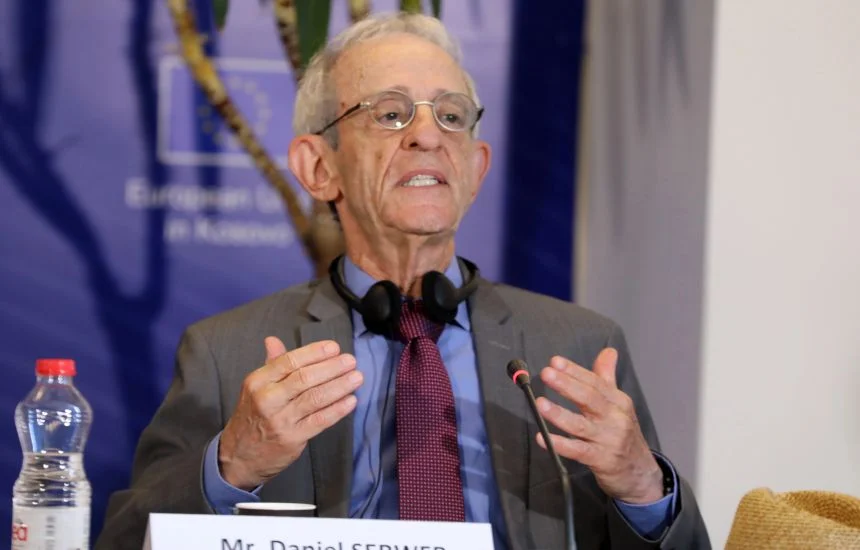
Pristina, Kosovo – October 15, 2026 – The protracted dialogue between Kosovo and Serbia, a cornerstone of stability in the Western Balkans, finds itself at a critical juncture, with an influential American expert, Daniel Serwer, emphasizing the urgent need for a strategic shift from the European Union. Serwer, a distinguished Professor and Senior Fellow at the Johns Hopkins School of Advanced International Studies (SAIS), has voiced concerns that the EU’s current approach, heavily prioritizing the establishment of the Association of Serb-majority Municipalities (ASM) without reciprocal benefits for Kosovo, is destined to perpetuate the existing stalemate.
In a recent interview with Kallxo.com, Professor Serwer unequivocally stated that genuine progress in the normalization process hinges on the EU adopting a more balanced and strategically sound negotiating framework. He argued that the Association of Serb-majority Municipalities, a contentious point in the dialogue, can only be acceptable to Kosovo once all threats to its sovereignty and territorial integrity are definitively eliminated. Crucially, Serwer highlighted that this elimination should ideally be formalized through diplomatic recognition from Serbia.
His remarks underscore a widespread sentiment in Kosovo that the current EU-facilitated dialogue disproportionately pressures Pristina to fulfill its obligations related to the ASM, an agreement stemming from the 2013 Brussels Accord, while Belgrade continues to resist recognizing Kosovo’s independence. This perceived imbalance, according to Serwer and many Kosovar officials, has stalled any meaningful advancement towards a comprehensive, legally binding agreement between the two nations.
"The EU’s negotiating strategy will be important," Serwer stated. "If Brussels continues to prioritize the Association of Serb-majority Municipalities without offering any counter-benefit to Kosovo, the dialogue will continue to make no progress. In my opinion, the Association can be acceptable to Kosovo only after all threats to its sovereignty and territorial integrity are eliminated, preferably through diplomatic recognition by Serbia."
He further suggested pragmatic alternatives for the Serb-majority municipalities should they wish to formalize cooperation. "If Serb-majority municipalities, which already cooperate with each other, want to institutionalize this cooperation, they can do so without any hindrance, by organizing as a non-governmental organization, or, even better, within the framework of the existing Association of Kosovo Municipalities," Serwer added. This proposal aims to address the needs of the Serb community for greater coordination while assuaging Kosovo’s fears of an entity that could undermine its statehood.
Serwer’s intervention arrives amidst renewed calls from international partners for both Pristina and Belgrade to demonstrate greater flexibility and commitment to resolving outstanding issues. His insights, drawing on decades of experience observing and analyzing Balkan politics, serve as a significant commentary on the complexities and the inherent challenges that continue to plague the normalization process.
Chronology: A Decade of Dialogue and Stalled Progress
The relationship between Kosovo and Serbia, marked by a history of conflict and mistrust, has been the subject of an internationally facilitated dialogue aimed at normalizing ties. This process, initiated over a decade ago, has seen periods of cautious optimism interspersed with deep-seated disagreements and recurrent crises.
Early Days and the Brussels Agreement (2011-2013)
The EU-facilitated dialogue officially began in March 2011, nearly three years after Kosovo declared independence from Serbia in 2008. Initially, the talks focused on technical issues aimed at improving the lives of citizens on both sides, such as freedom of movement, cadaster records, and integrated border management. However, the overarching goal remained the comprehensive normalization of relations.
A significant breakthrough came with the First Agreement of Principles Governing the Normalization of Relations, commonly known as the Brussels Agreement, signed on April 19, 2013, by then-Prime Ministers Hashim Thaçi of Kosovo and Ivica Dačić of Serbia. This landmark agreement, brokered by EU High Representative Catherine Ashton, aimed to integrate Serb-majority areas in northern Kosovo into Kosovo’s legal and institutional framework. Key provisions included the establishment of a single police force for Kosovo, a unified judicial system, and most controversially, the creation of an Association/Community of Serb-majority Municipalities (ASM).
The ASM was envisioned as a mechanism to ensure a level of self-governance for the Serb community within Kosovo, with specific competencies outlined in a subsequent management team’s draft statute. While Serbia viewed the ASM as a vital safeguard for the rights and identity of Serbs in Kosovo, Pristina quickly expressed reservations, fearing it could evolve into a parallel structure reminiscent of Bosnia and Herzegovina’s Republika Srpska, thereby undermining Kosovo’s unitary character and sovereignty.
Growing Tensions and Implementation Challenges (2014-2020)
Following the Brussels Agreement, the implementation phase proved to be far more arduous than anticipated. Differing interpretations of the ASM’s powers and competencies became a significant stumbling block. Kosovo’s Constitutional Court, in a 2015 ruling, found that while the principles of the ASM were largely constitutional, specific provisions of the proposed statute were not in line with the spirit of the Kosovo Constitution. This ruling further complicated the implementation, with Pristina insisting that any future ASM must fully comply with its constitutional order and not possess executive powers.
Throughout these years, the dialogue frequently stalled amidst political changes in both countries, electoral cycles, and various incidents on the ground, ranging from disputes over religious sites to challenges in integrating judicial and security structures in the north. The lack of political will, coupled with persistent disagreements over the scope and nature of the ASM, meant that the core issue of normalization, let alone mutual recognition, remained largely unaddressed.

Recent Stalled Efforts and Renewed International Focus (2020-Present)
In recent years, under the facilitation of EU Special Representative Miroslav Lajčák, efforts to revive the dialogue have intensified. High-level meetings between Kosovar Prime Minister Albin Kurti and Serbian President Aleksandar Vučić have taken place, often yielding little tangible progress. The EU and the United States have consistently urged both parties to commit to a comprehensive, legally binding agreement.
The EU’s "Franco-German" proposal, later known as the "European Proposal" or the "Basic Agreement on the path to normalization," gained prominence in 2022-2023. While not explicitly requiring immediate mutual recognition, it outlined a framework for normalizing relations, accepting each other’s state symbols, and not blocking each other’s path to international organizations. Both leaders verbally accepted the proposal in principle at a meeting in Brussels in February 2023 and subsequently at an implementation annex meeting in Ohrid in March 2023. However, concrete steps towards implementation, particularly regarding the ASM, have remained elusive.
The current situation reflects a deepening stalemate, with Kosovo steadfastly refusing to establish the ASM without a clear pathway to mutual recognition and without assurances that its sovereignty will not be compromised. Serbia, conversely, insists on the full implementation of the ASM as a precondition for further progress, while continuing to refuse recognition of Kosovo as an independent state. This historical context underscores the deep-seated nature of the challenges and provides a crucial backdrop to Daniel Serwer’s recent analysis.
Supporting Data and Expert Analysis
Daniel Serwer’s critique of the current EU strategy is rooted in a deep understanding of Balkan dynamics and the specific intricacies of the Kosovo-Serbia relationship. His analysis resonates with many observers who believe the dialogue has become imbalanced and, consequently, ineffective.
Daniel Serwer’s Perspective in Detail
Serwer’s call for a recalibration of the EU’s strategy is not merely a suggestion for tactical adjustment; it is an appeal for a fundamental shift in approach. He argues that the EU’s persistent emphasis on the ASM, without corresponding "counter-benefits" for Kosovo, has created a disincentive for Pristina to engage constructively. What are these "counter-benefits" that Serwer envisions?
Firstly, mutual recognition is paramount. For Kosovo, full recognition by Serbia is not just a symbolic act but a practical necessity for its full integration into the international community, including bodies like the United Nations, NATO, and the European Union itself. Without recognition, Kosovo’s statehood remains contested, perpetuating a state of frozen conflict. Serwer explicitly links the acceptability of the ASM to the prior elimination of threats to Kosovo’s sovereignty, with Serbian recognition being the preferred mechanism. This implies a sequencing: recognition first, then discussions on the modalities of an ASM that respects Kosovo’s constitutional order.
Secondly, Serwer implicitly suggests that the EU needs to exert more balanced pressure. While Brussels has consistently called for both sides to compromise, critics argue that the pressure on Kosovo to form the ASM has been more pronounced, while Serbia has faced less immediate consequence for its continued non-recognition and its often obstructionist tactics in international forums. A "counter-benefit" could therefore also entail the EU applying more significant leverage on Serbia to accept Kosovo’s reality and engage in good faith towards recognition.
Serwer’s alternative proposals for Serb-majority municipalities – operating as an NGO or within the existing Association of Kosovo Municipalities – highlight a pathway to address the needs of the Serb community for greater local autonomy and coordination without creating a parallel governmental structure. This approach aims to protect Kosovo’s constitutional integrity while still allowing for the expression of community-specific interests. It underscores the belief that cultural and local self-governance can be achieved without compromising national sovereignty.
The Association of Serb-Majority Municipalities (ASM): A Point of Contention
The ASM remains the most divisive element of the dialogue. Its very conception has been fraught with differing interpretations and deep-seated fears.
Kosovo’s fears: The primary concern in Pristina is that an ASM with executive powers would effectively create an autonomous entity within Kosovo, a "state within a state." This fear is deeply informed by the precedent of Republika Srpska in Bosnia and Herzegovina, which, despite being part of a larger state, often acts as a semi-independent entity, hindering central government functions and pursuing its own foreign policy objectives. Kosovo views such a structure as a direct threat to its territorial integrity, sovereignty, and functional capacity as a unitary state. There are also concerns that such an entity could be exploited by Belgrade to destabilize Kosovo internally and exert undue influence. The 2015 ruling by Kosovo’s Constitutional Court, which found that certain principles of the draft ASM statute were not in line with the constitution, further solidified Pristina’s position that any ASM must strictly adhere to the existing legal framework and not possess executive powers.
Serbia’s demands: From Belgrade’s perspective, the ASM is seen as a crucial mechanism to protect the rights, culture, and security of the Serb minority in Kosovo. Serbia argues that the Brussels Agreement, a legally binding international document, mandates the creation of the ASM and that Kosovo’s refusal to implement it is a violation of international commitments. For Serbia, the ASM is not about undermining Kosovo’s statehood (which it does not recognize anyway) but about ensuring the collective rights of Serbs in Kosovo, whom it considers its own citizens.
International Perspectives and Pressures
The international community, particularly the EU and the US, has been a key driver of the dialogue.

EU’s balancing act: The European Union, as the primary facilitator, faces a delicate balancing act. It seeks to normalize relations between Kosovo and Serbia, viewing it as essential for regional stability and for the Euro-Atlantic integration aspirations of both countries. However, the EU is composed of 27 member states, five of whom do not recognize Kosovo’s independence. This internal division within the EU often complicates its ability to present a unified and decisive stance, particularly on issues like recognition. The EU’s strategy has often been criticized for lacking sufficient leverage or a clear end-game, leading to a perception that it prioritizes process over outcome.
US role: The United States has historically played a crucial role in the Balkans, including in Kosovo’s independence. While generally supportive of the EU-led dialogue, Washington has often exerted its own diplomatic influence, sometimes with a more direct approach towards mutual recognition. The US generally aligns with Kosovo’s position that any ASM must be in line with Kosovo’s constitution and not undermine its sovereignty. The US engagement is critical, as it often provides the necessary weight to push for difficult compromises.
Regional context: The unresolved Kosovo-Serbia issue casts a long shadow over the entire Western Balkans. It hinders regional cooperation, fuels nationalist narratives, and serves as a potential source of instability. A comprehensive resolution, including mutual recognition, is seen as vital for the long-term peace and prosperity of the region and for its ultimate integration into the European family.
Official Responses and Stances
The positions of Pristina, Belgrade, and Brussels regarding the dialogue and the Association of Serb-majority Municipalities are deeply entrenched, reflecting their respective national interests, historical narratives, and political imperatives.
Kosovo’s Position
Kosovo’s official stance, particularly under Prime Minister Albin Kurti’s government, has been consistently firm on two key principles: mutual recognition as the central element of any final agreement, and the uncompromising protection of Kosovo’s sovereignty and territorial integrity.
- Rejection of an ASM with executive powers: Pristina unequivocally rejects any form of the Association of Serb-majority Municipalities that would grant it executive powers, legislative authority, or any form of self-governance that deviates from Kosovo’s constitutional framework. Prime Minister Kurti has frequently cited the 2015 Constitutional Court ruling as the legal basis for this position, emphasizing that any ASM must comply fully with the constitution and not create a "mono-ethnic association" that could jeopardize the multi-ethnic character of the state. Kosovo views the original Brussels Agreement as a set of principles that need to be implemented in accordance with its laws, not as a blank cheque for an autonomous entity.
- Prioritizing mutual recognition: For Kosovo, the ultimate goal of the dialogue is full, unconditional mutual recognition by Serbia. Without this, Kosovo argues, the normalization process is incomplete, and its international status remains contested. Pristina has repeatedly stated that it is prepared for dialogue, but any discussion about the ASM must be linked to or preceded by a clear commitment from Serbia towards recognition.
- Calls for an "even-handed" approach from the EU: Kosovar officials have often criticized the EU’s mediation for being perceived as imbalanced, placing undue pressure on Pristina to implement the ASM while failing to extract reciprocal concessions from Belgrade, especially on the issue of recognition. Kosovo seeks a more robust and symmetrical approach from Brussels, one that clearly defines the end-goal of the dialogue and holds both parties equally accountable for their commitments.
- Readiness for dialogue but with clear red lines: While affirming its readiness to engage in dialogue, Kosovo has drawn clear red lines, particularly regarding its sovereignty, territorial integrity, and constitutional order. Any solution for the Serb community must be integrated within the existing system of local self-governance, ensuring that all citizens, regardless of ethnicity, enjoy equal rights and opportunities under a unified legal framework.
Serbia’s Position
Serbia’s official position is equally resolute, anchored in its non-recognition of Kosovo’s independence and its insistence on protecting the Serb community.
- Insistence on the full implementation of the ASM: Belgrade views the establishment of the Association of Serb-majority Municipalities as the most critical and unfulfilled obligation arising from the Brussels Agreement. Serbian President Aleksandar Vučić and other officials have repeatedly stated that Serbia will not move forward on other aspects of the dialogue until Kosovo fully implements the ASM as agreed upon in 2013, without any amendments or reinterpretations that diminish its agreed-upon powers. For Serbia, the ASM is a matter of protecting the collective rights of Serbs in Kosovo and ensuring their survival and well-being.
- Refusal to recognize Kosovo: Serbia continues to maintain that Kosovo is an integral part of its territory, governed by its constitution and UN Security Council Resolution 1244. Belgrade explicitly refuses to recognize Kosovo’s independence, considering it a violation of international law and its territorial integrity. This refusal is a fundamental impediment to a comprehensive normalization agreement. Serbia instead advocates for a "status-neutral" dialogue that avoids the issue of recognition, focusing on practical arrangements and the protection of Serb rights.
- Claims of protecting Serb minority rights: Serbia consistently positions itself as the protector of Serb minority rights in Kosovo, frequently raising concerns about the security and political marginalization of Serbs. This narrative is used to justify its demands for the ASM and its overall stance in the dialogue.
- Leveraging international support: Serbia actively seeks and leverages support from non-recognizing states, particularly Russia and China, within international organizations like the UN, to block Kosovo’s membership bids and reinforce its narrative regarding Kosovo’s status.
European Union’s Role and Challenges
The European Union, as the facilitator of the dialogue, faces immense challenges in bridging the gap between these diametrically opposed positions.
- Mediator’s dilemma: The EU’s primary goal is to achieve a comprehensive, legally binding agreement that normalizes relations between Kosovo and Serbia, which it sees as indispensable for regional stability and the European future of both countries. However, as a mediator, it must navigate the deep mistrust and maximalist positions of both parties. Its role is often perceived as trying to cajole concessions from both sides without having sufficient leverage to impose a solution.
- Pressure on both parties for "compromise": The EU consistently urges both Pristina and Belgrade to demonstrate flexibility and political will for compromise. It has often presented various proposals, such as the European Proposal, to guide the parties towards an agreement. However, the definition of "compromise" differs significantly for each side.
- Critiques of EU’s approach: The EU’s mediation has drawn criticism from various quarters. Some argue that its lack of a clear, strong stance on mutual recognition, influenced by the five non-recognizing EU member states, weakens its negotiating position and prolongs the stalemate. Others contend that the EU has sometimes failed to hold both parties equally accountable for their commitments, leading to a perception of bias or ineffectiveness. Daniel Serwer’s critique precisely targets this perceived strategic deficiency, arguing that the EU needs a more robust and reciprocal approach to move beyond the current impasse.
Implications for Regional Stability and Future Prospects
The ongoing stalemate in the Kosovo-Serbia dialogue, as highlighted by Daniel Serwer, carries significant implications not only for the two parties involved but for the broader Western Balkans region and its Euro-Atlantic integration aspirations.
Risk of Continued Stalemate
The failure to achieve a comprehensive normalization agreement presents several severe risks:
- Increased Tensions and Instability: A prolonged lack of resolution keeps the region on edge. Recurring incidents, often linked to the unresolved status of Serb-majority areas in Kosovo, have the potential to escalate into broader conflicts, threatening the fragile peace established after the 1999 war. The presence of international peacekeepers (KFOR) mitigates this risk but does not eliminate the underlying tensions.
- Economic Stagnation: Both Kosovo and Serbia suffer economically from the unresolved conflict. The lack of normalized relations deters foreign investment, limits trade opportunities, and creates an environment of uncertainty that hinders long-term economic development. For Kosovo, its contested status impedes access to international financial institutions and full participation in global markets.
- Hindered Euro-Atlantic Integration: The normalization of relations is a explicit precondition for both Kosovo and Serbia’s progress towards EU membership. A continued stalemate means that both countries will struggle to advance their candidacies, potentially leading to increased disillusionment among their populations regarding the European perspective. It also impacts NATO integration for Kosovo and potentially for Serbia if it were to pursue it.
- Erosion of Trust in International Mediation: If the EU-facilitated dialogue continues to yield minimal results, it risks eroding trust in international mediation efforts in the region, making future diplomatic interventions more challenging.
- Brain Drain and Demographic Challenges: The political and economic uncertainty contributes to significant emigration, particularly among young, educated individuals, further exacerbating demographic challenges and hindering long-term development in both countries.
Pathways Forward: Serwer’s Vision and Beyond
Daniel Serwer’s intervention is not merely a critique but also an implicit call for a renewed and more effective strategy. His suggestions offer potential pathways forward:
- A Revised EU Strategy with Counter-Benefits: Serwer’s core proposal is for the EU to revise its negotiating strategy. This would involve a clear commitment to providing "counter-benefits" to Kosovo, most notably mutual recognition by Serbia, in exchange for concessions regarding the ASM. This reciprocal approach could incentivize both parties to engage more constructively. The EU would need to demonstrate greater political will and potentially leverage its own integration mechanisms more effectively to push for a genuine breakthrough.
- Modified ASM without Executive Powers, Linked to Recognition: A potential compromise could involve the establishment of an ASM that strictly adheres to Kosovo’s Constitutional Court ruling, meaning it would not possess executive powers and would operate within the existing legal framework. Such an ASM could focus on coordinating services, cultural preservation, and economic development for Serb-majority municipalities, similar to what Serwer suggested (as an NGO or within the existing Association of Kosovo Municipalities). Crucially, this would need to be explicitly linked to or preceded by Serbia’s de facto or de jure recognition of Kosovo.
- Importance of International Guarantees: Any comprehensive agreement would require robust international guarantees for its implementation, ensuring that neither side can renege on its commitments without significant international repercussions. This could involve continued strong engagement from the US and key EU member states.
- The Ultimate Goal: Comprehensive, Legally Binding Agreement: The end goal remains a comprehensive, legally binding agreement that fully normalizes relations between Kosovo and Serbia, culminating in mutual recognition and clearing the path for both countries’ full Euro-Atlantic integration. Such an agreement would need to address all outstanding issues, including border demarcation, property rights, and the fate of missing persons.
In conclusion, Daniel Serwer’s timely analysis serves as a stark reminder that the current approach to the Kosovo-Serbia dialogue is faltering. His emphasis on a strategically sound EU framework, one that prioritizes mutual recognition and offers tangible counter-benefits to Kosovo, is a crucial call to action. Without such a shift, the dialogue risks remaining in a perpetual stalemate, with detrimental consequences for both nations and the broader stability of the Western Balkans. The path to a lasting peace and prosperity in the region hinges on courageous leadership and a genuinely balanced international mediation.