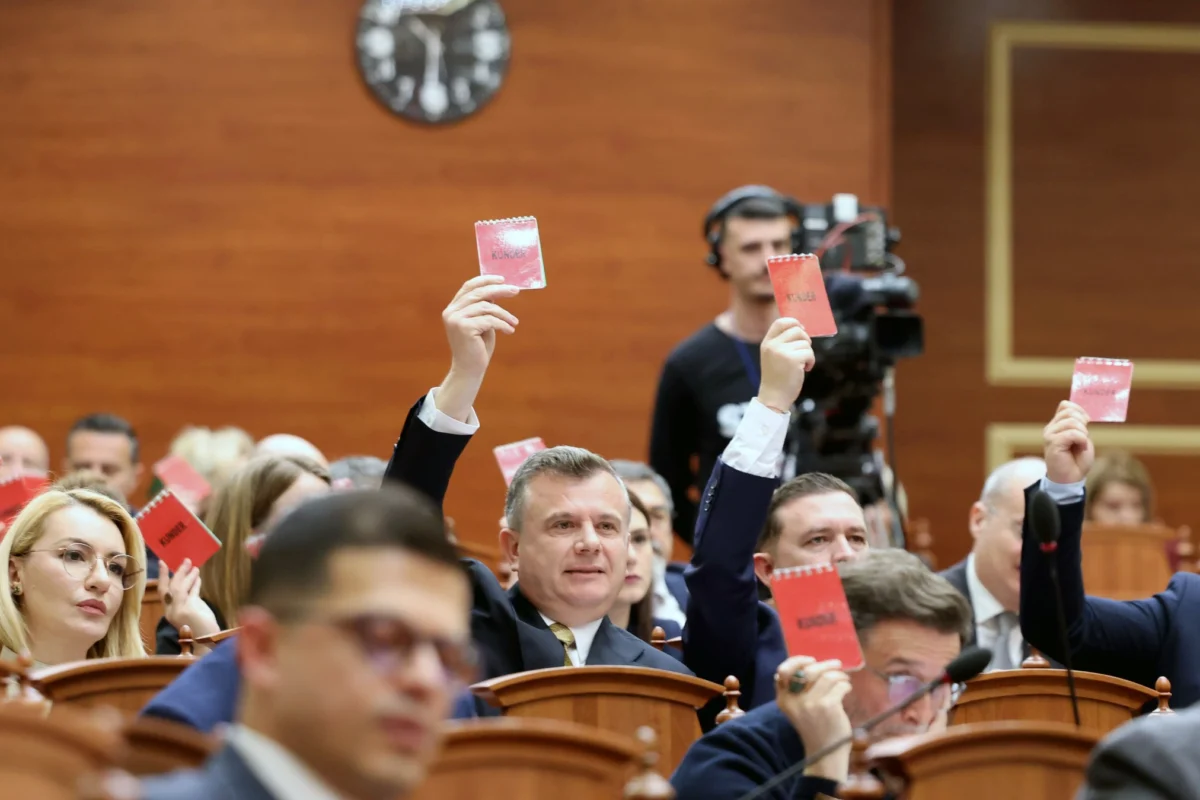
Tirana, Albania – October 26, 2026 – The ruling Socialist Party (PS) in Albania has signaled its intention to push through electoral reforms, even if it means employing a "cardboard force" in Parliament. This strong declaration comes on the heels of the majority unilaterally approving a new territorial map, raising concerns about the potential for partisan maneuvers in shaping the nation’s electoral landscape. The move has ignited a firestorm of criticism from the opposition and civil society organizations, who warn of jeopardizing democratic legitimacy and hindering Albania’s European integration aspirations.
Ruling Majority Signals Unilateral Path on Electoral Reform
The clear intent to proceed with electoral reforms, potentially without broad consensus, was articulated by Taulant Balla, the head of the Socialist Party’s parliamentary group. In a statement to the media on Tuesday, Balla directly accused the Democratic Party (PD), the largest opposition party, of "holding hostage" the realization of these crucial reforms. He asserted that the process would be concluded within the stipulated deadlines, implying a lack of patience for protracted negotiations.
"I sincerely hope that the electoral reform will not be unilateral, but I want to remind the Democratic Party that the final deadline for this commission is approaching – the end of November," Balla stated, underscoring the urgency perceived by the ruling party.
Balla further emphasized that these deadlines are intrinsically linked to Albania’s commitments in its European Union accession process. The ratification of laws related to electoral reform is slated for within the current year, a critical step towards meeting the conditions for EU membership.
The Socialist Party has also reiterated its proposal, originally put forth by Prime Minister Edi Rama, to reduce the number of parliamentary seats from 140 to 101. This suggestion, framed as a measure to streamline governance and enhance efficiency, is now being presented as a key component of the broader electoral reform agenda. Balla extended an invitation to the opposition to engage in discussions regarding potential constitutional amendments, signaling a willingness to explore changes that could reshape the very structure of Albanian representation.
Opposition Decries "Mafia-Style" Tactics and Threat to Legitimacy
The Socialist Party’s pronouncements have been met with swift and sharp condemnation from the opposition and civil society. Ina Zhupa, a Member of Parliament for the Democratic Party, branded Balla’s statement as a "mafia-style threat" that treats the Constitution as a bargaining chip.
"This mafia-style threat, which treats the Constitution as a bazaar, is a disgrace for a state that is in the process of European integration," Zhupa told BIRN, directly addressing Balla’s remarks. She argued that a unilateral electoral reform risks undermining the very legitimacy of future elections.
"It jeopardizes representation and is used as a tool of pressure against the opposition, creating the possibility of a constitutional supermajority," she warned, referring to the PS’s proposal to reduce the number of deputies. Zhupa asserted that the Democratic Party is committed to discussions based on principles and addressing all points raised in the OSCE/ODIHR report, and is not present "to haggle over representation."
Electoral Experts Stress Consensus for Sustainable Reform
Electoral experts have echoed the opposition’s concerns, highlighting the primary responsibility of the majority in ensuring that the reform aligns with OSCE/ODIHR recommendations and the standards set by the Venice Commission. However, they universally stress the indispensable need for parliamentary consensus.
Afrim Krasniqi from the Institute for Political Studies (IPS) explained to BIRN that the very nature of electoral reform, which dictates the rules of political competition, precludes it from being a unilateral affair. "Parliamentary consensus stems from the nature of electoral reform itself, which defines the rules of political competition, and for this reason, it cannot be treated as an issue for a single majority," Krasniqi stated.
He further elaborated on the historical context: "Albanian experience has shown that consensus-based reforms have had greater durability, while unilateral interventions in the rules of the game have produced tensions and political crises."
Krasniqi underscored that if the reform entails constitutional changes, the need for consensus becomes even more pronounced. The Constitution’s requirement for a qualified majority for certain amendments necessitates political compromise between the majority and the opposition. He suggested that debates on these matters should extend beyond the number of deputies to encompass broader issues related to institutional architecture, political representation, and the functioning of democracy.
"Precisely for this reason, any constitutional intervention must undergo a serious, open, transparent, and inclusive process, with the participation of institutions, the opposition, experts, and civil society," Krasniqi emphasized.
Civil Society Voices Alarm Over Unilateralism and "Bargaining"
The statement from Balla has been perceived as deeply concerning for the consensus required for both electoral and constitutional reforms. Rigels Xhemollari from "Qendra Qytetare" (Citizen Center) views Balla’s declaration as alarming, stating that "it cannot be called a reform when it is made by only one party."
"This would be a unilateral law and would jeopardize the legitimacy of the elections," he told BIRN.
Regarding the proposal for constitutional amendments, Xhemollari characterized it as an invitation for "bargaining" extended by the majority to the opposition, rather than the initiation of a dialogue and political consultation as a basis for building a constitutional reform.
Background and Chronology of Electoral Reform Efforts
The push for electoral reform in Albania is not a new phenomenon. It has been a recurring theme in the country’s political discourse, often amplified during election cycles and in the context of EU accession negotiations.
Key Milestones and Developments:
- Post-Communist Era: Albania has undergone numerous electoral system adjustments since the fall of communism in 1991. These have ranged from fully proportional representation to mixed systems, each with its own set of intended and unintended consequences.
- OSCE/ODIHR Recommendations: The Organization for Security and Co-operation in Europe’s Office for Democratic Institutions and Human Rights (OSCE/ODIHR) has consistently provided recommendations for improving Albania’s electoral processes. These recommendations often focus on issues such as voter registration, campaign finance, media access, and the clarity and fairness of the electoral framework.
- EU Accession Conditionality: As Albania pursues EU membership, electoral reform has become a critical benchmark. The European Commission has repeatedly emphasized the need for a comprehensive and inclusive reform that addresses identified shortcomings and aligns with European democratic standards.
- Previous Unsuccessful Attempts: Albania has a history of failed attempts at comprehensive electoral reform, often due to deep political divisions between the major parties. The inability to reach a broad consensus has frequently led to reforms being piecemeal or implemented unilaterally by the ruling party of the day.
- The 2020 Constitutional Amendments: In 2020, a significant set of constitutional amendments were passed, primarily aimed at judicial reform. While not directly electoral, these changes underscored the potential for major constitutional shifts when a strong parliamentary majority exists.
- Current Territorial Reform: The recent unilateral approval of the new territorial map by the majority adds a layer of complexity to the current political climate. This administrative reform, which reorganized local government units, was also met with opposition concerns about its potential political ramifications and lack of broad consultation. The Socialist Party’s willingness to proceed unilaterally on this issue appears to have emboldened their approach to electoral reform.
- The "End of November" Deadline: Taulant Balla’s explicit mention of an "end of November" deadline for the electoral reform commission signals a concrete timeline that the ruling party intends to adhere to, irrespective of opposition buy-in. This suggests a strategic approach to leverage the current parliamentary arithmetic.
Supporting Data and Context: The European Integration Imperative
Albania’s path towards EU membership is heavily contingent on its ability to demonstrate progress in democratic governance, the rule of law, and the strengthening of its institutions. Electoral reform is a cornerstone of this process. The European Commission’s annual reports on Albania consistently highlight the need for a robust and inclusive electoral framework.
Key Considerations from EU Integration Perspective:
- Legitimacy of Elections: The EU places paramount importance on the legitimacy of electoral processes. Reforms that are perceived as partisan or that fail to address the concerns of major political actors risk undermining public trust and international credibility.
- OSCE/ODIHR Standards: Adherence to the recommendations of the OSCE/ODIHR is a crucial benchmark for EU accession. These recommendations are designed to ensure that elections are free, fair, and transparent, and that they reflect the will of the people.
- Venice Commission Guidance: The Venice Commission, the Council of Europe’s advisory body on constitutional matters, provides expert opinions on electoral laws and constitutional amendments. Its guidance is often referenced by the EU in assessing a country’s democratic progress. The commission typically advocates for broad consensus on electoral reforms.
- Constitutional Requirements for Reform: Albania’s Constitution requires specific qualified majorities for constitutional amendments. For instance, changes to certain fundamental rights or electoral principles often necessitate a three-fifths or two-thirds majority of all parliamentary members. This constitutional hurdle necessitates opposition support for significant changes.
- The Impact of Reduced Parliament Size: The proposed reduction in the number of deputies from 140 to 101 is a significant structural change. While proponents argue for efficiency, critics worry about the potential for reduced representation, particularly for smaller parties and geographically dispersed constituencies. This could also concentrate power in fewer hands, raising concerns about accountability.
- Past Experiences with Unilateral Reforms: Albania’s political history is replete with examples where unilateral reforms, particularly in the electoral sphere, have led to prolonged political crises, boycotts of parliament, and contested election outcomes. The EU has consistently urged for inclusive processes to avoid such scenarios.
Official Responses and Stakeholder Perspectives
The Albanian political landscape is characterized by a stark divide on the approach to electoral reform.
Ruling Party (Socialist Party – PS):
- Official Stance: The PS, led by Prime Minister Edi Rama and parliamentary group leader Taulant Balla, maintains that electoral reform is essential for modernizing the country and aligning with EU standards. They emphasize the need for efficiency and the potential benefits of reducing the parliamentary size.
- Justification for Unilateralism (Implied): While not explicitly stating a desire for unilateral action, the language used by Balla suggests a willingness to proceed even if opposition consensus is not achieved, particularly if deadlines are to be met. They frame opposition obstructionism as the primary obstacle.
- Key Proposal: Reduction of parliamentary seats from 140 to 101.
Opposition (Democratic Party – PD):
- Official Stance: The PD, represented by MPs like Ina Zhupa, vehemently opposes any unilateral reform. They accuse the ruling majority of attempting to manipulate the electoral system for their own political advantage and of treating fundamental democratic principles as bargaining chips.
- Concerns: Jeopardy of electoral legitimacy, reduced representation, creation of a constitutional supermajority for the ruling party, and the disregard for established democratic processes and recommendations from international bodies.
- Demand: Inclusive dialogue and reform based on consensus, addressing all recommendations from OSCE/ODIHR and the Venice Commission.
Civil Society Organizations:
- Official Stance: Organizations like "Qendra Qytetare" (Citizen Center) and the Institute for Political Studies (IPS) align with the opposition’s concerns about unilateralism and the need for consensus.
- Expert Opinion: Electoral experts like Afrim Krasniqi and Rigels Xhemollari stress that electoral reforms, especially those involving constitutional changes, must be built on broad political agreement to ensure their durability and legitimacy. They warn that unilateral actions can lead to political instability and erode democratic norms.
- Call for Transparency: They advocate for open, transparent, and inclusive processes involving all stakeholders, including experts and civil society.
Implications and Future Outlook
The current trajectory of electoral reform in Albania carries significant implications for the country’s democratic development and its aspirations for European Union membership.
Potential Consequences:
- Erosion of Democratic Trust: If the Socialist Party proceeds with a unilateral reform, it risks further deepening the political polarization in Albania. This could lead to a decline in public trust in democratic institutions and processes, potentially impacting voter turnout and civic engagement in future elections.
- Jeopardizing EU Accession: The EU has made it clear that substantial progress on rule of law and democratic reforms, including electoral reform, is a prerequisite for opening new chapters in accession negotiations. A unilateral and contested reform could be viewed negatively by EU member states, potentially stalling Albania’s integration process.
- Contested Election Outcomes: Unilateral changes to electoral rules can create grounds for future election disputes and challenges, potentially leading to prolonged political crises and instability.
- Weakening of Parliamentary Oversight: The proposed reduction in the number of deputies, if implemented without broad consensus and careful consideration of representation, could concentrate power and weaken parliamentary oversight mechanisms, potentially leading to a less accountable government.
- Setback for Democratic Norms: The disregard for consensus-building in such a fundamental area of governance sets a negative precedent for future reforms and could undermine the principles of pluralism and compromise that are essential for a healthy democracy.
The coming weeks will be crucial in determining the path forward. The Socialist Party’s commitment to its stated deadlines and its approach to engaging with the opposition will be closely watched by both domestic and international observers. The challenge for Albania lies in navigating these complex political waters to enact reforms that are not only legally sound but also democratically legitimate and sustainable for the future of the nation. The call for consensus, echoed by opposition parties and electoral experts, remains the most prudent path to ensuring that electoral reform truly serves the interests of all Albanian citizens and strengthens the country’s democratic foundations.