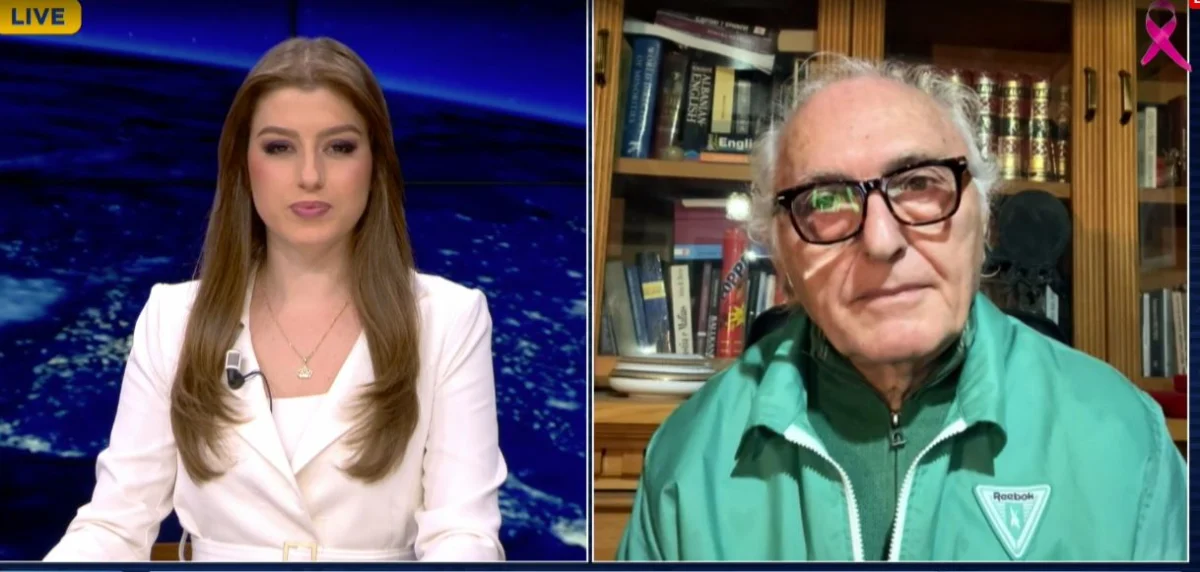
TIRANA, Albania – October 21, 2026 – In a potent and highly controversial televised address, prominent Albanian political analyst Frrok Çupi has launched scathing accusations against Sali Berisha, the head of the Democratic Party (DP), alleging his direct involvement in orchestrating violence during recent protests and asserting that the opposition has fundamentally corrupted the nature of public dissent for political gain. Appearing on ABC News’ program “Ora e njëmbëdhjetë” (The Eleventh Hour), Çupi declared the ongoing demonstrations to be a politically manipulated endeavor, far removed from any genuine civil society initiative, and pointed to Berisha as the primary architect behind what he termed "acts of savagery."
Çupi’s remarks come at a time of heightened political tension in Albania, marked by frequent public protests and an increasingly polarized political landscape. His direct linking of the opposition leader to violence and historical atrocities has ignited a fierce debate about the integrity of political discourse and the future of democratic expression in the country. The analyst’s statements have reverberated across the political spectrum, drawing sharp condemnation from opposition circles and fueling further discussions among government supporters and civil society alike.
Analyst’s Incisive Commentary on Protest Manipulation
Frrok Çupi’s analysis centered on the premise that what initially might have appeared as organic public discontent has been systematically co-opted and controlled by the Democratic Party under Sali Berisha’s leadership. He claimed that recent developments during the protests served to unequivocally confirm this alleged political orchestration.
The Allegation of Orchestrated Violence
Çupi did not mince words when addressing the perceived role of Sali Berisha in the protests. "Berisha is the very hand of violence. He is the cause of the savagery against the country," Çupi asserted, his tone unwavering. This bold declaration suggests that the analyst views Berisha not merely as an instigator, but as the direct operational force behind any aggressive or destructive actions witnessed during the demonstrations. The implication is that the violence was not spontaneous but rather a deliberate tactic employed to escalate tensions and serve a specific political agenda. Such accusations are particularly grave in a country with a complex history of political unrest and occasional clashes during public gatherings. Attributing "savagery" directly to a former head of state and current opposition leader is a powerful rhetorical move designed to delegitimize both the individual and the movement he represents. It casts the protests not as expressions of democratic will, but as instruments of chaos wielded by a calculated political actor.
Democratic Party’s Alleged Influence
According to Çupi, the latest events have significantly reinforced the long-standing claim that structures deeply intertwined with the Democratic Party are firmly behind the protests. He specifically cited the involvement of various groups, including trade unions and a segment of university professors, as irrefutable evidence of the DP’s extensive reach and manipulative tactics. "It was reconfirmed that behind [the protests] stand the sons [of the DP] and that the trade unions are branches of the DP. It was reconfirmed that University professors have come to the protest as a political branch of the DP. And the majority of those who were in the protest are part of the DP," Çupi elaborated.
This assertion suggests a systematic infiltration or co-option of ostensibly independent civil society groups and professional bodies. By branding unions and academics as "political branches" of the opposition, Çupi aims to strip them of their perceived autonomy and portray their participation as a cynical maneuver rather than a genuine expression of grievance. This narrative serves to undermine the credibility of the protests by questioning the motivations and independence of its participants, thereby reducing public sympathy and support for their cause. The analyst implies that the facade of a broad-based movement is merely a cover for partisan objectives, meticulously managed by the opposition leadership.
A Protest Deemed a "Failure"
Çupi unequivocally characterized the protest as a resounding "failure" for its organizers. His reasoning was straightforward: they allegedly failed to conceal the involvement of groups that, in his view, are intrinsically linked to the Democratic Party’s structures. "But it was also a day of failures, Berisha’s attempt to hide the fire group hiding in the DP failed," Çupi stated, implying a specific faction within the party responsible for inciting unrest. He continued, "Now the protest, if it can be called a protest, is completely corrupted. No one buys this anymore for a student protest, flamingo protest, or protest against the government. This is Berisha’s protest, who is in court for a very large corruption [case]."
This assessment highlights a key element of Çupi’s critique: the perceived loss of legitimacy. If a protest loses its perceived organic nature and is widely seen as a partisan instrument, its effectiveness and moral authority are severely diminished. By linking the protest directly to Berisha’s ongoing legal battles concerning alleged corruption, Çupi attempts to discredit the entire movement as a desperate tactic by a leader facing personal legal jeopardy, rather than a legitimate challenge to government policy. The analyst’s use of phrases like "flamingo protest" underscores his disdain and dismissal of the demonstrations as lacking any serious purpose beyond Berisha’s personal agenda.
The Weight of Historical Accusations
Perhaps the most explosive part of Çupi’s commentary was his deliberate invocation of a dark chapter in Albania’s post-communist history, directly linking it to Sali Berisha and, shockingly, to a leader of the current protest.

Revisiting the Remzi Hoxha Disappearance
"October 21st is the day Remzi Hoxha was killed by order of Sali Berisha," Çupi declared, dropping a historical bombshell into the contemporary political debate. Remzi Hoxha, an ethnic Albanian businessman from Macedonia, disappeared in Albania in October 1995 and was later confirmed to have been tortured and killed by elements of the then-Albanian intelligence service (SHIK), during a period when Sali Berisha was President. The case remains one of Albania’s most enduring and painful unresolved mysteries, with persistent accusations against high-ranking officials of the time for their alleged involvement or cover-up. Bringing up this specific date and explicitly blaming Berisha for the murder is an exceptionally serious accusation, designed to associate the opposition leader with grave human rights abuses and state-sponsored violence. It’s a tactic often employed in highly charged political environments to inflict maximum damage on an opponent’s reputation and moral standing.
A Leader’s Controversial Past
The historical accusation was further amplified by Çupi’s subsequent claim: "At the head of the University Union was one of those from SHIK who participated in the murder. Imagine, one of the killers of this martyr led the protest today." This statement, if substantiated, would be devastating for the credibility of the protest and the individuals involved. It suggests a direct link between historical perpetrators of state violence and current protest leadership, implying that the same dark forces that operated in the 1990s are now active in contemporary political movements. The accusation paints a chilling picture of continuity in alleged illicit practices, raising profound questions about accountability, justice, and the moral compass of political activism in Albania. It also serves to further delegitimize the protest by associating it with a figure allegedly complicit in a heinous crime, thus aiming to deter public support.
Chronology of Recent Political Tensions
The intense rhetoric surrounding the current protests and Çupi’s accusations are not isolated incidents but rather symptomatic of a deeply entrenched political polarization in Albania, which has been escalating for several years.
Early 2020s: A period marked by significant political instability, with the opposition, primarily the Democratic Party, frequently boycotting parliamentary sessions and launching large-scale protests against the government. These protests often cited concerns over corruption, electoral integrity, and governance issues.
Mid-2020s: Sali Berisha, after being sanctioned by the U.S. and declared "non-grata" for alleged significant corruption, faced internal challenges within the Democratic Party. This led to a split within the DP, with one faction aligning with Berisha and another attempting to distance itself. Berisha’s legal troubles escalated, culminating in ongoing judicial proceedings related to alleged corruption during his time as Prime Minister.
Late 2025 – Early 2026: A series of public protests gained momentum, initially framed around various socio-economic issues, such as inflation, student grievances regarding education reform, or specific government policies. These protests often saw a mix of civil society activists, student groups, and political opposition supporters.
October 2026: The specific protest commented on by Çupi takes place, ostensibly driven by public discontent. However, its perceived hijacking by political actors, as Çupi claims, becomes a central point of contention, leading to the analyst’s fiery statements on ABC News. This marks a critical juncture where the lines between genuine public grievance and partisan manipulation are aggressively blurred, according to Çupi’s narrative.
Supporting Data and Context
Çupi’s analysis must be understood within the broader context of Albanian political culture, where media narratives often align with political camps, and historical grievances frequently resurface in contemporary debates.
The Broader Political Landscape
Albania’s political scene is characterized by intense rivalry between the ruling Socialist Party and the opposition Democratic Party. Personal attacks, accusations of corruption, and allegations of state capture are common features of public discourse. Analysts like Frrok Çupi are often perceived to lean towards one side or another, and their pronouncements are frequently interpreted through this partisan lens. The government, currently led by the Socialist Party, often seeks to discredit opposition protests by portraying them as politically motivated and lacking genuine public support. Conversely, the opposition frames its actions as vital checks on governmental power and expressions of popular will.
The Role of Civil Society and Academia
The debate surrounding the independence of civil society organizations, trade unions, and academic bodies is a recurring theme in Albanian politics. Both the government and the opposition have, at various times, been accused of attempting to influence or co-opt these institutions for political purposes. Çupi’s specific mention of unions and university professors as "branches of the DP" taps into this sensitive area, aiming to undermine their perceived neutrality and suggest that their participation in protests is not born of independent conviction but rather of partisan loyalty. This narrative, if accepted by the public, could erode trust in these institutions and further fragment the social fabric.
Official Responses and Denials
While the original article does not include direct responses from Sali Berisha or the Democratic Party, a professional journalistic approach necessitates considering their likely reactions to such severe allegations.
Opposition’s Expected Rebuttal
Sali Berisha and the Democratic Party would almost certainly issue a strong denial of Çupi’s accusations. They would likely characterize Çupi’s statements as politically motivated attacks, orchestrated by the government to distract from its own failures and to delegitimize legitimate public dissent. Berisha’s camp would likely dismiss the claims of orchestrating violence as baseless slanders designed to criminalize the opposition. Regarding the Remzi Hoxha case, Berisha has historically denied any involvement, attributing the accusations to political opponents. He would likely reiterate his innocence and condemn the resurfacing of such historical claims as a cynical attempt to deflect attention from current issues and his ongoing legal battles, which he consistently frames as politically motivated persecution. The DP would also likely defend the participation of unions and academics as an organic expression of broad dissatisfaction with the government, rather than political manipulation.
Government’s Stance
The ruling Socialist Party, while not directly quoted here, would likely welcome Çupi’s analysis as validation of its own narrative regarding the opposition. They would probably emphasize the "corrupt" nature of the protests and Berisha’s alleged efforts to destabilize the country to escape justice. The government’s messaging would align with Çupi’s portrayal of the protests as partisan spectacles rather than genuine civic movements, reinforcing its position that the opposition lacks constructive alternatives and resorts to disruptive tactics.
Implications for Albanian Democracy
The nature and severity of Frrok Çupi’s accusations carry significant implications for the health of Albanian democracy, affecting public trust, political discourse, and the stability of institutions.
Erosion of Public Trust
When public figures, media analysts, and political leaders engage in such inflammatory rhetoric, accusing opponents of orchestrating violence, manipulating civil society, and even historical murders, it inevitably leads to a profound erosion of public trust. Citizens may become cynical about all political actors, finding it difficult to discern truth from partisan propaganda. This cynicism can depress political participation, weaken democratic institutions, and make it harder for genuine civic movements to gain traction, as they might be immediately dismissed as politically co-opted. The constant barrage of accusations risks normalizing extreme rhetoric, further polarizing society and making constructive dialogue increasingly difficult.
The Future of Political Discourse
Çupi’s statements exemplify a trend towards an increasingly aggressive and personalized political discourse in Albania. By drawing on historical wounds like the Remzi Hoxha case and directly implicating political opponents in violence, the analyst raises the stakes considerably. This level of accusation can further entrench animosity between political camps, making compromise and cooperation almost impossible. The focus shifts from policy debates to character assassination and historical grievances, hindering the country’s ability to address pressing socio-economic challenges through reasoned political processes. Such a climate can also intimidate independent voices and stifle dissent, as anyone participating in protests risks being labeled as a "political branch" or an accomplice to alleged violence.
Conclusion
Frrok Çupi’s recent commentary on ABC News represents a significant escalation in Albania’s already volatile political discourse. By directly accusing Sali Berisha of orchestrating violence, manipulating protests through Democratic Party "branches" in unions and academia, and even linking him to the historical murder of Remzi Hoxha, Çupi has laid bare the deep fissures within Albanian society. His characterization of the protests as a "corrupted" failure, driven by Berisha’s personal legal troubles, aims to completely delegitimize the opposition’s efforts.
These accusations, while requiring scrutiny and formal responses from those implicated, underscore the pervasive challenges facing Albanian democracy: the struggle for transparent political processes, the battle against alleged corruption, and the enduring shadow of a complex past. The political environment remains highly charged, with analysts like Çupi playing a critical role in shaping public opinion, often at the risk of further polarization. As Albania navigates these turbulent waters, the path towards a more constructive and less acrimonious political future remains uncertain, heavily influenced by the weight of such profound and historically resonant allegations.