Tirana, Albania – A palpable tension hung in the air of Tirana on Wednesday afternoon, a lingering scent of smoke from burnt shops near the Twin Towers on "Dëshmorët e Kombit" boulevard. Groups of young people, perched on curbs, engaged in hushed conversations, their faces illuminated by phone screens as they followed the day’s unfolding events and awaited the evening’s resumption of anti-government protests. Just hours earlier, a demonstration on Durrësi Street, near the Ministry of Education, had erupted into clashes between protesters and police. Rocks flew towards the ministry building, met by a barrage of tear gas and high-pressure water cannons.
While the afternoon on the boulevard offered a semblance of calm, it felt more like a temporary ceasefire in a conflict far from over. A week of intense, often violent, protests had transformed the capital’s main arteries into arenas for confrontation between masked youths and the Rapid Intervention Forces. The quiet of Wednesday afternoon was a stark contrast to the previous days, a fragile pause in a movement showing no signs of abating.
Since October 13th, hundreds of protesters have been arrested or prosecuted, including minors. Allegations of excessive force by law enforcement have raised significant concerns about the proportionality of police interventions. Amidst this unrest, a 20-year-old Landscape Planning and Architecture student at the Agricultural University of Tirana, Iris Kola, has emerged as a voice for a generation disillusioned with their country’s trajectory.
A Generation’s Frustration Fuels the Flames
Iris Kola, petite with a cascade of dark curls and a rapid, passionate speaking style, seemed to be the gravitational center of a small group of young people near the Twin Towers. Friends constantly approached her, seeking updates and discussing plans for later that evening. Unlike many students who shy away from media attention for fear of repercussions, Iris readily spoke about the reasons that had driven her, and thousands of her peers, to the streets. Their primary demand: the resignation of Prime Minister Edi Rama, who has led the country since 2013.
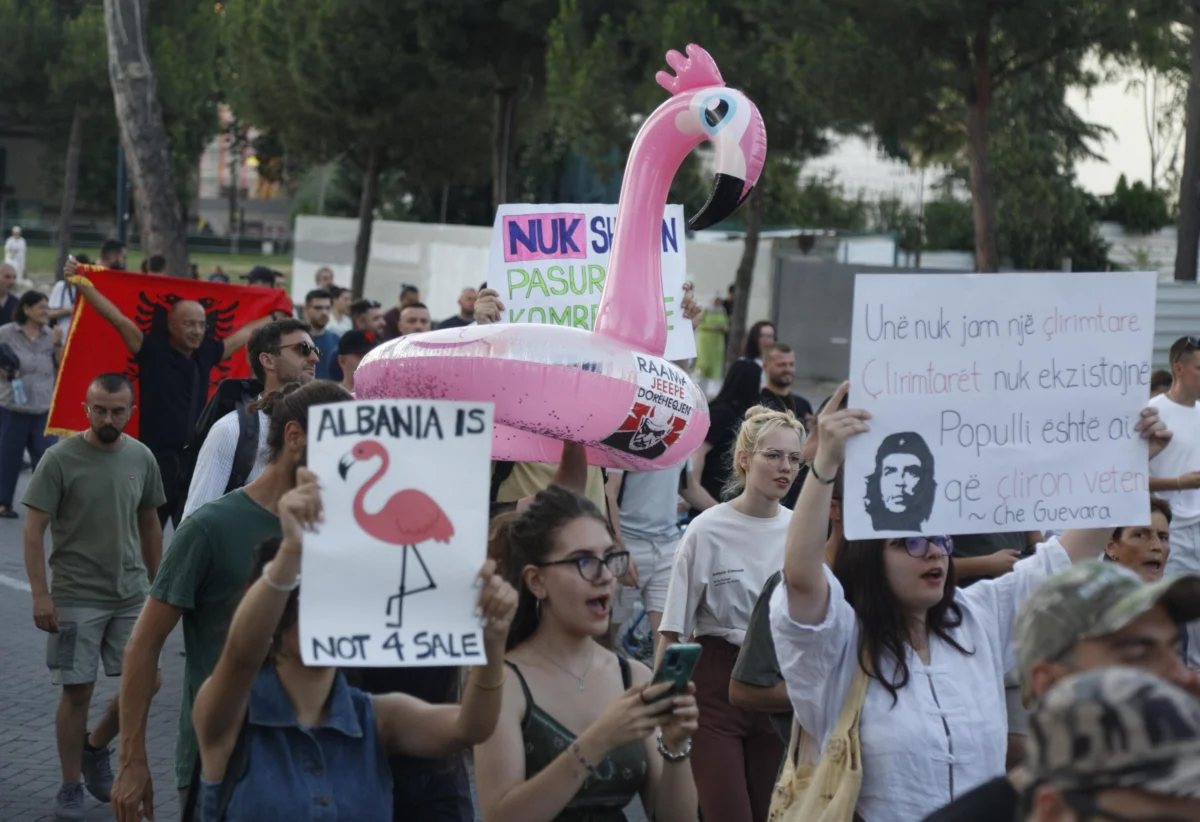
Born and raised in Tirana, Kola joined the protests in early June. The initial spark was a controversial project to develop tourist resorts in the protected Zvërnec area, reportedly linked to the son-in-law of the US President. This environmental concern quickly ignited a wider movement, known as the "Flamingo Revolution," drawing thousands of citizens to the streets.
"When the protest started, I was away with school commitments for the first three days, but I broke my ticket and came. And since then, my friends and I have supported it and have been consistently present," she shared.
Four months later, the environmental protests and calls for transparency regarding "strategic" coastal investments have morphed into a broader revolt against the government. This wider discontent unites young people frustrated by corruption, the rising cost of living, and a pervasive lack of future prospects. For Iris, these frustrations are rooted in a dilemma shared by many of her generation: whether to forge a future in Albania or seek opportunities abroad.
"I Protest Today So I Don’t Emigrate Tomorrow"
Emigration has been one of Albania’s most profound societal wounds over the past three decades, emptying villages and towns and leaving an increasingly aging population. According to the 2023 Census, the country’s population had fallen to approximately 2.4 million inhabitants, nearly 420,000 fewer than in 2011. This demographic contraction is attributed to both emigration and a declining birth rate.
For many young Albanians, leaving the country is seen as the most secure path to well-paying employment and a more dignified life. For Iris, however, protesting is an attempt to avoid making that same decision.

"I protest today so I don’t emigrate tomorrow," she stated, echoing one of the unifying slogans of the youth movement.
"As a student, the job market is insignificant if you don’t have connections or money," Iris added, highlighting the deeply entrenched issues of nepotism and corruption that plague access to employment.
Her frustration, however, extends beyond employment prospects. "There is no family in our country that hasn’t faced the arrogance or disregard of the state at least once, from healthcare to the lack of basic services like water and electricity," she asserted.
Iris cited the deplorable conditions in the healthcare system, the low standard of living, and a public administration that, in her view, often treats citizens as if they are bestowing a favor rather than providing a service. Similar sentiments have been echoed by other protesters in recent months, as initial demands for environmental protection have gradually broadened into calls for the Prime Minister’s resignation and systemic political change.
A Community Forged in Protest
As our conversation continued, a young man approached Iris, urging her to move closer to the Prime Minister’s office, where protesters were beginning to gather. He mentioned several names of girls and boys waiting for her. Iris knew them all.
Over the months of protests, she and her peers have cultivated a network of friendships and solidarity that operates both on the streets and across social media platforms.
"We’ve created a community where we share calls to gather for protests on our social networks, we share videos, memes," she explained.
This community has also developed its own unique language of humor, built around shared experiences on the front lines. "We have inside jokes like ‘if we don’t smell the gas, our eyes don’t open,’" she said with a laugh.
In Milan Kundera’s "The Book of Laughter and Forgetting," the Czech writer explores the power of humor to challenge truths imposed by totalitarian regimes. For Iris and her contemporaries, humor and sarcasm have likewise become tools to subvert government rhetoric and cope with the inherent tension of protests.

"We don’t follow the Prime Minister’s statements at all, or we are indifferent, or we usually turn them into memes," Iris remarked.
She pulled out her phone to show a meme circulating among protesters, humorously mocking Rama’s warnings about restricting transport for those involved in violence, which included trains – despite Albania lacking a functional regular passenger rail service.
Yet, the shared experience of protests has not solely been about levity. During clashes with police, Iris and several other young women have taken on the role of medics, distributing masks, saline solutions, and other protective gear to fellow protesters affected by tear gas. In the early days of confrontations, they wore red scarves on their arms or necks to identify themselves and signal those in need of assistance.
Iris recounted how she and her friends also took on the task of removing tear gas canisters thrown by the police from the crowd, moving them or throwing them into the Lana River. But alongside these newfound friendships came experiences of violence, fear, and uncertainty.
Fear and Defiance
Iris adamantly stated her opposition to violence, insisting she had never thrown a stone at the police. However, she expressed understanding for the actions of her peers engaged in confrontations, viewing it as a reaction to police brutality and the government’s prolonged dismissal of protesters’ demands.
"Violence is intolerable, but their violence [the police’s] makes us more vigilant and careful, but it doesn’t deter us," she asserted.
Her stance reflects a contradiction within the student movement in Albania: many participants reject violence as a political tool, yet they exhibit empathy for the frustration of young people clashing with law enforcement.
"We have protested peacefully for four months, and the Prime Minister ignored us, dismissed our demands," Iris stated. "We have stones as our only means against gas, water, and rubber batons."
When asked about fear, Iris admitted her greatest concern wasn’t the uniformed police visible on the boulevard, but plainclothes officers. "Some of us, even when the protest was peaceful, were followed at night when we went home," she claimed.

While her accusations could not be independently verified, the fear of detention and police intervention has become a daily reality for many young people participating in demonstrations. Iris lifted her sleeve to reveal a bruise on her arm, which she considered a normal consequence of the current circumstances. She wasn’t even certain if the bruise resulted from a police baton or an accidental impact from someone in the crowd while she was moving away from tear gas.
A Revolt Against the Political Class
Although the protesters demand the resignation of Prime Minister Edi Rama, the youth’s revolt has attempted to distance itself from political parties and the traditional divisions that have dominated the Albanian political scene for the past 35 years. Slogans like "Rama to prison, Berisha to prison" and "Your end has come" express the protesters’ dissatisfaction not only with the current government but also with the opposition and the political establishment as a whole.
Iris is cautious when questioned about her political beliefs. She avoids identifying with any specific party or political faction, emphasizing that such affiliations are secondary to what is happening on the streets. According to her, the protest has succeeded in uniting young people with diverse beliefs who might otherwise have little in common.
"The greatest achievement of the protest is the awakening of the youth, who are seeking true democracy," she declared, adding that "we have been in a dictatorship, it’s just now that its head is being cut off."
For her, the Prime Minister’s resignation is the primary and non-negotiable demand. This should be followed by new elections and concrete measures to improve conditions in schools and hospitals, alongside a robust fight against corruption.
"We will not leave the square until we see real change in the country," she warned.