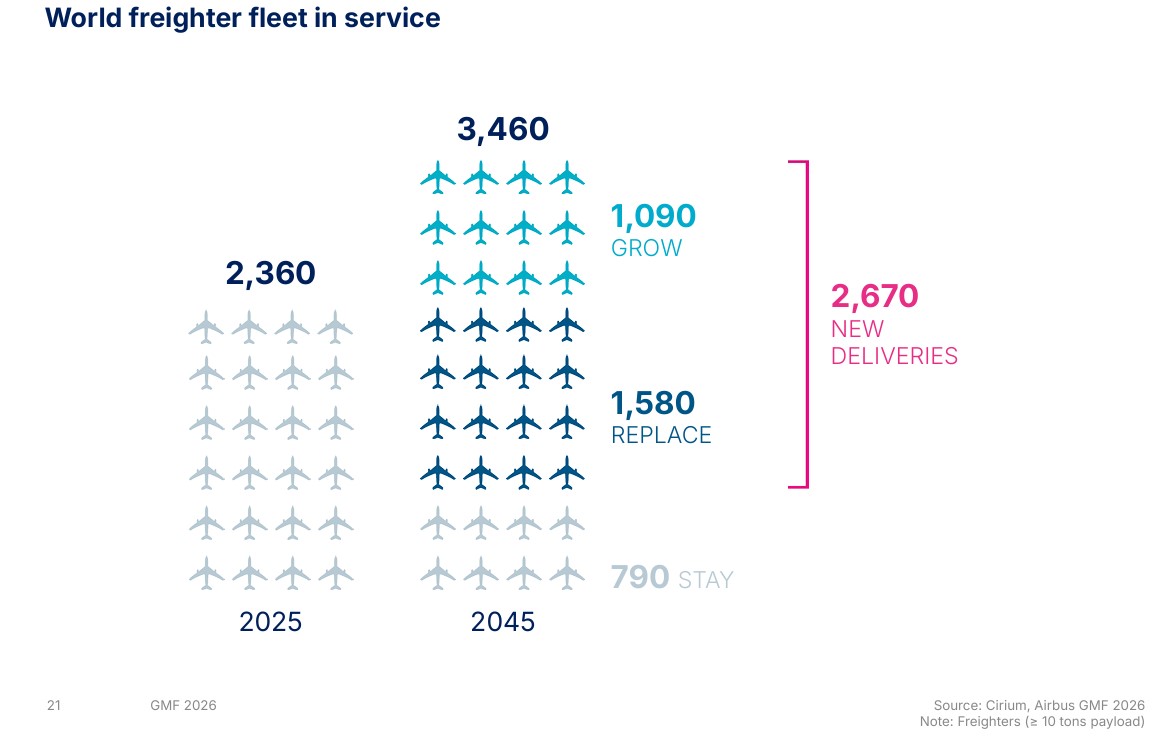
In a significant update to its long-term industry outlook, European aerospace giant Airbus has reaffirmed the resilience of the global air cargo market. Despite a backdrop of persistent geopolitical friction, shifting trade corridors, and macroeconomic turbulence, the manufacturer’s latest 20-year market forecast paints a picture of steady, sustained growth. Airbus now estimates that the global freighter fleet will expand by 46% by 2045, necessitating a total of 2,670 new aircraft deliveries to meet rising demand.
The revised figures represent a slight uptick in volume compared to the manufacturer’s 2025 assessment, suggesting that the industry’s appetite for new capacity remains high as carriers look to modernize aging fleets and capitalize on the digital economy’s logistics requirements.
The Core Data: A Fleet in Transition
According to the report released this Wednesday, the next two decades will see a massive influx of new airframes. Of the 2,670 aircraft projected to enter the global fleet, 970 will be factory-built, while the remaining 1,700 will be passenger-to-freighter (P2F) conversions. This represents a net increase of 65 aircraft compared to last year’s forecast.
The growth is underpinned by an anticipated compound annual growth rate (CAGR) of 3.2% in air cargo volumes. While this is a marginal "tick down" from the 3.3% estimate provided in 2025, it remains significantly more optimistic than the 2.3% CAGR observed over the past two decades—a period marked by severe global economic shocks, including the 2008 financial crisis and the COVID-19 pandemic.
The total fleet estimate for 2045 stands at 3,460 aircraft. Airbus emphasizes that a significant portion of this growth is driven by replacement demand. As Francois Cabaret, head of market forecasts at Airbus, noted during a virtual briefing, the current global fleet is aging rapidly. "The fleet is a lot older than it was five or ten years ago," Cabaret explained. "That’s why there is a very strong demand for replacement aircraft, whenever they become available."
Chronology: The Evolution of Market Turbulence
To understand the current forecast, one must examine the volatility of the last 24 months. The air cargo industry has navigated a labyrinth of obstacles, yet it has consistently outperformed expectations.
2025: The Year of Tariffs
Last year proved to be a challenging baseline. Global trade faced significant headwinds as the United States implemented a series of aggressive tariffs, particularly targeting Chinese exports. These measures disrupted traditional supply chains and caused a temporary dip in North American air cargo demand.
2026: A Shift in Global Trade Lanes
The landscape has shifted dramatically by late 2026. Data from the International Air Transport Association (IATA) shows that air cargo volumes through August 2026 rose by 4.6% year-over-year. This rebound is largely attributed to the redirection of trade.
U.S. tariffs on Chinese goods—including the closure of duty-free loopholes for e-commerce packages—have effectively rerouted $750 billion in exports. This volume has not vanished; rather, it has migrated to manufacturing hubs in Vietnam, Taiwan, and Thailand. Consequently, U.S. imports from these non-Chinese regions have surged by 12% this year, acting as a powerful offset to the cooling of direct trade with China.
The Middle East Conflict
Geopolitics continues to play a disruptive role. The ongoing military conflict involving the United States and Iran has caused Middle Eastern air cargo volumes to plummet by 6.5% year-to-date. Carriers are increasingly bypassing Middle Eastern hubs, opting for direct Europe-Asia routings. This has led to a noticeable rise in traffic through Central Asian transit points like Baku, Azerbaijan, and Tashkent, Uzbekistan.
Supporting Data: The High-Tech Engine
One of the most profound drivers of current air cargo growth is the "AI Gold Rush." The race to build and outfit massive data centers with servers has caused the value of computer and semiconductor shipments to double in just two years.
While these components represent only about 6.2% of the total weight of air cargo, they account for 15% of the total value. Because this equipment is high-value and time-sensitive, it is almost exclusively transported by air, providing a stable, high-yield revenue stream for cargo operators. This demand is currently concentrated in Asia, which remains the fastest-growing region for air cargo at a projected 4% annual pace.
Official Responses and Strategic Positioning
The Airbus Perspective
Airbus is positioning its all-new A350 freighter as the premium solution for the 80-ton cargo category. With 115 orders from 14 customers (and one undisclosed), the company is banking on the A350’s superior range and payload capacity to win over operators who might otherwise opt for conversions.
Crawford Hamilton, head of freighter marketing at Airbus, confirmed that the first delivery of the A350F is on track for late 2027. "The aircraft has completed its first initial test flight," Hamilton said. "We are now moving into nine months of rigorous flight testing to satisfy European civil aviation authorities."
The Competition: Boeing’s Stance
While Airbus focuses on the high-end, new-build market, its primary rival, Boeing, maintains a broader strategy. Last year, Boeing projected a 67% growth in the global freighter fleet, with 2,900 total additions. Boeing’s outlook, which is expected to be updated next week, focuses heavily on the 777-8 freighter and its established dominance in the conversion market.
While Airbus lacks a large-scale conversion program for its largest jets, it remains active in the A330-300 and A321 conversion segments. Conversely, Boeing’s partners, such as Israel Aerospace Industries and Mammoth Freighters, are aggressively fulfilling orders for 777 conversions, creating a competitive dual-track market where airlines must choose between the operational efficiency of new-builds and the capital-expenditure advantages of converted passenger jets.
Implications for the Global Supply Chain
The implications of these forecasts are far-reaching for logistics providers, shippers, and policy makers:
- Increased Capital Expenditure: Cargo airlines face a critical decision-making window. With the global fleet aging, the cost of maintenance is rising, forcing a shift toward new, more fuel-efficient assets. The 20-year demand for 2,670 aircraft suggests a multi-billion dollar investment cycle.
- Sustainability Pressures: New-build freighters like the A350 and 777-8 offer significantly better carbon footprints than the converted aircraft they replace. As ESG (Environmental, Social, and Governance) mandates become stricter, carriers will be under pressure to prioritize these newer, cleaner airframes.
- Regional Supply Chain Resilience: The shift of manufacturing away from China toward Southeast Asia and India indicates that air cargo infrastructure in these emerging regions will need to expand rapidly to handle the increased frequency and volume of high-tech exports.
- The Persistence of Air Cargo: Despite the "turbulence" mentioned by Airbus, the data confirms that air cargo has decoupled from the slower growth of general global trade. As long as the global economy relies on just-in-time delivery for high-value tech components and e-commerce, the freighter fleet will remain a vital, growing artery of international commerce.
Conclusion
Airbus’s 2026 market outlook serves as a sobering yet optimistic reminder of the aviation industry’s adaptability. While the world faces significant political and economic headwinds, the fundamental need for air bridge capacity is projected to expand. Whether through the deployment of advanced new-builds or the strategic conversion of retired passenger airliners, the next two decades will see a comprehensive renewal of the world’s cargo-carrying capacity. For operators, the race to secure these assets is already underway.