By [Your Name/Journalist Desk]
October 8, 2026
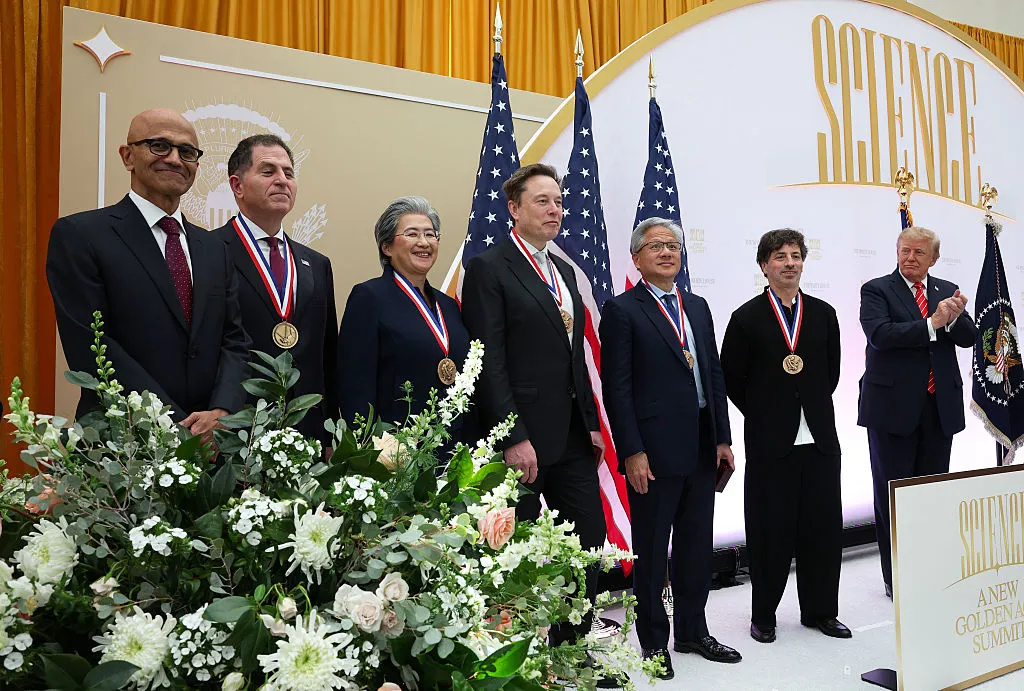
In a ceremony that underscored the deepening convergence between the American technology sector and the executive branch, President Donald Trump presided over the “Golden Age of American Innovation Summit” this Thursday. The event, held at the White House, served as a stage for the administration to bestow the nation’s highest scientific and technological honors upon a cohort of industry titans. The recipients, a “who’s who” of Silicon Valley and global computing leadership, were recognized for their contributions to what the President described as a new frontier of American dominance.
However, the prestige of the medals has been overshadowed by intense public discourse regarding the intersection of philanthropy, political contributions, and policy. With reports indicating that the recipients—or their affiliated entities—have collectively funneled nearly $6 billion into initiatives aligned with the Trump administration, the event has reignited debates over the influence of corporate wealth in government recognition.
The Honorees: A Blueprint of Modern Tech
The ceremony recognized two distinct categories of achievement. The National Medal of Science, historically reserved for researchers and scientists whose work has significantly advanced our understanding of the natural world, was awarded to:
- Elon Musk: For his contributions to space exploration and sustainable energy.
- Jensen Huang: For his foundational work in AI hardware and GPU acceleration.
- Sergey Brin: For his pioneering advancements in search algorithms and information architecture.
- Lisa Su: For her transformative leadership at AMD and advancements in high-performance computing.
Simultaneously, the National Medal of Technology and Innovation—which celebrates those who have made lasting contributions to America’s economic and social well-being—was presented to:
- Michael Dell: For his influence on supply chain logistics and personal computing infrastructure.
- Satya Nadella: For his strategic stewardship of Microsoft during the global AI transition.
Chronology: From Innovation to Integration
The path to this summit was paved over several months of shifting alliances between the administration and the tech sector.
- Early 2026: The administration signals a pivot toward “techno-nationalism,” emphasizing domestic hardware production and AI sovereignty.
- Spring 2026: High-level summits at Mar-a-Lago between the President and executives from AMD, Microsoft, and Tesla establish the framework for the “Golden Age” initiative.
- Summer 2026: Reports emerge regarding massive pledges from the Dell Foundation to the “Trump Accounts,” a national savings program for children.
- September 2026: The administration abruptly halts the H-1B visa program for Microsoft, creating a point of friction that many analysts thought would derail the relationship.
- October 8, 2026: The summit takes place, normalizing the relationship despite lingering policy tensions.
Supporting Data: The Cost of Recognition
The ceremony has drawn scrutiny from transparency groups, most notably following a report by The New Republic highlighting the financial entanglements between the recipients and the administration. The scale of the capital involved is unprecedented for a presidential awards ceremony.
Financial Contributions Breakdown:
- The Dell Contribution: Michael and Susan Dell committed $6.25 billion to the “Trump Accounts.” While framed as a philanthropic effort for American children, critics note the timing coincides with significant federal contracts awarded to Dell Technologies.
- Corporate PACs and In-Kind Support: Alphabet and Microsoft were confirmed to have contributed to the President’s inauguration fund and the renovation of the White House ballroom. AMD, under Lisa Su’s leadership, has been a significant donor to pro-Trump Super PACs, fueling a cycle of investment that critics argue creates a “pay-to-play” optics trap.
The optics of the ceremony were further complicated by the inclusion of Sergey Brin, whose company (Alphabet) has faced sporadic friction with federal regulators, yet remained a primary donor to administration-adjacent funds throughout the fiscal year.
Official Responses and Rhetoric
During the ceremony, President Trump framed the awards not as transactional, but as a recognition of a strategic partnership.
“These are the men and women who have helped pioneer an incredible future for America,” Trump stated during his remarks. “Because of their genius, because of their drive, and because of their loyalty to the concept of American greatness, we will always be on top. No one else can compete with us. The world is watching, and they are seeing that the American dream is alive and powered by the greatest minds in history.”

The honorees largely maintained a focus on the necessity of domestic technological self-reliance. Jensen Huang and Lisa Su both spoke briefly on the importance of maintaining an “American-first” approach to the semiconductor supply chain, emphasizing that the awards symbolized a commitment to ensuring that the next generation of AI development occurs exclusively within U.S. borders.
Perhaps the most curious moment of the day involved Satya Nadella. Accepting his medal shortly after the administration suspended Microsoft from the H-1B program, Nadella maintained a stoic demeanor, focusing his comments on the “shared goal of digital empowerment.” The disconnect between the punitive immigration policy and the high honor of the medal left many analysts questioning the true state of the Microsoft-White House relationship.
Implications for the Future of Policy
The Golden Age of American Innovation Summit is likely to have long-term ripple effects on how policy is crafted in the U.S.
1. The Erosion of Policy Independence
The primary concern among political scientists is the blurring of lines between meritocratic recognition and political patronage. When the nation’s highest scientific honors are distributed to the largest political donors, the intrinsic value of those medals may face a decline in public trust.
2. The H-1B Paradox
The suspension of the H-1B program for Microsoft, despite the administration honoring its CEO, signals a volatile policy environment. It suggests that while the administration is eager to partner with tech leaders, it remains prepared to use aggressive protectionist measures to force corporate behavior. Companies are now in the precarious position of being “honored” while simultaneously facing operational restrictions.
3. Shift Toward "Nationalized" Tech
The summit signaled a definitive move away from the globalized, free-market tech ecosystem of the early 2000s. By rewarding those who lean into the administration’s “America First” policy, the White House is effectively creating a tiered system: those who align with the administration’s economic and political goals are rewarded with prestige and, likely, future federal contracts; those who do not risk being sidelined in regulatory or labor-related policy decisions.
4. The Impact on Philanthropy
The $6.25 billion pledged by the Dells marks a new chapter in “political philanthropy.” By linking massive charitable donations to government-sanctioned savings programs, private wealth is increasingly becoming a vehicle for public policy implementation. This raises questions about whether private entities are now essentially serving as proxy agencies for the federal government.
Conclusion
As the dust settles on the White House ceremony, the Golden Age of American Innovation Summit remains a snapshot of a nation in flux. The recipients are undeniably among the most influential architects of the modern world, having transformed the way humanity communicates, computes, and explores the stars. Yet, the ceremony leaves a complex legacy.
The challenge for the current administration will be to prove that these honors were truly about the advancement of science, rather than a consolidation of corporate and political interests. For the tech titans, the challenge is even greater: navigating a landscape where their success is increasingly tethered to the whims of political favor, and where the line between national interest and political alignment is thinner than ever.
As the industry looks toward the next fiscal year, the message from the White House is clear: the government is no longer just a regulator or a client—it is a partner in the boardroom. Whether this leads to a true "Golden Age" or a stifling of competitive innovation remains to be seen.