In the rapidly evolving landscape of digital content, the barrier to entry for high-end video production is collapsing. For years, professional-looking video required expensive camera gear, a dedicated lighting crew, and hours of post-production labor. Today, Google’s Gemini Omni (formerly known as OmniFlash) is fundamentally shifting that paradigm, allowing marketers, creators, and small business owners to produce "scroll-stopping" content entirely through artificial intelligence.
As AI video generation matures, tools like Gemini Omni are moving beyond experimental novelties to become legitimate production assets. By leveraging Google’s massive, proprietary YouTube-trained models, Omni offers a level of nuanced movement and environmental awareness that is setting a new industry standard.
The Core Capabilities of Gemini Omni
Gemini Omni is the successor to Google’s earlier AI initiatives, including Veo3. Built upon the foundation of "world models," the software possesses a deep understanding of physics, lighting, and human expression. Unlike static image generators, Omni is designed to interpret speech inflections and complex environmental interactions, making it a potent tool for those looking to scale their video output without scaling their production costs.
Accessibility and Tiered Usage
For the average creator, the Gemini app—available on both desktop and mobile—is the primary gateway. Within the chat interface, users can trigger the video generation engine simply by selecting the "Video" option.
For professional workflows, however, the ecosystem is more complex. Google Labs provides a more robust set of editing features, while third-party aggregators—such as Open Art or Higgs Field—offer the ability to consolidate multiple AI models into a single, cohesive dashboard. Strategy experts suggest a hybrid approach: utilizing the Gemini app for basic experimentation while subscribing to Google Labs for the advanced editing and refinement capabilities that the standard mobile interface lacks.
Chronology: From Setup to Sophisticated Production
The process of moving from a blank page to a finished video involves a methodical approach to "AI twinning" and iterative prompting.
The Birth of an AI Twin
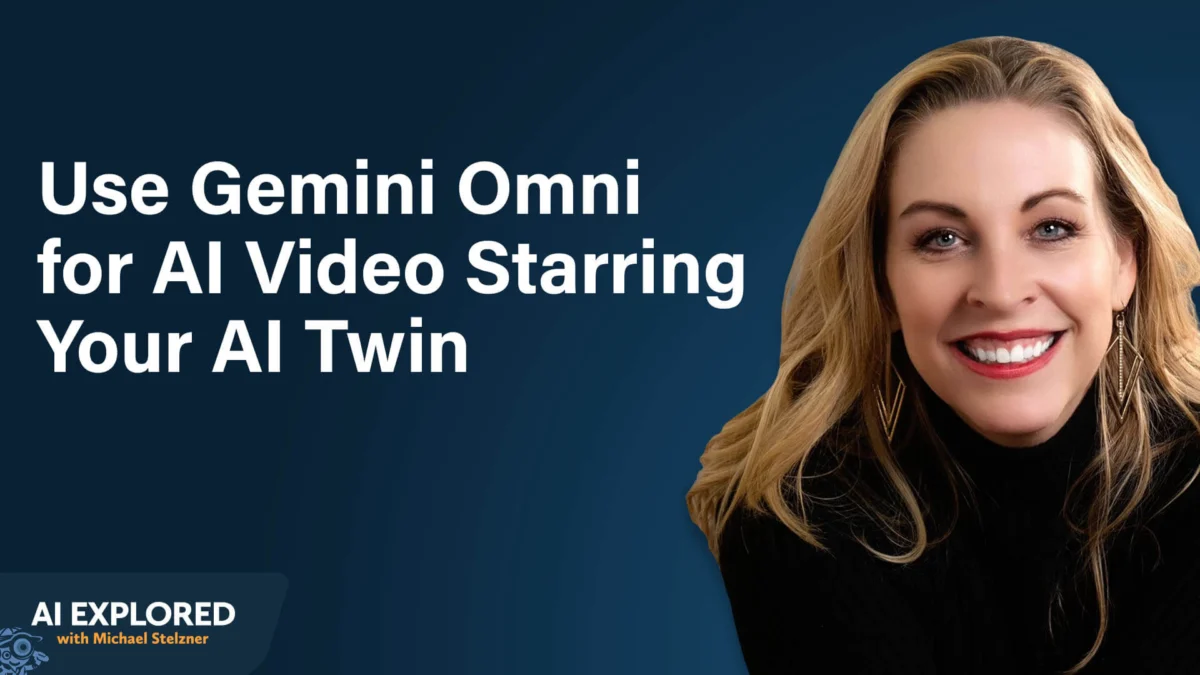
The most transformative feature of Gemini Omni is the creation of an "AI twin"—a digital avatar of the user that can be placed into any environment or scenario. Unlike "talking-head" clones that are limited to a single script pass, an AI twin is a reusable asset.
- Capture (The 5-Minute Setup): Users initiate the process via the mobile app. The AI guides the user through a Face ID-style calibration: looking in four directions to map facial features, followed by reading nonsensical text aloud. This specific, odd-sounding text is designed to strip away performative speech patterns, capturing the user’s natural cadence.
- Syncing: Once created, the avatar is stored at the account level. It can be summoned in any environment, including desktop sessions, by simply typing the "@" symbol followed by the avatar’s name.
- Refinement: Users must be mindful of their recording environment. Poor lighting or background noise during the initial capture will be "filled in" by the AI, leading to potential distortions. Natural light and a clean audio environment are mandatory for a professional-grade twin.
The Four-Element Prompting Formula
To move beyond generic results, creators are adopting the "four-element formula," which allows for precise control over the output:
- Subject: Identifying the actor (e.g., @YourName).
- Action: Defining the movement or task (e.g., "walking through a rainstorm").
- Environment: Establishing the setting (e.g., "a neon-lit Tokyo street").
- Camera: Dictating the angle and movement (e.g., "a tight close-up that pans to a wide shot").
Supporting Data and Technical Nuances
The power of Gemini Omni lies in its ability to iterate. Because the system is built for natural language, users no longer need to rely on complex coding syntax. However, creators must work within the constraints of the technology to maintain quality.
The 10-Second Constraint
Omni is optimized for 10-second clips. This is a deliberate limitation designed to maintain high fidelity and prevent the "hallucination" of visual elements. For a 60-second commercial, the professional workflow involves generating six individual 10-second clips and assembling them in external software like CapCut or Premiere Pro.
Optimization Strategies
- Resolution Management: While 1080p is the gold standard for television, 720p is often sufficient for social media platforms like TikTok and Instagram. By generating at 720p, users conserve their credit allowances and can rely on third-party upscaling tools later if a specific clip needs a higher-quality finish.
- Visual Continuity: When assembling a longer narrative, the "jump cut" is the enemy. Utilizing an LLM to pre-plan the transition—ensuring the final frame of clip A matches the first frame of clip B—is essential for maintaining a seamless visual flow.
Official Perspectives and Expert Insight
Industry experts like Eve Whitaker emphasize that the most effective use of Gemini Omni is not to replace human creativity, but to augment it. By using an LLM (like ChatGPT or Claude) as a "production assistant," creators can bypass the "blank page syndrome."
The "Captain Obvious" technique serves as a prime example of this professional workflow. When an LLM suggests a cliché concept for a video hook, the creator explicitly instructs it to "think outside the box" or "use metaphors." This iterative dialogue ensures that the resulting AI-generated hook is distinct, creative, and optimized for high engagement.
Furthermore, the integration of real-world assets is a game-changer. By uploading a screenshot of an actual office or a specific outfit as a reference image, users can anchor their AI-generated content to their real-world brand identity. This prevents the "uncanny valley" effect and keeps the transition between traditional video and AI-enhanced segments feeling professional.
Implications for the Marketing Industry
The shift toward AI-generated video has profound implications for marketing agencies and small businesses alike.

1. Speed to Market
The ability to generate a highly stylized hook while waiting in line for coffee represents a fundamental change in production velocity. Brands can now A/B test seven different video intros in the time it once took to film a single take.
2. The Democratization of Production
The "hero shot"—a camera angle looking up at a subject to make them appear larger than life—was once the domain of high-budget film crews. Now, it is a simple prompt command. This levels the playing field, allowing small-business owners to command the same visual authority as massive corporations.
3. The New Skill Set
The role of the "videographer" is evolving into the "AI prompt architect." Success in this field now requires:
- Visual Literacy: Understanding camera angles, lighting, and composition.
- Prompt Engineering: The ability to communicate intent clearly to the model.
- Post-Production Prowess: The skill to weave 10-second segments into a cohesive, long-form story.
Conclusion: The Path Forward
Google’s Gemini Omni is not merely a tool for automation; it is a creative force multiplier. By understanding the limitations of the technology—specifically the 10-second generation cycle and the necessity of high-quality initial captures—creators can build professional-grade content that stands out in the crowded social media landscape.
As we look toward the future, the integration of these tools will only deepen. For the marketer, the takeaway is clear: the era of expensive, inaccessible production is over. The future of storytelling is built on a foundation of natural language, iterative refinement, and the ability to imagine a scene, describe it in detail, and watch it come to life in seconds. Whether you are a solo entrepreneur or a seasoned creative director, mastering the art of the AI prompt is no longer an optional skill—it is the new baseline for digital success.