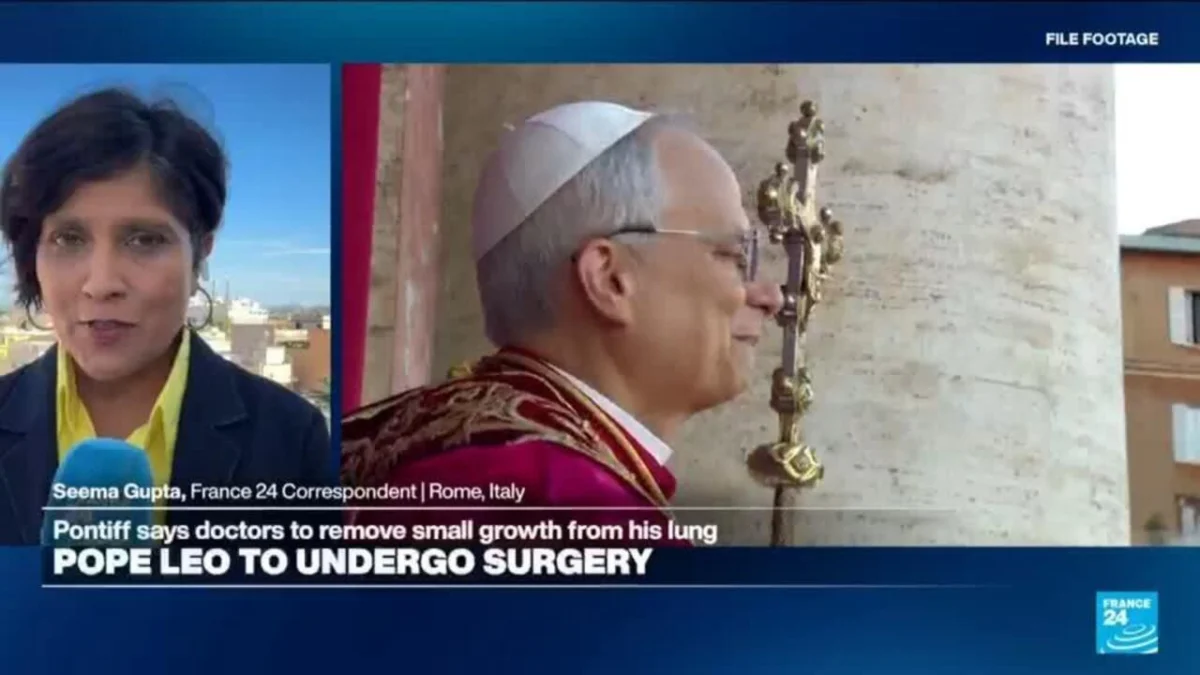
VATICAN CITY — In a development that has sent ripples of concern through the global Catholic community and the corridors of international diplomacy, Pope Leo has announced that he will undergo a surgical procedure to remove a small growth discovered on his lung. The announcement, delivered with the characteristic poise that has defined his papacy, marks a significant juncture for the 266th successor of Saint Peter, prompting immediate discussions regarding the stability of the Holy See and the future trajectory of his pontificate.
The news, confirmed via an official communique from the Holy See Press Office on October 11, 2026, details a planned medical intervention aimed at addressing a localized pulmonary issue. While the Vatican has been careful to characterize the procedure as a proactive measure, the nature of the announcement—coming at a time of immense geopolitical volatility—has invited intense scrutiny regarding the physical vigor of the Pontiff.
The Main Facts: An Unfolding Medical Procedure
Pope Leo, who has navigated the Church through complex theological and social transitions, informed his inner circle earlier this week that medical examinations had revealed a "small growth" on his lung. Following comprehensive consultations with a specialized medical team at the Agostino Gemelli University Hospital, the decision was made to proceed with a surgical resection.
According to preliminary reports, the growth was detected during a routine check-up, a standard protocol for the leader of the world’s 1.3 billion Catholics. The Vatican has emphasized that the Pope is in good spirits and remains fully committed to his administrative duties in the lead-up to the procedure.
The surgery is expected to be performed under general anesthesia, necessitating a temporary transfer of certain administrative oversight functions, though the Holy See has stopped short of declaring a sede vacante or any formal regency. This surgical event is being viewed not merely as a health update but as a pivotal chapter in the modern history of the papacy, highlighting the fragility of the office and the human toll of the papal burden.
A Chronology of the Papacy’s Health Challenges
To understand the weight of this announcement, one must look at the historical context of papal health in the 21st century.
- September 2026: Pope Leo begins experiencing persistent fatigue, which his medical team initially attributes to the grueling schedule of his recent Apostolic Journey to Southeast Asia.
- October 5, 2026: A series of diagnostic tests, including high-resolution imaging, reveals the presence of a localized growth on the lung.
- October 8, 2026: The medical team meets with the Pontiff to discuss treatment options. The decision to pursue surgery is formalized.
- October 10, 2026: The Pope informs the College of Cardinals of the upcoming surgery during a private consistory, ensuring transparency within the Church hierarchy.
- October 11, 2026: The Holy See issues a formal statement, officially notifying the global faithful of the medical procedure.
This timeline reflects a trend of increased medical transparency within the Vatican. Unlike the era of Pope John Paul II, where health struggles were often shielded from the public eye, the current administration of Pope Leo has adopted a policy of proactive disclosure, acknowledging that the digital age demands an open relationship between the Papacy and the global Catholic constituency.
Supporting Data: The Medical Realities of an Aging Pontificate
The medical challenges faced by Pope Leo are reflective of broader demographic trends within the Church’s leadership. The demands of the papacy—involving constant travel, public appearances, and the heavy mental load of governance—place immense strain on the physical constitution of the individual.
Pulmonary Health and the Papacy
Pulmonary concerns are not uncommon among elderly leaders. Clinical data suggests that the risks associated with lung-related procedures in patients of the Pope’s age bracket require careful management of post-operative recovery, particularly regarding respiratory capacity and cardiovascular stress.
The Gemelli Connection
The Agostino Gemelli University Hospital has long served as the "Vatican hospital." With specialized facilities and a long-standing history of treating popes, the hospital is equipped with state-of-the-art diagnostic and surgical technology. The proximity of the medical facility to the Vatican ensures that, while the Pope is away from his residence, he remains within the immediate reach of the Church’s administrative apparatus.
Official Responses: Global Reaction and Internal Solidarity
The announcement has triggered a wave of reactions from across the religious and political spectrum.

The Vatican Perspective
The Holy See Press Office has issued a call for "prayer and calm," emphasizing that the procedure is routine and that the Vatican’s daily operations remain unaffected. A spokesperson stated, "The Holy Father is preparing for this moment with serenity and entrusts his health to the hands of the medical staff and the prayers of the faithful."
International Leaders
World leaders have been quick to send their well-wishes. From the White House to the European Union and the United Nations, heads of state have recognized Pope Leo’s role as a moral compass in international relations. President [Name] of [Country] remarked, "Pope Leo’s dedication to global peace is unparalleled. Our thoughts and prayers are with him and the medical team during this time."
The Catholic Faithful
In cathedrals from Manila to Mexico City, the mood is one of profound solidarity. Vigils have been organized, and the hashtag #PrayForLeo has trended globally, underscoring the deep personal connection many believers feel toward the Pope.
Implications: The Future of the Pontificate
The impending surgery raises critical questions about the long-term governance of the Catholic Church.
Administrative Continuity
While the Vatican has not activated the emergency protocols reserved for the incapacitation of a Pope, the surgery serves as a reminder of the need for robust succession planning. The administrative reforms introduced by Pope Leo earlier in his term were designed to streamline Church bureaucracy; those reforms are now being tested as the Church prepares for a period of temporary leadership transition.
Theological and Policy Impact
Many are wondering how this health development will affect the Pope’s agenda. His upcoming encyclical on environmental justice, which was slated for release in late November, may now face delays. Furthermore, the synodal processes currently underway—which represent a radical shift toward a more inclusive Church governance—could see a shift in pace.
The Question of Retirement
While there is no indication that Pope Leo intends to step down, the conversation around the "resignation precedent" established by his predecessor, Benedict XVI, is inevitably reignited. This surgery forces the Church to confront the reality that the Papacy is not just a spiritual mission but a physically demanding role that may eventually necessitate a graceful exit.
Conclusion: A Moment of Reflection
As the world waits for the results of the surgery, the focus remains on the humanity of the man at the center of the storm. Pope Leo’s decision to face his illness openly is being hailed as an act of humility and honesty—a reflection of the very values he has championed throughout his life.
Whether the recovery is swift or necessitates a longer period of convalescence, the event serves as a unifying moment for a Church that often finds itself divided by ideological factions. In this time of uncertainty, the focus of the global community remains fixed on the recovery of a leader who, in his vulnerability, has reminded the world of the universal nature of the human experience.
The coming days will be critical, not only for the health of the Pope but for the image of the Holy See as it navigates the complexities of the 21st century. The world will be watching with bated breath, hoping for a successful procedure and a swift return to the pulpit, where Pope Leo continues to call for unity, peace, and the stewardship of our shared humanity.