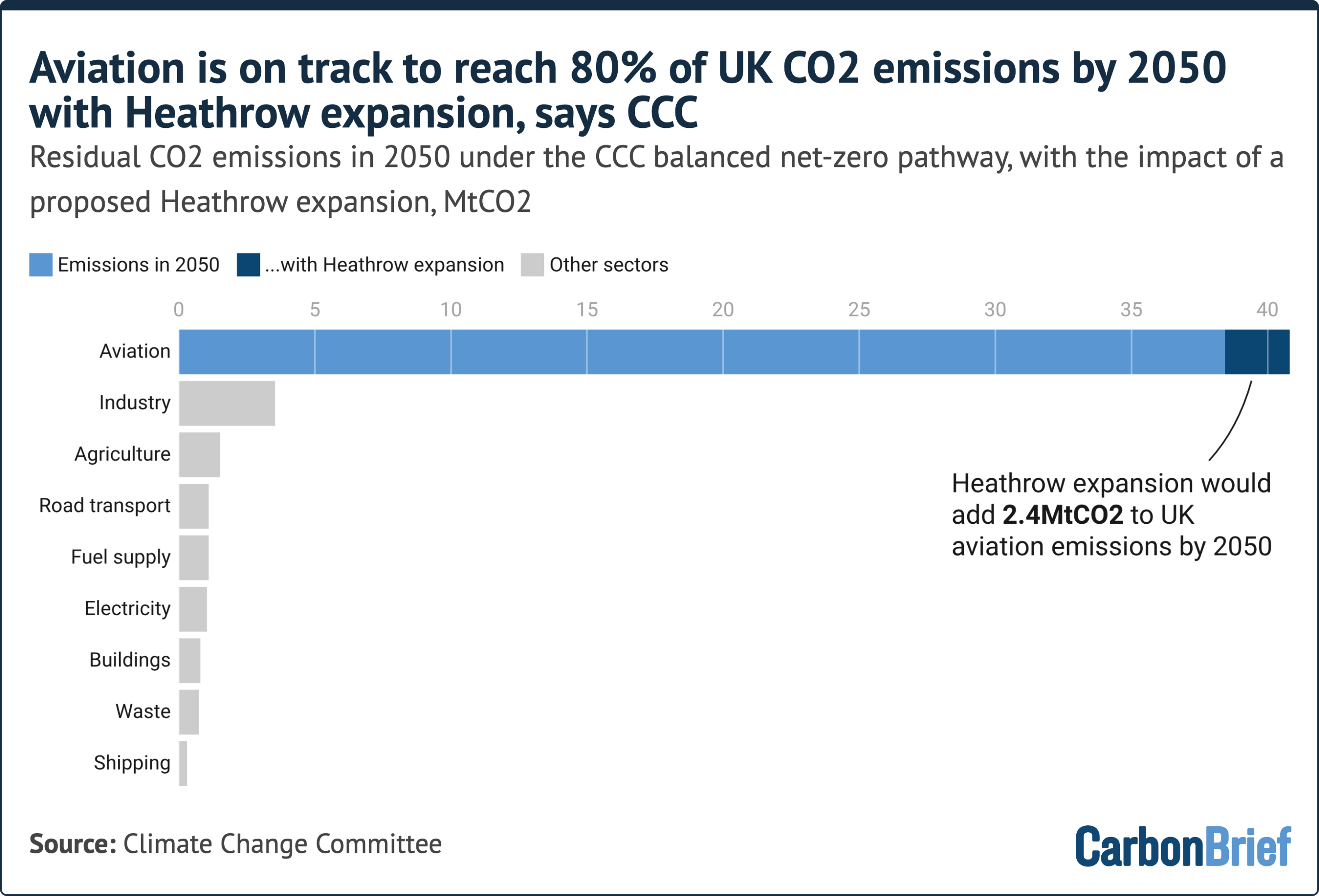
As the United Kingdom accelerates its transition toward a decarbonized economy, one sector remains defiantly grounded in the fossil-fuel era: aviation. According to a stark new assessment from the Climate Change Committee (CCC), the UK’s independent advisor on emissions, the aviation industry is on a trajectory to account for a staggering 80% of the nation’s total carbon dioxide (CO2) emissions by 2050.
This revelation places the government in a precarious position. While other sectors—from power generation to heating and transport—have seen consistent declines in their carbon footprint, aviation emissions have more than doubled since 1990. Driven by insatiable demand and rising passenger numbers, the sector has become the primary obstacle to the UK’s legally binding commitment to reach net-zero by the middle of the century.
The Core Conflict: Growth vs. Climate Targets
The central tension lies in the government’s dual approach: professing a commitment to stringent climate targets while simultaneously signalling support for the expansion of Heathrow, the UK’s busiest airport.
The CCC’s latest report serves as a blunt reality check. Even without the proposed expansion of Heathrow, aviation emissions are projected to reach 38 million tonnes of CO2 (MtCO2) by 2050. When factoring in the planned expansion, that figure climbs significantly. An expanded Heathrow would contribute an additional 2.4 MtCO2 by 2050, surging to 4.5 MtCO2 by 2054 once the project is fully operational.
These figures are not merely statistics; they represent the majority of the remaining "carbon budget" for the entire UK economy. Under a net-zero framework, every tonne of CO2 emitted must be removed from the atmosphere. By allowing aviation to consume the lion’s share of this budget, the government risks creating a scenario where the rest of the economy is forced into extreme, potentially unfeasible, decarbonization measures simply to accommodate the flight path of the aviation industry.
Chronology of a Policy Crisis
The path to this impasse has been marked by overly optimistic projections and a reliance on "techno-fixes" that have yet to materialize at scale.
- 1990–2020: The Era of Unchecked Growth: Aviation emissions trended upward as air travel became more accessible and globalization drove demand for long-haul flights. While other sectors began the slow process of moving away from coal and oil, aviation remained largely untouched by aggressive climate regulation.
- 2022: The "Jet-Zero" Strategy: The previous Conservative government launched the "Jet-Zero" strategy, which relied heavily on the promise of sustainable aviation fuels (SAFs), the electrification of short-haul flights, and significant improvements in fuel efficiency.
- 2025: Acknowledging the Reality Gap: Under the current administration, the government has been forced to concede that the assumptions underpinning the Jet-Zero strategy were fundamentally flawed. Expectations for the rapid adoption of SAFs and electric aircraft proved to be, in the words of climate analysts, unrealistic.
- 2026: The CCC’s Call to Action: In its most recent briefing, the Climate Change Committee officially declared that the UK lacks a "credible" plan for aviation. With a final decision on Heathrow expansion looming in 2029, the committee has warned that current policies are fundamentally incompatible with the UK’s climate obligations.
Supporting Data: The Scale of the Challenge
To understand the magnitude of the problem, one must look at the math of carbon removal. The CCC emphasizes that "engineered removals"—such as Direct Air Carbon Capture and Storage (DACCS)—are essential to address aviation’s legacy.
Current policy discussions often conflate "natural solutions," such as mass tree planting, with the industrial-scale carbon removal required for aviation. However, the CCC notes that natural sinks are already earmarked to offset methane emissions from the agricultural sector. Consequently, the aviation industry must rely on engineered removals, a technology that is currently nascent and prohibitively expensive.
The financial burden of these technologies is the next hurdle. The CCC suggests that the "polluter pays" principle must be the bedrock of future policy. This implies that the cost of carbon capture should be borne by the aviation industry itself, rather than the taxpayer. The economic implications are significant: by 2050, the committee estimates that implementing these policies could add £150 to a return flight to Alicante and up to £400 for a return flight to New York (in 2024 prices).
Official Responses: Navigating the Political Minefield
The response from the government has been a delicate balancing act. While ministers have signaled support for the economic benefits of airport expansion, they are increasingly under pressure to reconcile this with the findings of the CCC.
Nigel Topping, chair of the Climate Change Committee, was unequivocal during a recent press briefing. "The UK does not currently have a credible plan to reduce [aviation emissions] in line with net-zero," Topping stated, noting that any expansion of infrastructure like Heathrow would only "compound the problem."
The government has committed to drafting a revised aviation strategy by 2027. The CCC maintains that only through this new, robust framework—which must include clear mandates for the industry to fund its own decarbonization—could airport expansion potentially be aligned with national climate targets.
Critics, however, argue that the 2027 timeline is too slow. With airport planning processes moving forward, there is a risk that the UK will commit to infrastructure that essentially "locks in" high-carbon travel for the next several decades.
Implications: The Social and Economic Trade-offs
The debate over aviation is as much about social equity as it is about environmental science. Currently, roughly 50% of the UK population does not fly in any given year. If the government chooses to subsidize the transition to net-zero aviation—or if it fails to regulate the industry, leading to massive public spending on carbon removal—the financial burden will fall on non-flyers.
The "Demand Management" Argument
The CCC notes that one of the most effective ways to curb emissions is through demand management. If the true cost of flying—including the price of removing the carbon emitted during the flight—is passed onto the consumer, ticket prices will naturally rise. While this might be unpopular with the travel industry and frequent flyers, the committee suggests that it is a necessary lever to ensure the sector contributes its fair share to the climate effort.
A New Policy Framework
For the UK to meet its 2050 targets, the upcoming 2027 strategy must move beyond vague promises of future technology. It must:
- Mandate Industry Responsibility: Require airlines to pay the full cost of engineered carbon removal for their emissions.
- Shift to "Polluter Pays": End the era of aviation being effectively subsidized by the public’s climate efforts.
- Realistic Forecasting: Replace the inflated, "unrealistic" projections of the previous decade with data-driven targets that account for current technological limitations.
Conclusion: A Turning Point for UK Aviation
The UK stands at a crossroads. The aviation sector has enjoyed a long period of expansion with minimal climate accountability, but that era is drawing to a close. As the Climate Change Committee has made clear, the physics of climate change do not care for economic growth projections or political convenience.
If the UK is to remain a leader in the global race to net-zero, it must confront the aviation paradox head-on. Expanding infrastructure while failing to address the emissions that infrastructure facilitates is a policy contradiction that can no longer be sustained. Whether through higher ticket prices, mandatory carbon removal investments, or a fundamental shift in how the nation views air travel, the industry is about to face a new reality. The decisions made between now and the 2029 Heathrow deadline will determine whether the UK’s skies remain a symbol of progress or a permanent obstacle to a habitable climate.