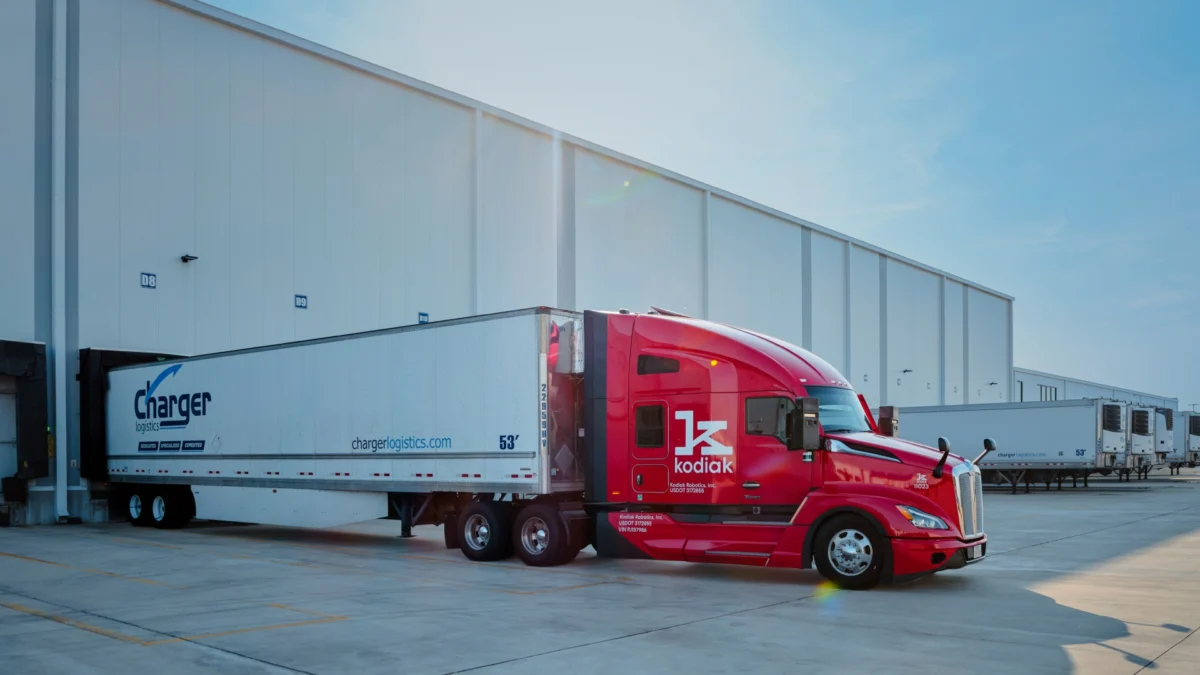
The landscape of American logistics is undergoing a fundamental transformation. In a significant step toward the commercialization of autonomous trucking, Kodiak AI and Charger Logistics officially announced the launch of an autonomous freight service connecting Dallas and Laredo, Texas. This 435-mile corridor, a critical artery for North American trade, is now being serviced by Kodiak’s self-driving technology, marking a pivotal moment in the integration of artificial intelligence into the nation’s supply chain.
The service, which saw its first delivery completed on September 8, focuses on the high-demand transport of refrigerated and dry van freight. While a safety driver remains behind the wheel to oversee operations—a necessary step for current regulatory and safety protocols—the partnership serves as a testing ground for the ultimate goal: fully driverless, long-haul operations.
The Strategic Importance of the Dallas-Laredo Corridor
To understand why Kodiak AI and Charger Logistics prioritized this specific lane, one must look at the economic gravity of Laredo, Texas. As the highest-volume commercial land port of entry in the United States, Laredo is the heartbeat of U.S.-Mexico trade. In 2025 alone, the Port of Laredo facilitated more than $350 billion in international trade, accounting for nearly 40% of all U.S. commerce with Mexico.
By establishing a presence on this route, Kodiak is not merely testing technology; it is embedding its "Kodiak Driver" software into one of the most vital logistical pipelines in the world. The route is particularly well-suited for autonomous intervention due to the steady, high-volume flow of consumer packaged goods (CPG) and food and beverage products. These sectors rely heavily on predictable replenishment schedules. For carriers, the ability to maintain consistent transit times and potentially extend operating hours beyond the constraints of human driver fatigue represents a massive competitive advantage.
Chronology of Progress: A Path to Autonomy
Kodiak’s path to this launch has been marked by a transparent and rigorous commitment to safety milestones. The company tracks its progress through the "Autonomy Readiness Measure" (ARM), a metric that quantifies the volume of evidence and safety documentation the company has compiled in preparation for driverless operations.
- February 2026: Kodiak reported an ARM of 84%, signaling the early stages of its final safety validation phase.
- August 2026: The readiness measure climbed to 93%, reflecting significant data collection and testing success.
- September 8, 2026: The official launch of the Dallas-Laredo freight service, with the first commercial load successfully delivered.
- End of September 2026: The ARM reached 96%, putting the company on a clear trajectory for its stated year-end goal.
The company has maintained a consistent pace of innovation. Since December 2024, Kodiak’s driverless trucks have already been active in commercial service within the Permian Basin, a controlled but rugged environment that provided the necessary data to refine the system for longer-haul, higher-speed highway environments. With the Dallas-Laredo lane now active, the company is positioning itself to launch fully driverless, long-haul service on the Dallas-Houston lane along Interstate 45 by the close of 2026.
The Technological Ecosystem: Driver-as-a-Service
A defining feature of the Kodiak business model is its "Driver-as-a-Service" approach. Unlike companies that seek to operate their own massive fleets, Kodiak focuses on deploying its proprietary software and sensor suite—the Kodiak Driver—onto trucks owned and operated by its partners.
This strategy allows established carriers like Charger Logistics to maintain their existing fleet and operational control while leveraging autonomous technology. Charger, an asset-based carrier with a deep footprint in both the U.S. and Mexico, operates a sophisticated network built on a proprietary transportation management system (TMS). By integrating the Kodiak Driver with its internal software, Charger aims to create a "nearly fully automated ecosystem."
"Autonomy lets us build a network that serves both our customers and our drivers," said Andy Khera, president of Charger Logistics. "Combining our in-house TMS, managed transportation, and the Kodiak Driver creates a nearly fully automated ecosystem that gives our customers long-term capacity continuity through changing labor markets and freight demand, while bringing our drivers home every night."
Competitive Landscape and Industry Implications
The partnership between Kodiak and Charger is not an exclusive one, which highlights the broader industry trend of rapid adoption and cross-collaboration. Notably, Charger Logistics has also entered into an agreement with Aurora Innovation to deploy second-generation driverless trucks on the exact same Dallas-Laredo lane.
The Aurora deal operates on a "Transportation-as-a-Service" model, wherein Aurora assumes the mantle of the carrier, holding the U.S. Department of Transportation (DOT) operating authority, controlling the truck, and carrying the insurance. This provides a fascinating contrast to the Kodiak model. While Kodiak empowers the carrier to control the assets, Aurora is positioning itself to be the carrier, fundamentally changing the traditional relationship between technology providers and logistics companies.
This competitive environment is accelerating the pace of development. As Don Burnette, founder and CEO of Kodiak, noted, "Charger came to us knowing what they wanted from autonomy and what they need to see before scaling it. The Dallas-Laredo lane extends the Kodiak Driver into a new corridor and gives both companies the operating foundation we need to scale driverless service."
Implications for the Future of Freight
The implications of this move go far beyond the technical achievement of self-driving trucks. The industry is currently facing a dual challenge: a persistent shortage of long-haul drivers and the escalating cost of supply chain volatility.
1. Capacity Continuity
For large shippers, the promise of autonomous freight is not just cost reduction; it is reliability. By utilizing autonomous trucks for the "middle mile," companies can ensure that freight continues to move even when human driver availability is tight. This creates a buffer against the boom-and-bust cycles of the freight market.
2. Driver Quality of Life
A common concern regarding automation is the displacement of human workers. However, industry leaders like Khera emphasize a different narrative: "bringing our drivers home every night." By utilizing autonomous trucks for long-haul, repetitive highway segments, the industry may be able to shift human drivers to local, short-haul roles. This would allow drivers to work shorter shifts and return home daily, potentially reducing the high turnover rates that currently plague the trucking industry.
3. Regulatory and Insurance Hurdles
The transition to fully driverless operations remains contingent upon completing the "safety case." This involves proving to regulators, insurers, and the public that the technology is not only as safe as a human driver but consistently safer. As Kodiak’s ARM approaches 100%, the focus will shift from technical feasibility to legal and insurance frameworks. The successful operation of the Dallas-Laredo route will provide the empirical data required to satisfy these stakeholders.
Conclusion: A Turning Point for Logistics
As the year 2026 draws to a close, the transportation industry is witnessing a shift from speculative R&D to active, scalable deployment. The partnership between Kodiak AI and Charger Logistics represents a pragmatic approach to this transition—combining advanced robotics with the established expertise of a seasoned carrier.
The Dallas-Laredo corridor serves as a microcosm for the future of the American supply chain: high-volume, tech-integrated, and increasingly autonomous. While the transition will continue to be managed with caution and human oversight for the immediate future, the momentum is undeniable. With 96% of the safety case evidence already in hand, the industry is closer than ever to a reality where driverless, long-haul freight is not a futuristic concept, but a standard component of the global economy.
As stakeholders prepare for upcoming industry events like the Future of Freight Festival (F3) in Chattanooga, the discussions will undoubtedly pivot from if autonomous trucking will change the industry, to how quickly it can be scaled to meet the demands of a modern, fast-paced world. Through the convergence of technology and operational rigor, Kodiak and Charger are setting the blueprint for that new era.