In the contemporary landscape of digital marketing, the conversation surrounding Google Ads has shifted dramatically from manual keyword bidding to the sophisticated, black-box world of Artificial Intelligence. While industry experts frequently highlight the transformative power of AI in identifying new audiences and optimizing conversion paths, a critical element is often overlooked: the art of strategic exclusion. In an era where intent-driven search is paramount, telling Google’s AI who to avoid is just as vital as identifying who to target.
For years, search engine marketers relied on negative keywords to filter out irrelevant traffic. However, as Google’s algorithms evolve to understand searcher intent rather than just literal strings of text, traditional methods are proving insufficient. To maintain brand integrity and budget efficiency, advertisers must now master a new suite of guardrails, ranging from text guidelines to asset-level optimizations.
The Evolution of Search: Why Negative Keywords Are No Longer Enough
The traditional methodology of using negative keywords—such as adding “cheap” or “free” to prevent ad spend on bargain-hunting traffic—faces a fundamental flaw in the age of AI. Today’s search engine isn’t just matching words; it is interpreting intent. A user searching for a “high-end computer case” may never type the word “cheap,” yet they may still be bucketed into an audience segment that values price over quality.
If an advertiser sells premium, high-margin laptop cases, they cannot simply filter out the word “cheap.” The AI might still infer that the user is interested in a “value” product based on their browsing history or secondary search behavior. Consequently, the challenge for modern advertisers is no longer about managing a list of excluded words; it is about providing the machine with a blueprint of the desired customer persona. We are moving from a world of "negative keyword lists" to a world of "strategic behavioral constraints."
Text Guidelines and Asset Optimization: Building the Guardrails
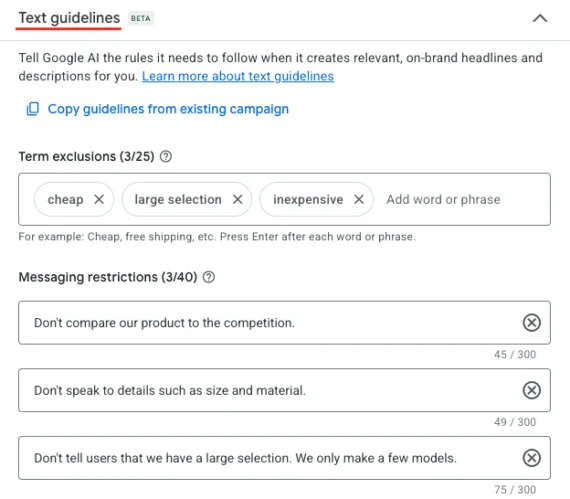
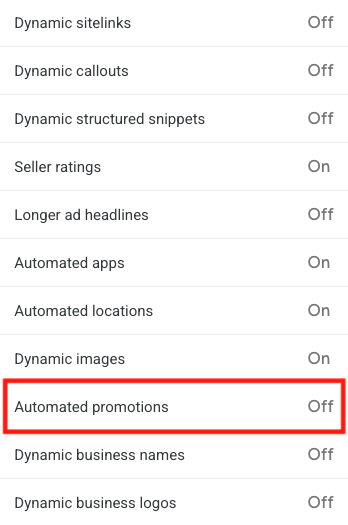
To regain control, advertisers must utilize "Text Guidelines" and "Asset Optimizations," features increasingly central to Performance Max and AI Max Search campaigns. These tools act as guardrails, preventing the AI from straying into territory that doesn’t align with brand positioning.

Defining Brand Boundaries
Text guidelines allow advertisers to explicitly state messaging restrictions. For example, a luxury brand can instruct the AI to avoid comparisons with competitors or to explicitly steer clear of value-oriented language like "discount," "inexpensive," or "clearance." By embedding these constraints into the campaign settings, advertisers ensure that the dynamically generated ad copy—which Google creates on the fly—remains consistent with their premium brand identity.
URL Exclusions: Protecting the Conversion Funnel
Beyond text, URL exclusions are critical. If a brand offers both budget and premium lines, the AI might naturally attempt to drive traffic to a high-converting "clearance" page to satisfy a volume-based objective. By using URL exclusions, marketers can force the AI to keep traffic within the premium ecosystem, ensuring that high-value prospects aren’t directed to discount-heavy landing pages that could jeopardize the average order value.
The Hidden Power of Account-Level Automated Assets
One of the most elusive yet impactful sections of the Google Ads interface is "Account-level automated assets." Because this feature is tucked away within advanced settings, many advertisers are unaware that Google is dynamically populating their ads with sitelinks, callouts, and images without explicit approval.
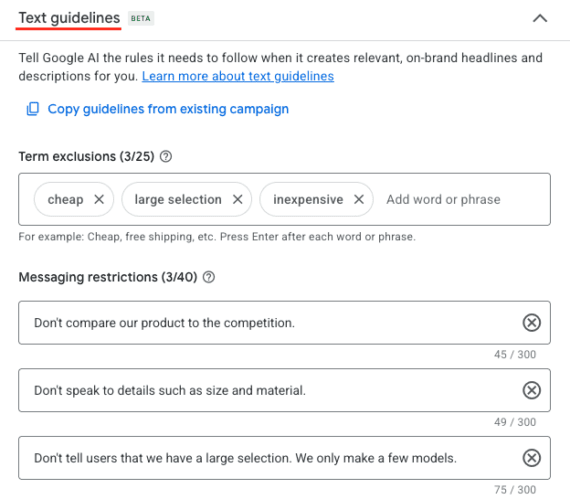
Recently, Google introduced "automated promotions," which scan an advertiser’s website for discounts and automatically feature them in ads. While this might seem like a benefit for retailers, it can be a disaster for premium brands that do not want their current pricing strategy undermined by an AI-selected discount.
How to Audit and Control Assets
Advertisers should follow these steps to regain authority over their automated assets:
- Navigate to the Assets tab in the Google Ads left-hand menu.
- Select Account-level automated assets.
- Click the three-dot menu to access Advanced settings.
- Review the status of each asset type. If an automated promotion or branding asset is live, you can toggle it off to regain manual control.
By filtering assets with the "Added by: Google AI" label, marketers can see exactly what the algorithm has chosen to represent their brand. If the AI has selected an outdated logo or an inaccurate promotional claim, this is the primary location to rectify the issue.
Optimized Targeting: A Strategic Deployment
"Optimized targeting" and "Audience expansion" represent the dual-edged sword of modern Google Ads. These features allow the platform to reach users who fall outside the advertiser’s initial targeting parameters but who are deemed "likely to convert" by Google’s vast data set.
The Chronology of Implementation
The consensus among seasoned performance marketers is that these features should never be toggled on at the inception of a campaign. The rationale is data-dependent:
- Phase 1 (Training): Run the campaign using your own first-party data and defined audience signals. This allows the AI to learn who your best customers are without external interference.
- Phase 2 (Evaluation): Once the campaign has reached a statistically significant volume of conversions, analyze the audience reports.
- Phase 3 (Expansion): Only after the AI has "learned" your business model should you consider turning on optimized targeting.
Enabling these features too early often leads to "budget drift," where the AI spends a significant portion of the budget on peripheral audiences that may convert but do not necessarily represent the core customer base.
Implications for the Future of Search Marketing
The shift toward AI-driven advertising does not signify the end of the human search marketer; rather, it marks a transition toward a more strategic role. The modern marketer is less of a "bid adjuster" and more of an "AI trainer."
The Shift in Responsibility
The implications are clear: performance is no longer just about the budget or the creative; it is about the instructions provided to the machine. As Google continues to integrate Generative AI into the search experience, the accuracy of these guardrails will become the primary differentiator between brands that thrive and those that see their brand equity diluted by irrelevant traffic.
The Call for Transparency
Industry bodies and advertisers have long called for greater transparency regarding how Google’s AI determines "likelihood to convert." As we move forward, the "black box" nature of these campaigns will remain a point of contention. However, the tools discussed here—text guidelines, URL exclusions, and asset audits—provide a necessary layer of transparency that allows businesses to maintain their strategic focus.
Conclusion: Orchestrating the AI
To succeed in the current Google Ads ecosystem, advertisers must adopt a "trust but verify" mindset. AI is a powerful engine for scale, but it lacks the contextual understanding of a brand’s long-term strategy. By diligently setting guidelines, auditing automated assets, and carefully timing the deployment of audience expansion features, marketers can leverage the speed of AI without sacrificing the integrity of their brand.
The future of advertising belongs to those who can effectively communicate their brand’s boundaries to the machine. As the algorithm continues to learn and adapt, the most successful marketers will be those who spend as much time defining what their brand is not as they do defining what it is. In this new era, the most powerful tool in the shed is not the one that reaches the most people, but the one that ensures you reach the right people, while keeping the wrong ones at a distance.