In the increasingly complex world of global logistics, the decision-making process for shippers and freight brokers has historically been fragmented. Evaluating the viability of shifting freight from traditional over-the-road (OTR) truckload to intermodal rail has often required disparate data sources, manual spreadsheet consolidation, and a significant margin for error.
SONAR, the industry-leading freight market intelligence platform, has announced a significant expansion to its Rate Intelligence suite. By integrating intermodal rates directly into its core interface, SONAR is providing shippers, carriers, and 3PLs with a seamless, data-driven methodology to evaluate truckload-to-intermodal conversion potential on virtually any lane. This move represents a paradigm shift in how transportation procurement professionals approach cost optimization and capacity management.
The Evolution of Freight Procurement
For decades, the “mode-shift” analysis—the process of determining whether a shipment should travel via truck or rail—has been hampered by a lack of visibility. While truckload spot and contract rates have become increasingly transparent through digital marketplaces, intermodal data has remained siloed, often requiring specialized knowledge to interpret rail schedules, drayage costs, and terminal availability.
By embedding intermodal contract and spot rates directly alongside van pricing, SONAR has removed the technical barrier to entry. Users can now view these rates side-by-side, allowing for instant, real-time comparisons that highlight the fiscal and operational impact of switching modes. This integration is not merely a data aggregation tool; it is a strategic decision-support system designed to identify arbitrage opportunities that were previously hidden by information asymmetry.
Chronology: Building a Comprehensive Intelligence Ecosystem
The integration of intermodal data into Rate Intelligence is the latest milestone in SONAR’s long-term strategy to provide a “single source of truth” for the logistics industry.
- Foundation: SONAR established itself by providing high-frequency, granular truckload data, utilizing proprietary algorithms to process billions of data points daily.
- Expansion: Recognizing that truckload is only one piece of the supply chain puzzle, the platform began incorporating broader macroeconomic and modal data.
- The Intermodal Integration: Over the past 18 months, the product development team worked to map out the complexities of rail-based transit, specifically focusing on the critical “first and last mile” drayage components that often make or break an intermodal decision.
- Deployment: As of October 2026, the functionality is live, enabling users to toggle between van and intermodal views with a single click, effectively standardizing the evaluation process for intermodal conversion.
Supporting Data: The Case for Conversion
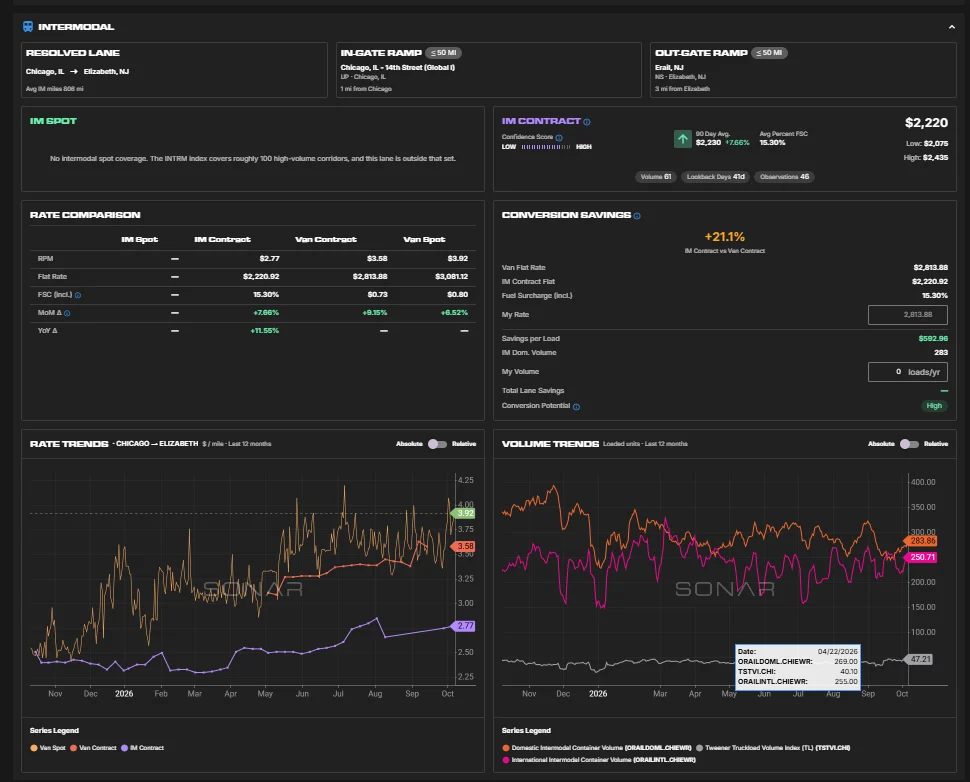
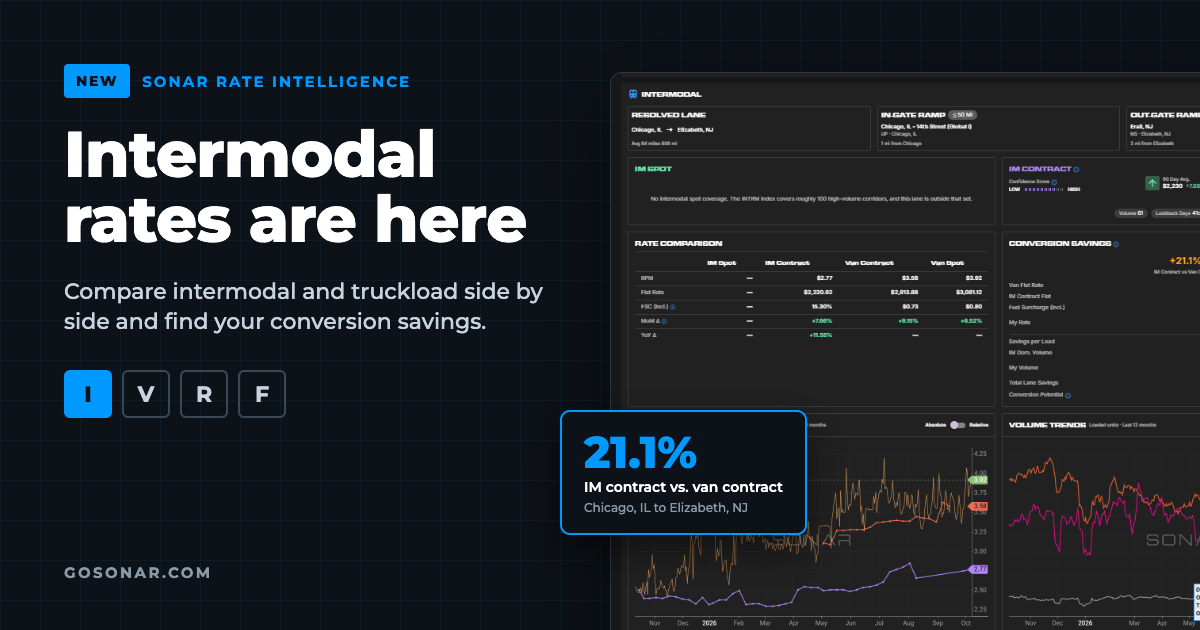
To illustrate the power of this new capability, SONAR points to the high-traffic Chicago-to-Elizabeth, New Jersey corridor. In this lane, the delta between modes is significant. Current data indicates that intermodal contract pricing is running roughly 21.1% lower than van contract pricing—a savings of approximately $593 per load.
The following comparative breakdown highlights why this granular visibility is vital for logistics managers:
| Mode | Rate per Mile | Flat Rate | Month-over-Month Change |
|---|---|---|---|
| Intermodal Contract | $2.77 | $2,220.92 | +7.66% |
| Van Contract | $3.58 | $2,813.88 | +9.15% |
| Van Spot | $3.92 | $3,081.12 | +6.52% |
These figures demonstrate that while intermodal rates are also subject to market fluctuations, the spread between rail and OTR remains substantial enough to justify the additional transit time required for intermodal service. By visualizing these trends in real-time, procurement managers can determine if a specific lane is a candidate for long-term intermodal conversion or if it is better suited for the agility of OTR.
Implications for the Industry: A New Standard of Efficiency
The introduction of intermodal intelligence into the SONAR ecosystem has profound implications for the freight market.
1. Procurement and Bid Optimization
For shippers, the primary goal of any RFP (Request for Proposal) is to optimize cost without sacrificing service levels. With this new tool, shippers can run “what-if” scenarios during the bidding process. By applying projected intermodal savings to their annual volume, they can present concrete evidence to stakeholders for shifting portions of their freight network to rail, effectively lowering their total cost of ownership.
2. The Brokerage Advantage
Freight brokers and 3PLs often operate on razor-thin margins. The ability to identify high-potential conversion lanes allows brokers to offer more competitive rates to their customers while maintaining healthy spreads. By identifying where intermodal is cheaper than truckload, a broker can present the shipper with a “green” alternative that is also more cost-effective, creating a value-added service that differentiates them from competitors who rely solely on truck capacity.
3. Sustainability Initiatives
As corporations face increasing pressure to reduce their Scope 3 emissions, mode-shifting to rail is a primary lever for reducing carbon footprints. Because rail is significantly more fuel-efficient per ton-mile than OTR, the ability to identify, quantify, and act upon conversion opportunities is as much a sustainability victory as it is a financial one.
Addressing the Complexity: Frequently Asked Questions
To ensure users fully leverage these new capabilities, SONAR has addressed the nuances of intermodal logistics through its platform documentation and support infrastructure.
What is the definition of "Conversion" in this context?
Truckload-to-intermodal conversion involves moving freight from over-the-road trailers to rail containers. This process requires drayage—the short-haul transport by truck—to move the container from the shipper to the rail ramp, and from the destination rail ramp to the final consignee. The platform helps calculate if the cost savings of the rail portion outweigh the additional handling and drayage costs.
How comprehensive is the data?
SONAR’s intermodal spot index currently covers approximately 100 high-volume corridors across the United States. For lanes that fall outside of this primary set, the platform provides robust intermodal contract rates, ensuring that users always have a benchmark for comparison regardless of the lane’s volume.
Who is the primary audience for this feature?
While the feature is designed for any stakeholder in the supply chain, it is particularly impactful for:
- Shippers: Looking to lower transportation spend and meet ESG goals.
- Brokers: Seeking to expand their service offerings and win more freight.
- Carriers: Who may operate both truck and intermodal divisions and need to balance their internal capacity based on market signals.
Looking Toward the Future
The integration of intermodal data into SONAR Rate Intelligence marks a broader trend in the logistics industry: the democratization of high-level analytical tools. By removing the silos between different modes of transport, SONAR is empowering a new generation of supply chain professionals to make decisions based on holistic market intelligence rather than fragmented anecdotes.
As the industry moves toward a future defined by volatile capacity, shifting fuel costs, and increasing environmental mandates, the ability to pivot between modes with confidence will be the defining trait of successful logistics operations. SONAR’s latest update ensures that this shift is no longer a guessing game, but a calculated, data-backed strategy.
For those looking to see the technology in action, SONAR’s Rate Intelligence is currently live with these updates. Industry professionals interested in the intersection of freight technology and market strategy are encouraged to attend the upcoming Future of Freight Festival (F3) in Chattanooga, Tennessee, on October 27-28, 2026, where these tools and their real-world applications will be featured in interactive demonstrations and expert-led discussions.