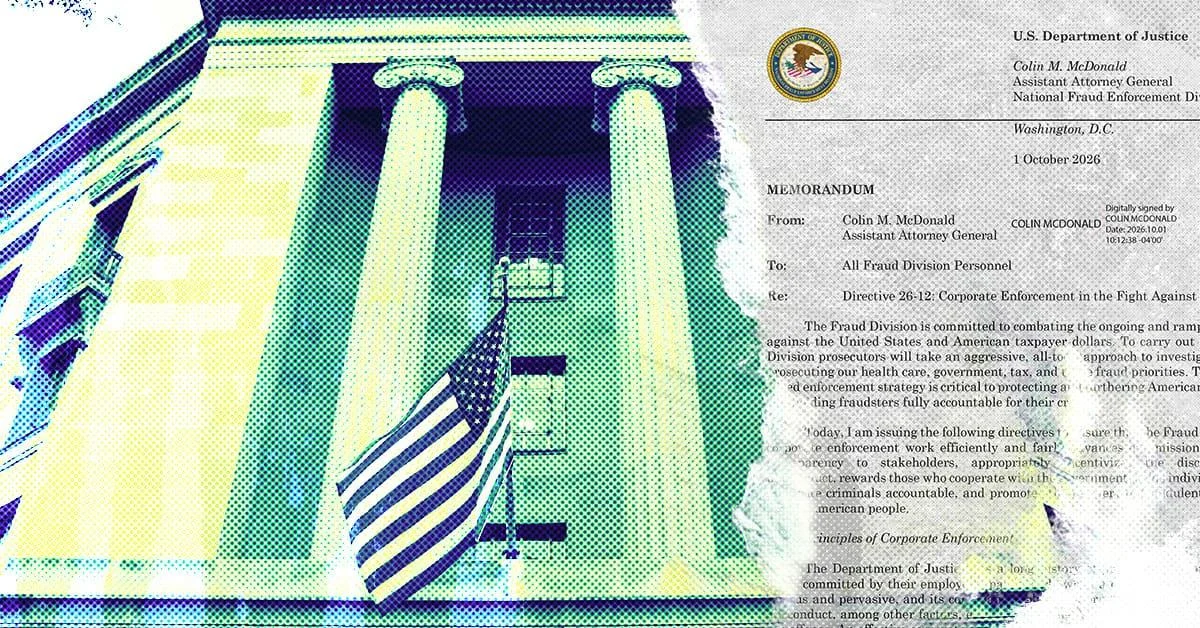
The U.S. Department of Justice (DOJ) has entered a new era of corporate oversight. With the formalization of the National Fraud Enforcement Division (NFED), federal prosecutors have received their most substantive public guidance to date, signaling a shift in how the government evaluates, charges, and resolves corporate misconduct.
At the center of this transformation is a directive issued on October 1 by Colin McDonald, the assistant attorney general for the newly minted division. The memo provides a rigorous framework for assessing corporate criminal liability, mandating that prosecutors weigh ten specific factors before moving forward with charges or settlements. For the corporate world, the message is clear: the DOJ is tightening its grip, leveraging data-driven investigations, and preparing to incentivize a new wave of internal whistleblowers.
The Evolution of the National Fraud Enforcement Division
To understand the current landscape, one must look at the rapid reorganization of the DOJ. In January 2026, the White House announced the creation of a dedicated division to consolidate the government’s fraud-fighting apparatus. By April, a foundational memo had transitioned the Criminal Division’s heavy hitters—including the Health Care Fraud Unit, the Market, Government and Consumer Fraud Unit, and the Tax Section—into this new entity.
By August, the division was fully formalized via federal regulation. It now boasts a workforce of approximately 500 attorneys and professional staff, a significant expansion from the roughly 200 lawyers who staffed the Criminal Division’s Fraud Section just one year prior. As the NFED has grown, other components of the DOJ have seen their resources thinned, raising questions about potential overlap. Specifically, the Criminal Division retains its own corporate enforcement unit, meaning that for the first time in recent memory, two distinct arms of the Justice Department are tasked with similar missions: evaluating compliance programs and overseeing corporate resolutions.
Legal experts warn that this dual-track system could lead to friction. While the department-wide Corporate Enforcement Policy (CEP) is intended to provide a uniform rulebook, the practical application—how prosecutors in different units interpret "cooperation" or "remediation"—remains a point of concern for defense counsel and compliance officers.
The McDonald Memo: A Roadmap for Prosecution
The October 1 directive is the most granular guidance issued by the division since McDonald’s appointment was confirmed by the Senate in March. Rather than broad, abstract policy, the memo offers a "roadmap" of conduct that will trigger aggressive scrutiny.
The Ten Key Factors
When deciding whether to charge a corporation, resolve a case through a plea, or pursue other resolutions, prosecutors are instructed to give "great weight" to several critical variables:
- Management Complicity: Did executive leadership know of or participate in the alleged misconduct?
- Concealment: Did the firm actively attempt to hide the behavior from regulators, auditors, or law enforcement?
- Safety and Security: Does the misconduct pose a threat to public safety, military readiness, or national security?
- Financial Harm: Is there substantial impact on taxpayer-funded programs?
- Systemic Scope: Does the scheme affect multiple government programs simultaneously?
- Geopolitical Risk: Does the conduct involve foreign adversaries or facilitate prohibited international trade?
- Duration: Was the conduct ongoing for at least three years?
- Geographic Reach: Did the misconduct touch at least three federal districts?
- Victim Impact: Does the scheme involve at least 25 victims?
- Loss Magnitude: Did the conduct cause at least $25 million in losses?
While these figures—specifically the $25 million threshold or the three-year duration—might seem like "safe harbors" to some, practitioners are urging extreme caution. Carla Baumel, a trial litigator at Robins Kaplan, notes that these are not bright-line rules. "A scheme involving $24 million or lasting 35 months does not suddenly become insignificant," Baumel warns. "The memo preserves prosecutorial judgment; these thresholds are merely indicators of what the DOJ considers high-priority."
Implications for Compliance Programs
The consensus among legal experts is that companies do not necessarily need to reinvent their compliance programs from scratch. However, they must pivot from a "check-the-box" mentality to a risk-based assessment that mirrors the DOJ’s own priorities.
Focus on Exposure, Not Industry
The NFED’s reach is not confined to healthcare or defense contracting. Any company that interacts with federal funds, government procurement, or international trade is now squarely in the division’s crosshairs. Allen Slaughter, counsel at Robins Kaplan, advises that compliance teams should map their "touchpoints" with the federal government. "If your company touches federal programs or moves goods into the U.S., the McDonald memo is essentially a direct look into the DOJ’s targeting lens," Slaughter says.
Beyond Written Policies
The DOJ continues to emphasize that a compliance program that looks perfect on paper is insufficient if it fails in practice. The focus remains on the four pillars of a functional program:
- Identification: How does the company surface potential risks?
- Escalation: Do critical red flags reach the right decision-makers in real-time?
- Investigation: Is the internal probe robust, objective, and well-documented?
- Response: Is the company prepared to remediate and self-disclose with speed?
The Impending Rise of Whistleblower Incentives
Perhaps the most disruptive aspect of the new directive is the instruction for division leaders to design aggressive whistleblower incentives. The DOJ is actively seeking to encourage insiders—including those who may have participated in the misconduct—to report fraud directly to the government.
This creates a "race to disclose." Under the current Corporate Enforcement Policy, a company generally only receives full credit for voluntary self-disclosure if it reports the misconduct before the DOJ becomes aware of it. In a world where the government is increasingly using data analytics through its National Fraud Detection Center to identify leads, the window for a company to "get there first" is closing.
If an insider goes directly to the DOJ, the company’s opportunity for a declination—the gold standard of corporate resolution—may vanish entirely. "The memo makes the race for voluntary-disclosure credit significantly more difficult," says Slaughter. "Companies can no longer assume they are the only ones who know about an internal problem."
Chronology of the DOJ Restructuring
- January 2026: The White House announces the creation of a new division for national fraud enforcement to streamline federal efforts.
- March 2026: Colin McDonald is confirmed as Assistant Attorney General in a narrow, partisan Senate vote.
- April 2026: The DOJ issues a foundational memo transferring key units (Healthcare Fraud, Market Fraud, Tax) into the new division and sets a 120-day timeline for further organizational review.
- August 2026: The division is formalized via federal regulation; McDonald issues his first set of strategic priorities.
- October 1, 2026: The "McDonald Memo" is released, providing the first substantive guidance on charging decisions and internal priorities.
Official Responses and Future Outlook
The legal community is watching closely to see how this centralization affects the pace of corporate investigations. Jacqueline Kelly, a partner at Boies Schiller Flexner, suggests that the new, high-priority criteria may actually result in a decrease in the overall number of corporate investigations opened. "By being more selective at the outset, the DOJ is signaling a focus on ‘high-impact’ cases rather than a high volume of minor ones," Kelly explains.
However, the reality for the average corporation is that the margin for error has decreased. The directive to maintain an "immediate inventory" of ongoing corporate investigations suggests the DOJ is tightening its control over the lifecycle of a case. This could mean faster resolutions for some, but more intense, resource-heavy scrutiny for others.
As for the relationship between civil and criminal enforcement, the divide remains, with the False Claims Act matters still largely under the purview of the Civil Division. Yet, as Baumel notes, the trend toward "parallel proceedings" is unmistakable. Companies should prepare for a future where a single incident of misconduct triggers simultaneous, coordinated scrutiny from multiple government entities.
Conclusion: The New Normal
The McDonald memo does not represent a change in the law, but it represents a profound change in the enforcement culture of the Department of Justice. By aligning its organizational structure with its technological capabilities—specifically data analytics—and by creating new pathways for whistleblowers, the DOJ is ensuring that it is no longer waiting for companies to come forward.
For corporate leaders and compliance officers, the mandate is clear: build internal mechanisms that prioritize speed, transparency, and a deep understanding of federal exposure. In the current enforcement climate, the ability to detect, investigate, and self-report is no longer just a best practice; it is a vital shield against an increasingly aggressive and well-resourced federal prosecutor.