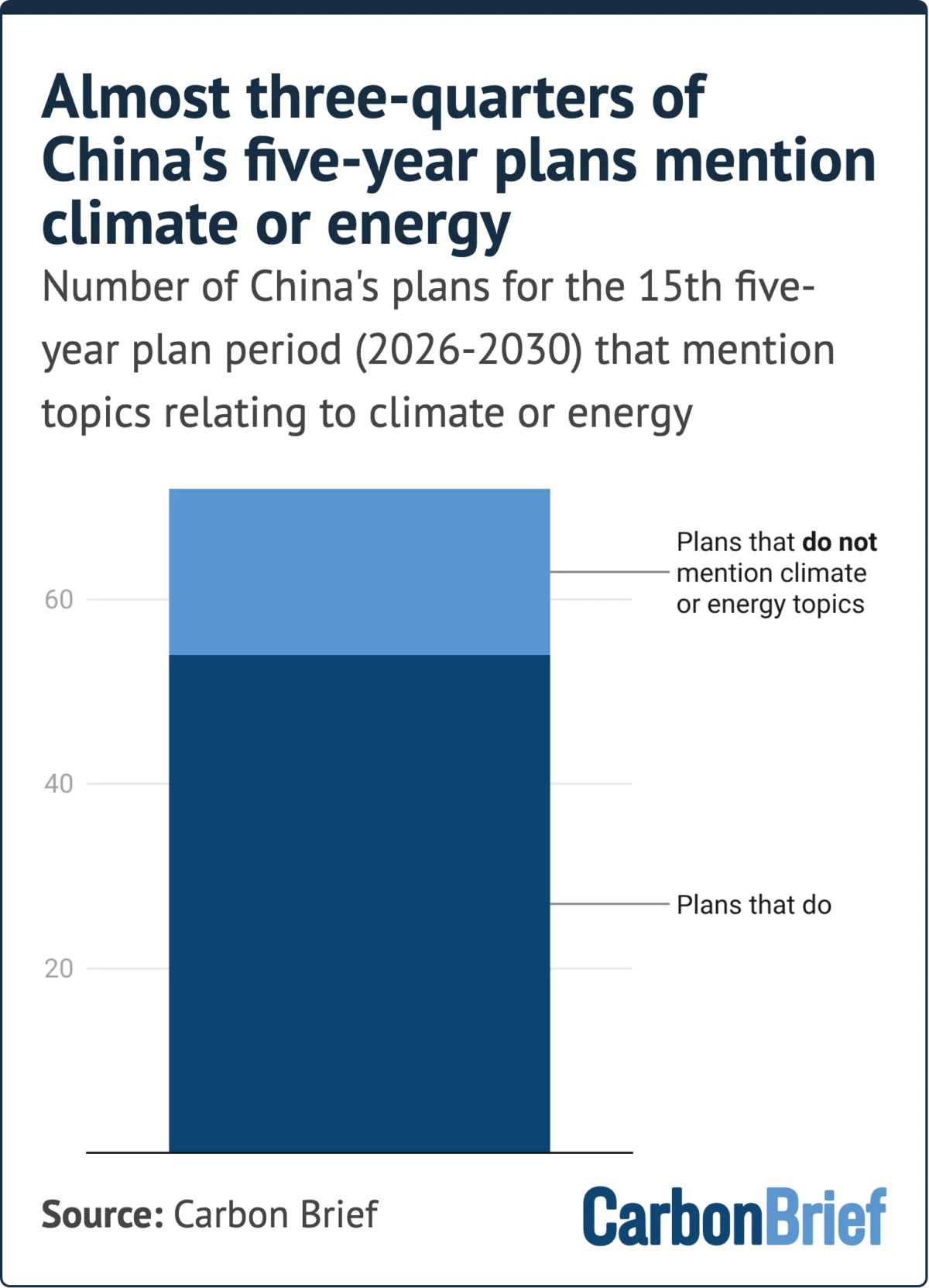
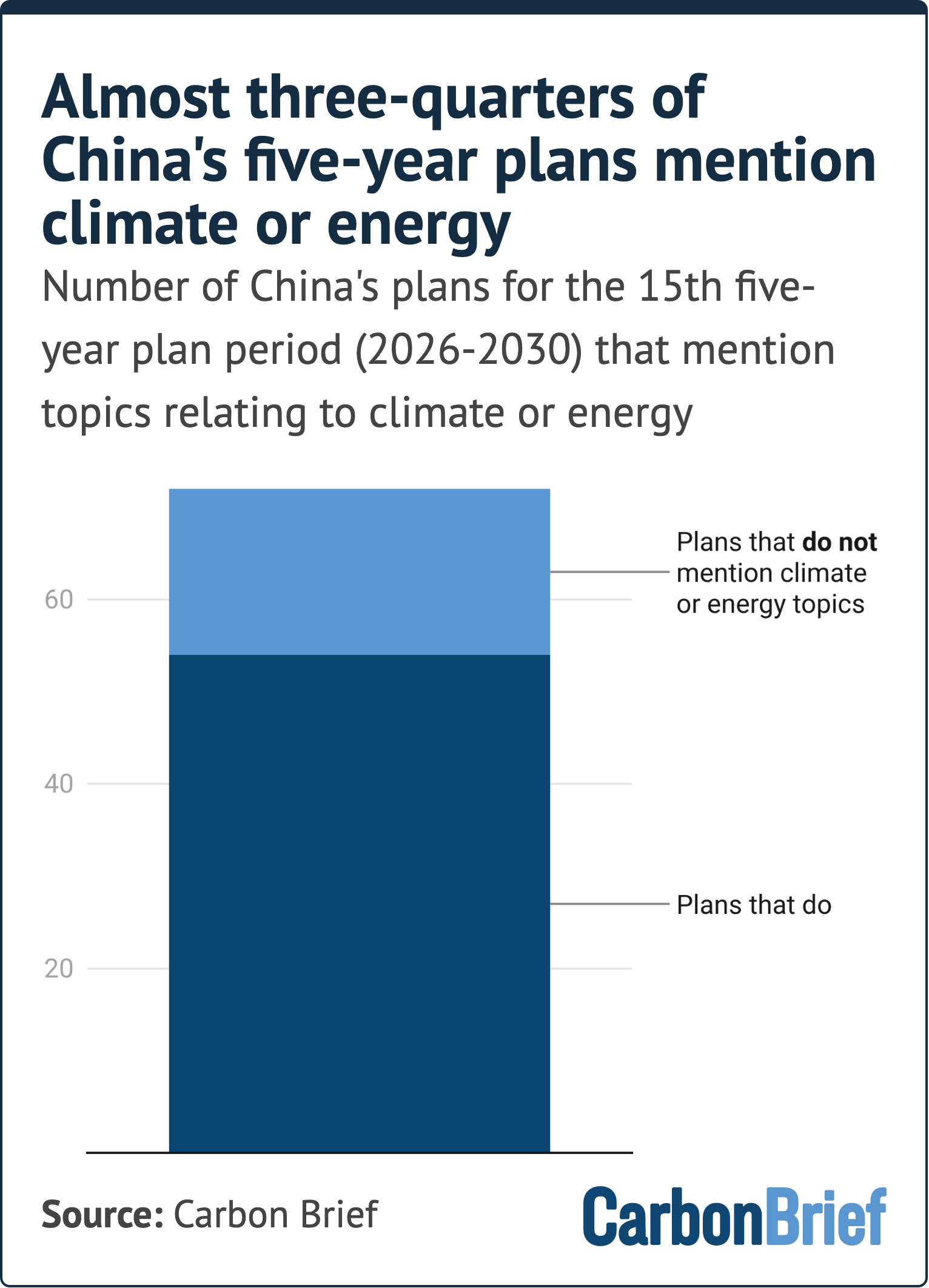
As the global community accelerates its transition toward a net-zero future, the policy architecture of the world’s largest carbon emitter has taken a decisive turn. Recent analysis by Carbon Brief reveals that nearly three-quarters of the 72 strategic "Five-Year Plans" (FYPs) published by the Chinese government this year incorporate explicit climate change and energy targets. This integration signals a systemic shift in how Beijing intends to navigate the critical window leading up to its 2030 deadline for peaking carbon dioxide emissions.
The 15th Five-Year Plan period (2026–2030) is not merely a bureaucratic cycle; it is a fundamental stress test for China’s "dual carbon" goals. By embedding decarbonization mandates into the granular operations of ministries—ranging from coal mining to tourism and civil aviation—China is attempting to weave climate considerations into the very fabric of its economic and social governance.
The Strategic Framework: Understanding the 15th FYP
Five-year plans are the heartbeat of Chinese policymaking. They act as both a roadmap for state-led development and a signal to local governments and industry of where the political and financial winds are blowing.
The process begins with the "Overarching Plan," published in March 2026. This high-level document serves as the master blueprint, setting the national tone for economic and social development. Once this is established, central-government ministries release a secondary wave of specialized, thematic plans. These documents provide the "how-to" for individual sectors.
According to Carbon Brief, 54 of the 72 plans currently available to the public contain specific climate policies. This suggests that climate action is no longer confined to the Ministry of Ecology and Environment (MEE) or the National Energy Administration (NEA); it has become a cross-departmental mandate.
Chronology of the Green Transition
To understand the current policy landscape, one must view the timeline of the 15th FYP as a cascading effort:
- March 2026: The release of the overarching 15th Five-Year Plan during the "Two Sessions" in Beijing. This set the ambitious goal of a 17% reduction in carbon intensity—the amount of CO2 emitted per unit of GDP—over the five-year period.
- Q2–Q3 2026: The release of sectoral plans. Key departments, including the National Development and Reform Commission (NDRC), began issuing specialized blueprints for "New-Type Energy Systems," renewable energy development, and the modernization of the coal industry.
- Late 2026–2030 (The Implementation Phase): The current era, where ministries move from target-setting to monitoring. These plans utilize both numerical targets (e.g., specific percentages for renewable energy integration) and non-numerical mandates (e.g., "significantly enhancing" extreme weather forecasting).
This methodical release structure ensures that every corner of the Chinese economy is aligned with the central government’s long-term vision.
Supporting Data: By the Numbers
The depth of this integration is best illustrated by the breadth of sectors covered. Carbon Brief’s tracker categorizes these 72 plans into four main pillars:
- Core Energy Transition: Plans covering the coal industry, oil and gas, and the development of new-type power systems.
- Environmental Stewardship: Policies such as "Building a Beautiful China," eco-environmental monitoring, and soil/groundwater protection.
- Industrial Transformation: Blueprints for green industrial development, electric vehicle (EV) advancement, and the digitalization-greening nexus.
- Peripheral Integration: Plans that appear non-climate-focused on the surface—such as tourism, traditional Chinese medicine, and port modernization—but which nonetheless contain "green and low-carbon" provisions.
The presence of climate language in sectors like "National Archives Development" or "Publishing Industry Development" is perhaps the most telling evidence of the government’s "whole-of-government" approach. It suggests that compliance with low-carbon standards is now a prerequisite for all administrative activities.
Official Responses and Governance
The Chinese government’s approach to these plans is highly pragmatic. Rather than imposing a blanket policy, the state uses these documents to create "primary" and "secondary" goals.
Primary goals (known in Chinese as zhuyào mubiao) are the non-negotiable targets. These are often found in the opening sections of policy documents or in standardized tables of numerical targets. For instance, the 2026–2030 plans emphasize the "coordinated transformation of digitalization and greening," reflecting Beijing’s belief that technological efficiency is the key to energy conservation.
Secondary policies serve as the tactical guide for local authorities. These provide the specific directives, such as energy-efficiency requirements for public institutions or mandates for the reduction of solid waste in rural areas. By providing a menu of policy options, the central government empowers local officials to tailor their actions to regional economic realities, provided they meet the overarching national carbon benchmarks.
Global Implications: A New Era for Climate Diplomacy
The 15th FYP is not just a domestic affair; it is a cornerstone of global climate diplomacy. As China approaches its self-imposed 2030 deadline, the eyes of the international community are fixed on its ability to decouple economic growth from carbon emissions.
1. The Carbon Intensity Challenge
The 17% reduction in carbon intensity is a critical metric. By focusing on intensity rather than just absolute volume, China is attempting to grow its economy while increasing the efficiency of its energy consumption. Critics argue that this allows for absolute emissions to continue rising; however, supporters point out that the massive build-out of renewables—as outlined in the "Renewable Energy Development" FYP—is intended to peak emissions well ahead of the 2030 target.
2. The "Beautiful China" Paradigm
The recurring theme of "Building a Beautiful China" represents a shift from purely industrial, high-growth focus to a more holistic approach that considers environmental health as a component of social stability. This aligns with the "dual carbon" strategy, suggesting that environmental protection is now seen as essential to long-term economic legitimacy.
3. Technological Leadership
China’s emphasis on "new energy vehicles" (NEVs) and "new-type power systems" in its FYPs underscores a desire to capture global market share in green technologies. By setting high standards domestically, China is effectively creating a testing ground that positions its firms to lead the global supply chain for solar, wind, battery storage, and smart grid technology.
Conclusion: The Path to 2030
The 15th Five-Year Plan marks a maturation of China’s climate policy. Gone are the days when climate targets were isolated, aspirational goals. They are now deeply institutionalized, appearing in the mundane and the critical alike.
While the success of these plans depends on the capacity for enforcement at the provincial and municipal levels, the sheer volume of climate-integrated documentation suggests a shift in political priority. China is signaling that the transition to a low-carbon economy is no longer just a policy goal—it is the guiding principle for the next five years of its development.
For the rest of the world, the 15th FYP provides a granular view into the mechanics of a superpower attempting to rewrite its own energy DNA. Whether this massive mobilization of state resources will be sufficient to avert the worst impacts of climate change remains to be seen, but the intent—and the systemic commitment—is now clearer than ever.
As we move toward 2030, the world will be watching these 72 plans closely. Each represents a potential pivot point in the global effort to limit warming, and for China, each represents a step toward a future that is, at least by design, significantly greener.