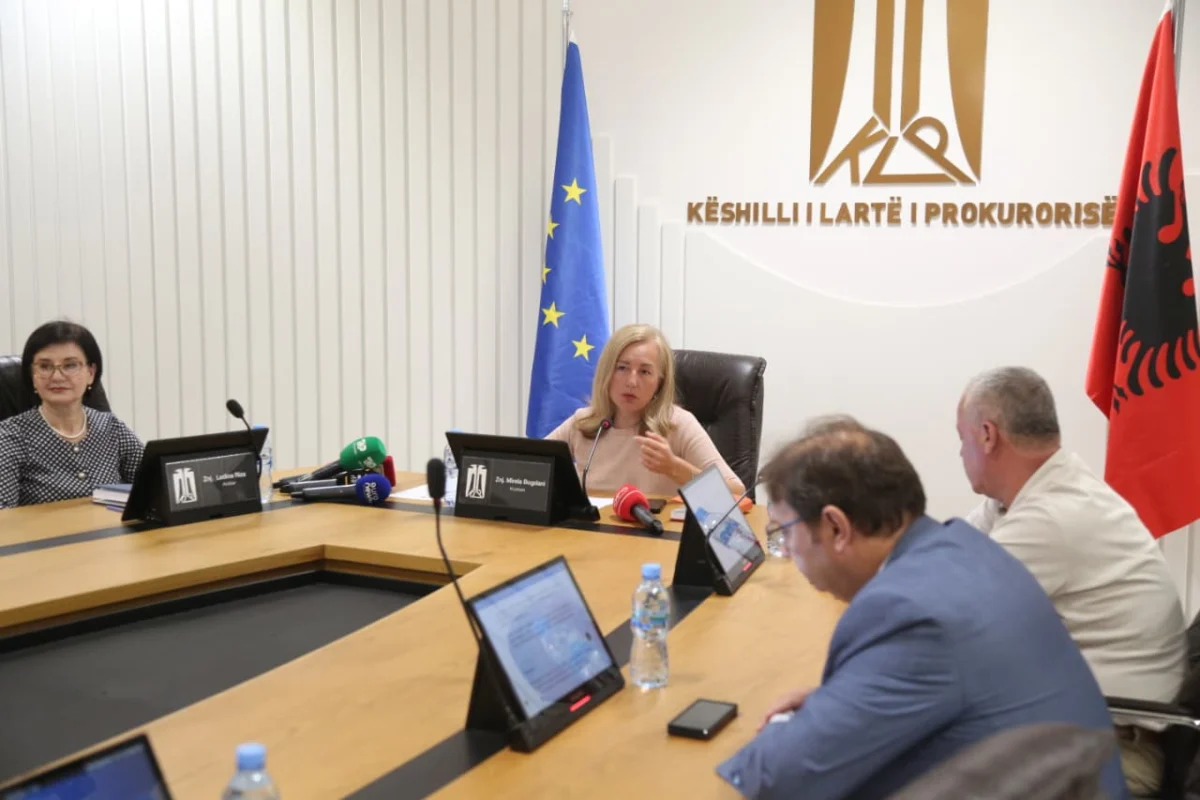
TIRANA, Albania – In a marathon session marked by heated debate and strategic maneuvering, the High Prosecutorial Council (KLP) has decisively rejected requests to disqualify members from the selection process for the next Chief Prosecutor. The September 1st plenary meeting, spanning nearly six hours, ultimately unblocked a process that had been stalled for weeks, allowing for the continuation of the crucial appointments. The decisions, reached by a significant majority, underscore a complex internal dynamic within the KLP and raise questions about the impartiality and effectiveness of its decision-making bodies.
The session was convened to address a series of recusal requests filed by candidates vying for the top prosecutor position. These requests, aimed at removing specific KLP members from the voting process, had created a significant bottleneck, preventing the Council from moving forward with vital appointments. The day’s proceedings saw allegations of conflicts of interest and procedural disputes take center stage, as Council members grappled with the delicate balance between ensuring a fair selection and navigating internal political currents.
The Impasse: Weeks of Stagnation and the Core of the Dispute
The protracted stalemate preceding the September 1st meeting stemmed from a series of challenges lodged by candidates against KLP members. These challenges, often rooted in allegations of bias or pre-existing professional relationships, threatened to derail the entire selection process for the Chief Prosecutor. The urgency to break this deadlock was palpable, as the integrity of the entire judicial system hinges on the appointment of an independent and competent leader for the prosecution service.
The core of the dispute revolved around the interpretation and application of rules governing conflicts of interest and the procedural rights of both candidates and KLP members. The lengthy deliberations highlighted the inherent tension between the need for transparency and accountability in judicial appointments and the potential for such processes to become entangled in internal power struggles or personal vendettas.
A Day of Deliberation: From Procedural Arguments to Recusal Votes
The plenary session commenced with an attempt by Council members Ledina Riza and Arta Mandro to introduce a new procedural element. They raised concerns regarding a request filed by Council member Zeqir Hoda, who had been excluded from the entire selection process. Hoda had reportedly requested to review all relevant documents. Mandro questioned the logic of proceeding with candidate recusal requests before addressing Hoda’s request, emphasizing her commitment to a fair and lawful process. Her intervention underscored the intricate procedural arguments that characterized the day.
However, the majority of Council members, including Sokol Stojani, Vata Staka, Moisi Duda, Erind Gërmenji, Erind Mërkuri, and Olger Eminaj, advocated for an immediate continuation of the review of candidate requests and their subsequent voting. This bloc, seemingly prioritizing the advancement of the selection process, sought to bypass the procedural questions raised by Riza and Mandro.
The first significant recusal request to be put to a vote was filed by candidate Ylli Pjetërnikaj. He sought the disqualification of KLP member Vata Staka, citing concerns about a potential conflict of interest. Pjetërnikaj’s request alluded to Staka’s involvement in previous decisions concerning his professional trajectory, including appointments and pedagogical roles.
Staka vehemently refuted the allegations, labeling them as baseless and unlawful. He pointed to the Council’s minutes and his own past opinions, asserting that Pjetërnikaj had not raised any objections to his participation in four prior voting procedures related to his appointments, including his nomination as a lecturer at the School of Magistracy. "In none of these procedures did he file a request for my disqualification," Staka stated, emphasizing the belated nature of the challenge.
Following a lengthy discussion among Council members, Pjetërnikaj’s request was put to a vote. The outcome was a clear rejection, with only two Council members, Ledina Riza and Arta Mandro, voting in favor of Staka’s disqualification. The vast majority, comprising Sokol Stojani, Erind Gërmenji, Erind Mërkuri, Moisi Duda, Olger Eminaj, and Council Chairwoman Mirela Bogdani, voted against the request. Mandro, prior to the vote, expressed her disillusionment, suggesting that the Council was "entering a path of war with each other over matters of character, perhaps of ego, or perhaps I am mistaken."
The focus then shifted to the recusal request filed by candidate Arta Marku. Marku sought the disqualification of Sokol Stojani, alleging a conflict of interest stemming from their past professional interactions. Marku claimed that she had appointed Stojani to a leadership position within the General Prosecutor’s Office, only to later dismiss him through an individual order. She argued that this history placed Stojani in a position of conflict of interest.
Stojani countered Marku’s assertion, deeming it unsubstantiated. He explained that the dismissal order had been issued in response to his own request to resign from the leadership position he held. Stojani further contended that differing professional opinions on specific issues should not be misconstrued as personal conflicts or indicative of bias. "A conflictual situation does not produce a conflict of interest," he argued. "If this logic were to be followed, then every prosecutor whose decision has been overturned by a superior would be in a conflict of interest. Marku’s request proves a professional relationship, but it does not prove a personal conflict or prejudice."
The vote on Marku’s request also resulted in its rejection. Five Council members – Vata Staka, Moisi Duda, Erind Gërmenji, Erind Mërkuri, and Olger Eminaj – voted against her request. In favor of Marku’s disqualification were Ledina Riza, Arta Mandro, and Chairwoman Bogdani.
Chronology of Key Events During the Plenary Session:
- Opening Remarks and Procedural Debate: The session began with discussions on procedural matters, including a request from the excluded member Zeqir Hoda to review documents, and an attempt by members Riza and Mandro to address this before proceeding with candidate recusal requests.
- Majority’s Stance: A bloc of Council members, including Stojani, Staka, Duda, Gërmenji, Mërkuri, and Eminaj, pushed for an immediate review and vote on the candidates’ recusal requests.
- Pjetërnikaj’s Request Against Staka: Candidate Ylli Pjetërnikaj requested the disqualification of KLP member Vata Staka due to alleged conflict of interest.
- Staka’s Defense: Staka presented a robust defense, highlighting Pjetërnikaj’s past silence on similar issues and the procedural history.
- Vote on Pjetërnikaj’s Request: The request to disqualify Staka was rejected by a significant majority (8-2).
- Marku’s Request Against Stojani: Candidate Arta Marku requested the disqualification of KLP member Sokol Stojani, citing their prior professional relationship and a subsequent dismissal order.
- Stojani’s Defense: Stojani countered that the dismissal was a consequence of his resignation request and that professional disagreements do not constitute personal conflicts.
- Vote on Marku’s Request: The request to disqualify Stojani was also rejected by a majority vote (7-3).
- Conclusion of the Session: The KLP concluded its deliberations for the day, having addressed and rejected the primary recusal requests, thereby unblocking the selection process.
Supporting Data and Procedural Nuances:
The deliberations were replete with references to KLP statutes, prior meeting minutes, and the specific legal framework governing judicial appointments in Albania. The arguments presented by Council members often hinged on interpretations of what constituted a genuine conflict of interest versus a mere professional disagreement or a procedural technicality.
The voting patterns revealed a clear division within the Council. While a majority consistently voted to reject the recusal requests, a minority, often including members Riza and Mandro, advocated for stricter scrutiny and adherence to principles of impartiality. This division highlights the ongoing internal debates and differing perspectives on how to best uphold the integrity of the judicial selection process.
The case of Zeqir Hoda’s exclusion and his subsequent request to review documents also underscored the procedural complexities. The decision to proceed with the candidate recusal votes without fully addressing Hoda’s request, as advocated by the majority, suggests a prioritization of immediate progress over comprehensive procedural adherence in this instance.
Official Responses and Implications:
The KLP’s decision to reject the recusal requests signifies a commitment to moving forward with the selection of the Chief Prosecutor. Chairwoman Mirela Bogdani’s role in presiding over these contentious debates underscores the leadership challenges in navigating such deeply divided bodies.
However, the outcomes also raise significant implications for the perceived impartiality of the selection process. The rejections, particularly when viewed against the dissenting votes, could fuel arguments that the Council is susceptible to internal politics or that certain members are unduly protected. The perception of fairness is as critical as the reality, and future appointments will undoubtedly be scrutinized through the lens of these deliberations.
The implications extend beyond the immediate selection process. The internal divisions exposed during this session could have a lasting impact on the KLP’s ability to function cohesively and effectively in the future. Building trust and consensus among members, particularly on critical issues like candidate vetting, will be paramount for the long-term health of Albania’s judicial system.
The decision to push forward with the selection process, despite the clear rifts within the Council, signals a pragmatic approach to unblocking a vital governmental function. However, the underlying tensions and the differing interpretations of impartiality and procedural fairness remain significant factors that will likely continue to shape the discourse surrounding Albania’s judiciary. The coming weeks and months will reveal whether the KLP can truly move beyond these internal struggles to appoint a Chief Prosecutor who commands broad confidence and can effectively lead the nation’s prosecution service.