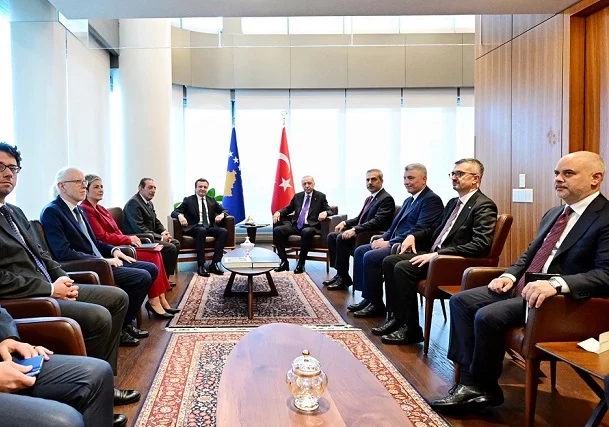
New York, United States – In a significant diplomatic maneuver at the heart of global politics, Ardita Sinani, the Mayor of Preševo Municipality, was a prominent member of Prime Minister Albin Kurti’s delegation during a high-profile meeting with Turkish President Recep Tayyip Erdoğan. The encounter, held on the sidelines of the United Nations General Assembly (UNGA) in New York on September 22, 2026, marked a pivotal moment for the Albanian community in Serbia’s Preševo Valley, offering a rare platform for their concerns to be voiced directly to an influential international leader.
The inclusion of Mayor Sinani in the Kosovar delegation underscored Prime Minister Kurti’s persistent commitment to the rights and welfare of Albanians residing outside the Republic of Kosovo’s borders, particularly those in the Preševo Valley. Her presence at such a high-level diplomatic engagement was not merely symbolic; it provided a direct channel for presenting the multifaceted challenges faced by the Albanian population in southern Serbia to President Erdoğan, a leader with considerable influence in the Balkans and a strong historical and cultural affinity with Albanian communities.
Mayor Sinani expressed profound gratitude to Prime Minister Kurti, acknowledging his consistent dedication to keeping the Preševo Valley firmly on his diplomatic agenda. "Prime Minister Kurti is keeping the Preševo Valley in his attention and giving voice to our concerns and requests," Sinani stated, highlighting the tangible support felt by her constituents. She further emphasized that the meeting with President Erdoğan represented a unique opportunity for "the voice of the Albanians of the Valley to be heard directly at a meeting of this level," thereby transcending local political boundaries and resonating on an international stage.
A Voice for Preševo on the Global Stage
The setting of the UN General Assembly provided an unparalleled backdrop for this diplomatic engagement. As world leaders convened to address pressing global issues, the bilateral meeting between Prime Minister Kurti and President Erdoğan offered a focused opportunity to discuss regional dynamics, including the specific situation of the Preševo Valley. Sinani’s participation amplified the message that the challenges faced by this Albanian-majority region are not merely internal Serbian matters but hold broader implications for regional stability and human rights, deserving international attention.
For Mayor Sinani, representing the interests of Preševo in New York was a deeply significant occasion, both personally and for her municipality. "My participation, as Mayor of Preševo Municipality, in Prime Minister Kurti’s delegation during the meeting with the President of the Republic of Turkey, Mr. Recep Tayyip Erdoğan, in New York, was a moment of special importance for me and for Preševo," she remarked. This sentiment reflects the long-held aspirations of Preševo Albanians to have their plight recognized and addressed by the international community, particularly by allies who understand their historical and cultural ties.
The meeting was meticulously structured to ensure that the core issues affecting Preševo were presented comprehensively. Sinani, alongside Prime Minister Kurti, meticulously outlined a range of critical concerns that directly impact the daily lives and future prospects of Albanians in the Valley. These issues, long-standing and deeply entrenched, form the bedrock of the community’s struggle for equal rights and opportunities within the Serbian state.
The Preševo Valley: A Region in Focus
The Preševo Valley, comprising the municipalities of Preševo, Bujanovac, and Medveđa, is a predominantly Albanian-inhabited region in southern Serbia, bordering Kosovo and North Macedonia. Its unique geopolitical position has historically made it a sensitive area, often caught between competing national narratives and political interests.
Geopolitical Significance and Demographics
The region is home to an estimated 60,000 to 70,000 ethnic Albanians, who constitute a significant majority in Preševo and Bujanovac, while Medveđa has a smaller but notable Albanian population. Historically, the Albanian communities in the Preševo Valley have expressed aspirations for greater integration with Kosovo or, at the very least, for enhanced autonomy and full respect for their minority rights within Serbia. These aspirations have often led to periods of tension and have been a recurring topic in regional dialogues.
The region’s economy faces significant challenges, marked by high unemployment, particularly among the youth, and limited investment. This economic stagnation exacerbates feelings of marginalization and neglect among the Albanian population, who often perceive themselves as second-class citizens within the Serbian system. The lack of economic opportunity is a key driver of emigration, further depleting the region’s human capital and weakening its demographic strength.
Kosovo’s Enduring Commitment to its Kin
Prime Minister Albin Kurti and his government in Kosovo have consistently championed the cause of Albanians in the Preševo Valley. This commitment stems from a shared ethnic identity, cultural heritage, and a sense of responsibility towards Albanian communities living under different state administrations. Kurti’s approach often emphasizes a pan-Albanian perspective, advocating for the rights and self-determination of all Albanians in the region.

The inclusion of Mayor Sinani in the delegation to the UN General Assembly is a powerful testament to this policy. It signifies Kosovo’s diplomatic efforts to internationalize the issues of the Preševo Valley, moving them beyond bilateral discussions with Serbia and bringing them to the attention of key international players. By providing a platform for Sinani, Kurti not only demonstrates solidarity but also strategically positions Kosovo as a protector of Albanian interests throughout the Western Balkans. This approach, while welcomed by Preševo Albanians, is often viewed with suspicion by Belgrade, which considers such engagements as interference in its internal affairs. However, for Kurti, ensuring the well-being and fundamental rights of Albanians in Preševo is a moral imperative and a crucial aspect of regional stability.
Advocating for Fundamental Rights and Development
During the meeting with President Erdoğan, Mayor Sinani and Prime Minister Kurti meticulously presented a dossier of issues that "directly affect the lives and future of Albanians" in the Preševo Valley. These concerns span from administrative disenfranchisement to educational and economic disparities, painting a comprehensive picture of systemic challenges.
Tackling Systemic Discrimination: Address Passivation and Diploma Recognition
One of the most critical issues raised was the passivation of addresses (pasivizimi i adresave). This refers to a controversial administrative practice by Serbian authorities where ethnic Albanians, particularly those who have temporarily moved to Kosovo or Western European countries for work or study, are systematically removed from civil registers and voter lists in their municipalities of origin. This administrative action, often carried out without due process or notification, effectively disenfranchises individuals, stripping them of their citizenship rights, including the right to vote, own property, access social services, and even basic documentation. Human rights organizations have repeatedly flagged this practice as a form of "ethnic cleansing through administrative means," designed to alter the demographic structure of the Preševo Valley and diminish the political influence of its Albanian majority. Sinani’s direct appeal to Erdoğan underscored the urgency of halting this discriminatory practice and restoring the rights of affected individuals.
Equally pressing is the issue of the non-recognition of diplomas. Many Albanian students from the Preševo Valley choose to pursue higher education in Kosovo or Albania, seeking culturally congruent environments and opportunities. However, upon returning to Serbia, their diplomas are often not recognized by Serbian institutions, effectively barring them from employment in the public sector and limiting their career prospects in the private sector. This creates a significant barrier to their professional development and contributes to brain drain, as many talented young Albanians are forced to seek opportunities elsewhere, further impoverishing the region. Sinani highlighted this as a direct impediment to the socio-economic advancement of the Albanian youth and a violation of their right to education and equal opportunity.
Addressing Underrepresentation and Cultural Preservation
Another critical concern articulated by Sinani was the underrepresentation of Albanians in public institutions. Despite forming a majority in Preševo and Bujanovac, Albanians are significantly underrepresented in local and national state institutions, including the police force, judiciary, healthcare system, and various administrative bodies. This lack of representation translates into a feeling of marginalization, a deficit of trust in state institutions, and a perception that their voices and needs are not adequately addressed by the government. Sinani emphasized the need for equitable treatment and full respect for the rights of Albanians, including their right to proportional representation in all spheres of public life, which is a fundamental tenet of democratic governance and minority rights.
Beyond contemporary political and social issues, Mayor Sinani also stressed the importance of preserving and protecting the Albanian cultural heritage in the Preševo Valley. The region boasts a rich history and numerous cultural sites that are integral to Albanian identity and historical memory. However, these sites often suffer from neglect, lack of funding for preservation, and sometimes even deliberate attempts to diminish their Albanian character. Sinani specifically requested Turkey’s support in this area, recognizing Turkey’s extensive experience and commitment to cultural heritage preservation across the Balkans through organizations like TİKA (Turkish Cooperation and Coordination Agency). Safeguarding this heritage is seen not just as an act of cultural preservation but as a vital component of maintaining the community’s identity and historical narrative in the face of pressures.
Turkey’s Growing Engagement in the Balkans
Turkey, under President Erdoğan’s leadership, has significantly deepened its engagement in the Balkans over the past two decades. This renewed focus is rooted in a complex interplay of historical ties, economic interests, and a broader foreign policy vision that seeks to reassert Turkey’s influence in its former Ottoman domains.
Historical Bonds and Modern Diplomacy
The historical connections between Turkey and the Balkans are profound and enduring, dating back to the Ottoman era. These ties are particularly strong with Muslim-majority communities and ethnic groups like Albanians, Bosniaks, and Turks themselves, who share a common heritage and often a similar religious background. Turkey leverages these historical bonds through cultural diplomacy, religious initiatives, and significant development aid.
Turkish cultural centers, mosques, and schools operate across the Balkans, fostering cultural exchange and strengthening people-to-people connections. Economically, Turkey has become a major investor and trading partner for many Balkan countries. Turkish companies have invested in infrastructure, energy, and various industrial sectors, creating jobs and fostering economic growth. This economic engagement is often complemented by development projects implemented by TİKA, which focuses on restoring historical monuments, building schools and hospitals, and providing humanitarian assistance. For many Albanians, Turkey is seen as a benevolent partner and a strong supporter of their aspirations.
Erdoğan’s Pledge for Greater Support
Mayor Sinani explicitly conveyed to President Erdoğan the need for Turkey to be "even closer to Preševo through concrete investments in economy, infrastructure, and development." This direct appeal for Turkish investment aligns perfectly with Turkey’s current foreign policy trajectory in the Balkans, which prioritizes economic partnership and development assistance as tools of influence.

President Erdoğan’s response was reportedly positive and encouraging. Sinani expressed her gratitude to President Erdoğan "for the warm reception, the respect shown, and the readiness for an even greater commitment of Turkey towards the Preševo Valley." This readiness for increased engagement suggests that the Turkish leadership views the Preševo Valley as an area where its support can make a tangible difference, aligning with its broader strategy of fostering stability and prosperity among its historical allies in the region. Potential Turkish investments could provide a much-needed boost to Preševo’s struggling economy, creating jobs and improving living standards, thereby mitigating some of the pressures driving emigration.
Implications and Future Outlook
The meeting in New York carries significant implications for the Preševo Valley, regional dynamics, and the broader diplomatic landscape involving Kosovo, Serbia, and Turkey.
Enhanced Visibility and Potential for Concrete Action
For the Albanian community in Preševo, this diplomatic engagement represents a major victory in terms of international visibility. Having their concerns articulated at the UN General Assembly by their mayor, alongside the Prime Minister of Kosovo, and heard by a leader of President Erdoğan’s stature, elevates their struggle from a localized issue to one of international concern. This enhanced visibility could attract greater attention from other international actors, potentially leading to increased pressure on Serbia to address the long-standing grievances of the Albanian minority.
More importantly, the prospect of "concrete investments" from Turkey offers a tangible hope for economic development in a region that desperately needs it. Should Turkey follow through on its expressed readiness for greater engagement, this could translate into new infrastructure projects, business investments, and cultural initiatives that directly benefit the citizens of Preševo. Such investments would not only improve economic conditions but also provide a psychological boost to a community that often feels neglected and isolated.
A Broader Diplomatic Web: Kosovo, Serbia, and Turkey
This meeting intricately weaves a broader diplomatic web involving Kosovo, Serbia, and Turkey. For Kosovo, it solidifies its role as a regional advocate for Albanian rights, projecting its influence beyond its borders and demonstrating its commitment to a pan-Albanian agenda. This strategy, however, is likely to be met with strong disapproval from Serbia, which views Kosovo’s engagement with the Preševo Valley as an infringement on its sovereignty and a provocative act. Belgrade may interpret Sinani’s presence as an attempt by Pristina to destabilize southern Serbia and challenge its territorial integrity.
For Turkey, its increased involvement in the Preševo Valley signals a deepening of its influence in the Western Balkans. By supporting the Albanian community in Serbia, Turkey strengthens its ties with a key ethnic group in the region, aligning with its broader foreign policy objectives. This move also positions Turkey as a significant player in addressing minority rights and development challenges in a geopolitically sensitive area. This tripartite dynamic adds another layer of complexity to the already intricate regional politics, potentially influencing future dialogues between Belgrade and Pristina.
Sinani’s Unwavering Advocacy
Mayor Sinani unequivocally articulated her long-term vision and commitment. "For us, these meetings are not just a matter of protocol or diplomacy. They are opportunities to build bridges of cooperation, to bring investments, and to open new perspectives for our citizens," she stated. This perspective underscores the pragmatic goals behind her diplomatic efforts: to translate high-level discussions into tangible benefits for her constituents.
Her concluding remarks serve as a powerful affirmation of her dedication: "Preševo needs friends who know its reality and partners who turn support into concrete work. And I will continue to raise the voice of Preševo wherever I am given the opportunity." This unwavering commitment to advocacy, coupled with strategic diplomatic engagements, positions Mayor Sinani as a crucial figure in the ongoing struggle for the rights and prosperity of Albanians in the Preševo Valley. Her presence at the UNGA, facilitated by Prime Minister Kurti and met with a positive reception from President Erdoğan, represents a significant stride towards achieving these long-held aspirations, opening new avenues for international cooperation and support for a region often overlooked on the global stage.